Jio Leads Mobile Speeds While ACT Fibernet Tops Broadband in India: SpeedGeo Report Q1 2026
Companies Mentioned
Why It Matters
The rankings highlight where operators are gaining competitive advantage, influencing investment decisions and shaping the rollout of data‑intensive services across India’s massive user base.
Key Takeaways
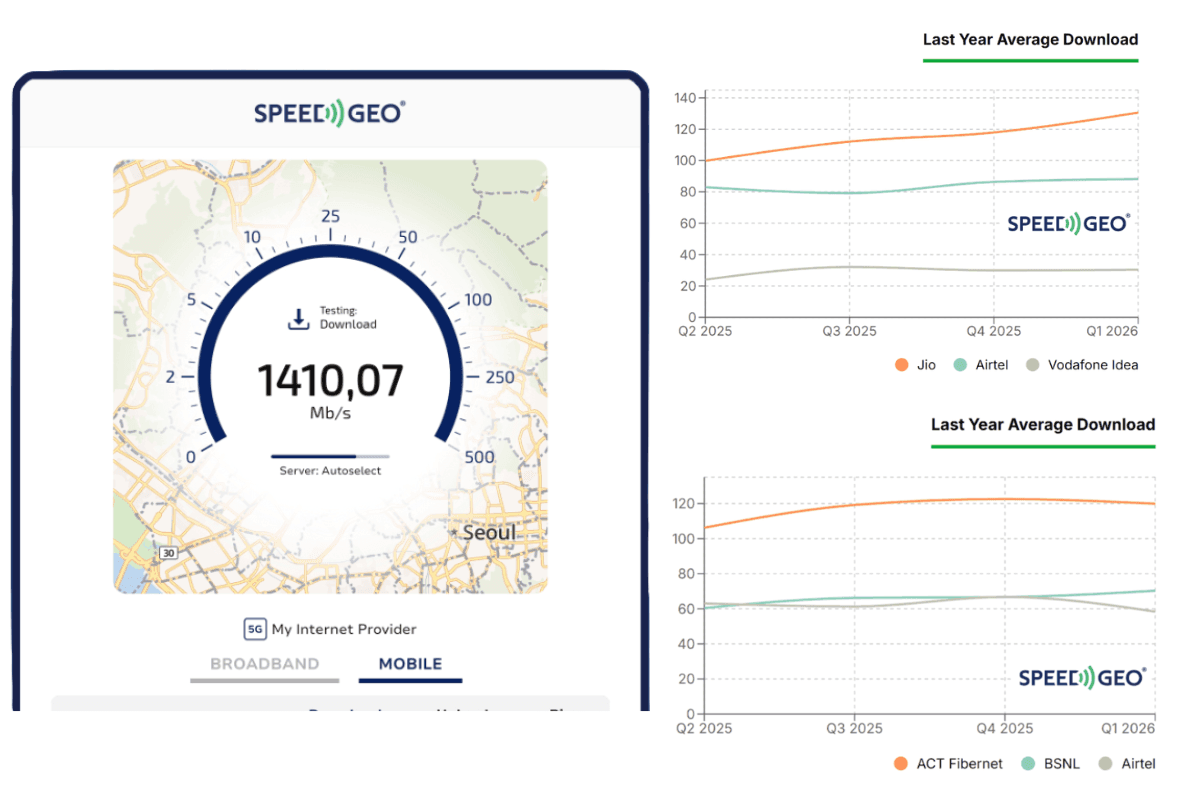
- •ACT Fibernet averages 118.1 Mbps download, double next competitor
- •Jio leads mobile with 115.3 Mbps download, 4% growth YoY
- •Broadband latency averages 40 ms; mobile latency 69 ms
- •5G speeds top out at 195.6 Mbps on Jio network
- •Indian internet speeds rise, narrowing gap with global benchmarks
Pulse Analysis
The SpeedGeo Q1 2026 report offers the most granular view of Indian connectivity in over a year, drawing on 545,000 fixed‑line tests and 61,000 mobile measurements collected via its V‑Speed platform. By aggregating real‑world user data across Wi‑Fi routers, fixed wireless and 3G/4G/5G handsets, the study captures latency, download and upload performance under everyday conditions. This methodology contrasts with regulator‑issued averages, giving operators, investors and policymakers a clearer picture of how network upgrades translate into consumer experience across the subcontinent’s 1.4 billion‑strong market.
In the fixed‑broadband arena, ACT Fibernet cemented its lead with an average download speed of 118 Mbps—almost twice the 66 Mbps posted by BSNL, the nearest rival. Its upload rate of 110 Mbps and latency of just 23 ms set a new benchmark for consistency, suggesting that fiber‑to‑the‑home deployments are reaching maturity in its service regions. For enterprise customers, such performance narrows the gap with global Tier‑1 providers, enabling smoother cloud migration, high‑definition video conferencing and latency‑sensitive applications without the need for costly private links.
On the mobile front, Reliance Jio sustained its dominance, delivering 115 Mbps downlink and 10 Mbps uplink, while its 5G network peaked at 196 Mbps—figures that outpace most Asian peers. The 4‑point rise in average mobile speed (to 89 Mbps) reflects aggressive spectrum refarming and nationwide 5G rollout, which is reshaping e‑commerce, streaming and fintech services. However, latency remains higher than broadband at 69 ms, indicating room for optimization. As competition intensifies, operators that compress this latency gap will likely capture the next wave of high‑bandwidth, low‑latency applications such as AR/VR and edge computing.
Jio Leads Mobile Speeds While ACT Fibernet Tops Broadband in India: SpeedGeo Report Q1 2026
Comments
Want to join the conversation?
Loading comments...