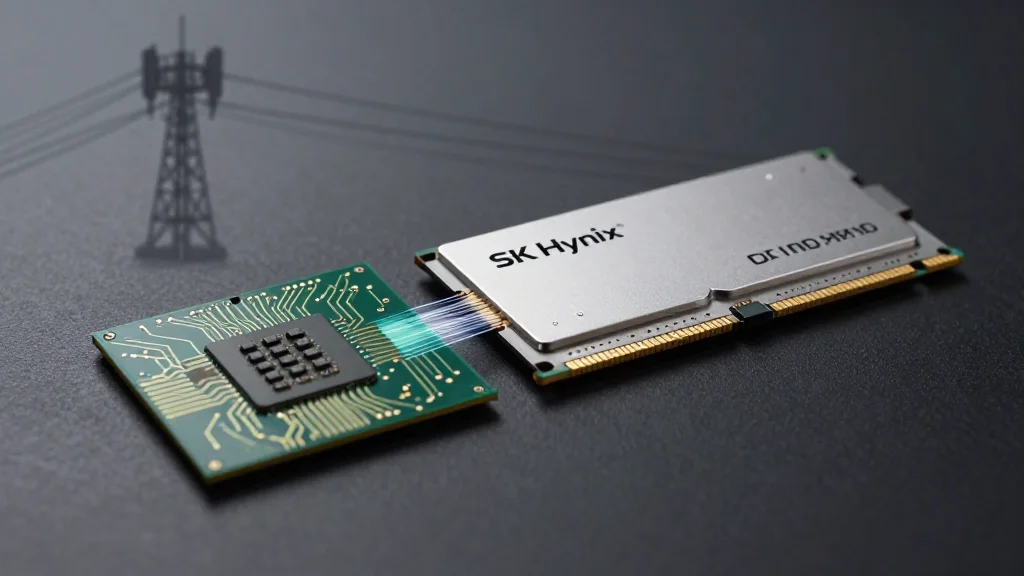
Nvidia Partners with SK Hynix to Supply Memory for Vera AI Chips, Boosting Telecom AI Infrastructure

Companies Mentioned
Why It Matters
The Nvidia‑SK Hynix deal ties together two critical layers of AI hardware—compute and memory—at a time when telecom operators are racing to embed AI across their core networks. By securing a dedicated memory pipeline, Nvidia can deliver Vera processors that meet the ultra‑low latency and high‑throughput requirements of 5G edge computing, network slicing, and autonomous network management. This partnership also reduces supply‑chain volatility, giving carriers confidence to commit to multi‑year AI infrastructure rollouts. Beyond telecom, the collaboration signals a broader industry shift toward vertically integrated AI ecosystems, where chip designers, memory makers, and software providers co‑develop solutions. As AI workloads become more distributed—from central clouds to edge nodes—the need for tightly coupled compute‑memory stacks will only intensify, making this deal a bellwether for future hardware alliances.
Key Takeaways
- •Nvidia and SK Hynix sign a multiyear partnership to co‑develop AI‑optimized memory for Vera processors.
- •SK Hynix shares fell 7.68% to 1,911,000 won (≈ $1,400 USD) after the announcement; Nvidia stock rose 1.37% to $207.92.
- •Memory supply aims to eliminate bottlenecks for AI workloads in telecom edge and data‑center equipment.
- •Deal aligns with Nvidia’s South Korean AI infrastructure expansion with NAVER, targeting gigawatt‑scale AI factories.
- •Partnership expected to accelerate AI‑driven 5G/6G network upgrades and reduce supply‑chain risk for telecom OEMs.
Pulse Analysis
Nvidia’s move to lock in SK Hynix memory is more than a component contract; it’s a strategic play to dominate the AI stack that powers next‑generation telecom infrastructure. Historically, telecom hardware has been a battleground for Intel and AMD CPUs paired with legacy DRAM. By offering a purpose‑built memory solution that matches the bandwidth and latency profile of Vera’s heterogeneous architecture, Nvidia can undercut incumbents and force carriers to adopt a single‑vendor stack. This vertical integration mirrors the approach taken by hyperscalers, which have long co‑designed silicon and memory to squeeze every watt of performance.
The timing is crucial. With 5G networks reaching maturity and operators eyeing 6G research, AI is becoming the glue that ties together network slicing, predictive maintenance, and real‑time traffic engineering. The Vera platform, bolstered by SK Hynix’s memory, promises to deliver the compute‑memory synergy needed for these use cases. Telecom OEMs that can ship AI‑ready base stations and edge nodes faster will capture market share, especially in regions where spectrum is scarce and efficiency is paramount.
Looking ahead, the partnership could set a precedent for similar alliances across the semiconductor ecosystem. If Nvidia and SK Hynix can demonstrate a faster time‑to‑market for AI‑optimized memory, other chipmakers may pursue comparable deals, potentially reshaping the supply‑chain dynamics that have long favored a few large memory suppliers. For investors, the deal adds a new revenue stream for Nvidia beyond GPUs, while SK Hynix gains a high‑margin, high‑growth customer in the AI space, reinforcing both companies’ positions in the rapidly expanding telecom AI market.
Nvidia partners with SK Hynix to supply memory for Vera AI chips, boosting telecom AI infrastructure
Comments
Want to join the conversation?
Loading comments...