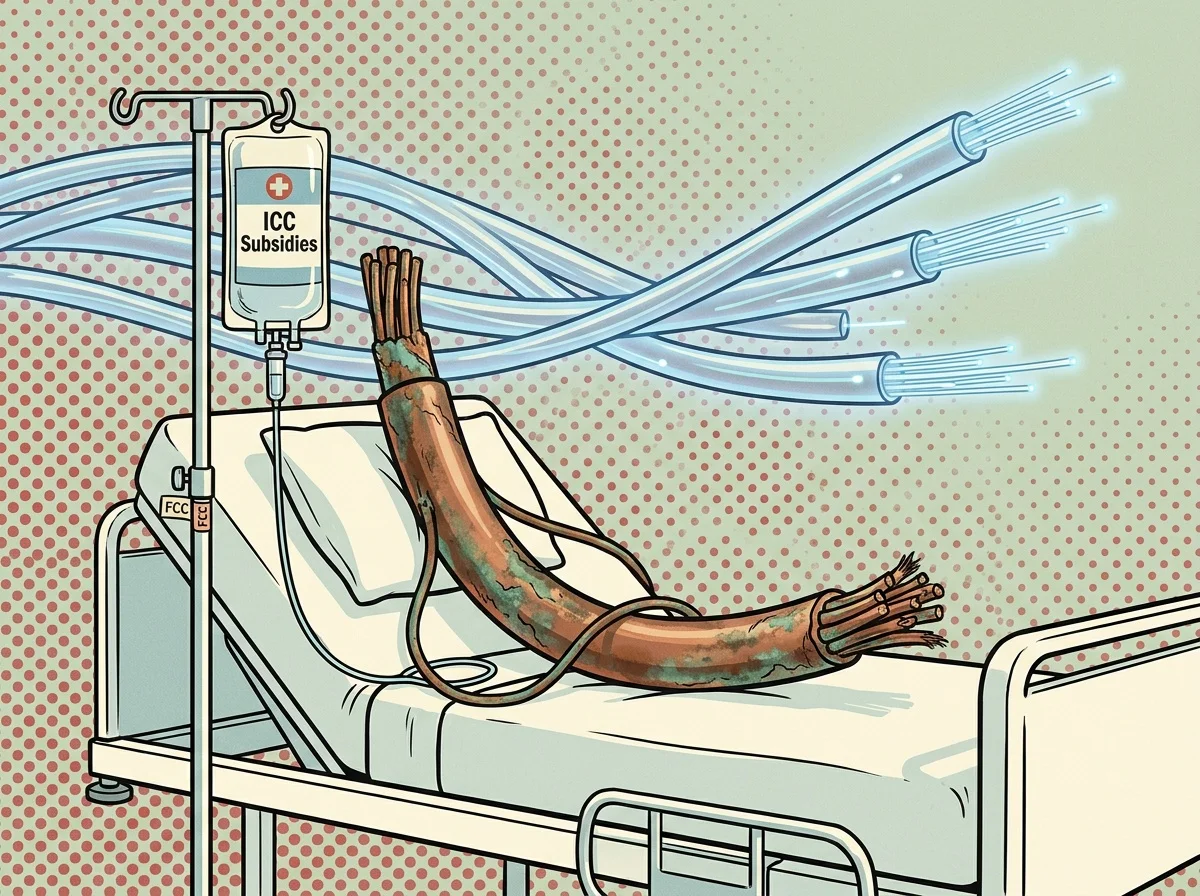
Subsidizing Obsolescence: How FCC Rules Keep Copper Alive
Key Takeaways
- •FCC proposes full bill‑and‑keep transition, ending ICC fees.
- •CAF ICC subsidy to be phased out, saving $300 M annually.
- •Copper maintenance costs $6 B for AT&T, hindering fiber rollout.
- •Rural LECs already 86% fiber‑served, reducing upgrade urgency.
- •Eliminating subsidies eases pressure on Universal Service Fund contributions.
Pulse Analysis
The FCC’s latest notice of proposed rulemaking marks the culmination of a decade‑long effort to replace the legacy intercarrier compensation (ICC) framework with a pure bill‑and‑keep model. Under the historic per‑minute, calling‑party‑pays system, carriers collected termination fees that were tied to time‑division multiplexing (TDM) copper switches. Those fees created a financial incentive for rural and competitive local exchange carriers to keep outdated copper lines operational, even as the industry migrated to packet‑switched, IP‑based fiber networks. By eliminating the remaining ICC charges, the commission aims to align interconnection economics with the bandwidth‑centric reality of modern telecommunications.
Maintaining copper is expensive. In 2024 AT&T reported roughly $6 billion in direct operating costs to sustain its copper plant, representing about 5 % of its revenue, while Verizon’s fiber migration saved $180 million annually and cut dispatches by 60 %. The FCC’s proposal also targets the Connect America Fund’s ICC component, which currently subsidizes lost ICC revenue for rate‑of‑return carriers. Phasing out this CAF ICC support would trim more than $300 million from the Universal Service Fund each year, relieving pressure on the contribution factor that is increasingly strained as voice traffic shifts to data services.
For carriers, the shift removes a regulatory arbitrage channel and forces cost recovery to come directly from customers, sharpening incentives to retire TDM equipment and accelerate fiber deployment. Rural local exchange carriers are already 86 % fiber‑to‑the‑premises, suggesting that most of the market can transition without jeopardizing service continuity. Consumers benefit from lower bills, higher reliability, and better robocall protection, while policymakers gain a leaner USF structure. As the FCC moves to close the copper subsidy loop, the telecommunications landscape is poised for faster broadband expansion and a clearer path to an all‑IP network.
Subsidizing Obsolescence: How FCC Rules Keep Copper Alive
Comments
Want to join the conversation?