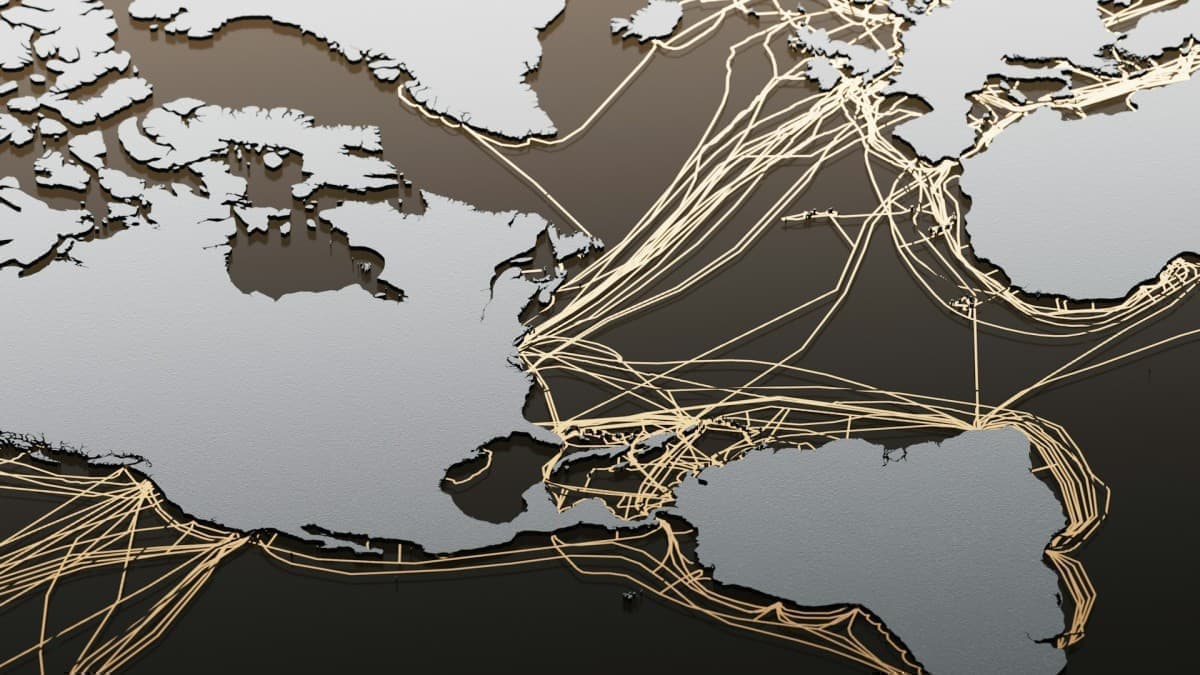
The World’s Data Lifelines Are Increasingly Exposed to Sabotage
Why It Matters
A disruption to the subsea cable mesh could cripple internet services, AI workloads and renewable‑energy transmission, creating immediate economic fallout for regions dependent on these links, such as India’s Gulf‑connected traffic.
Key Takeaways
- •119 submarine cables planned for 2026, up from 66 in 2020
- •Annual unintentional damages hit 150‑200 cables, mainly from fishing
- •Sabotage risk rises amid U.S.-Iran tensions, targeting Gulf routes
- •Distributed acoustic sensing and sonar arrays boost real‑time cable monitoring
Pulse Analysis
The undersea cable ecosystem has become the backbone of the modern digital economy, carrying virtually all cross‑border internet and artificial‑intelligence data while also serving as conduits for offshore renewable‑energy power. The surge in AI‑driven demand and the rollout of new offshore wind farms have accelerated cable deployments, with industry forecasts showing more than a hundred new routes slated for 2026. This rapid expansion not only improves global connectivity but also underpins critical services such as cloud computing, digital payments, and real‑time analytics, making the cables indispensable for both private sector innovation and national infrastructure.
Despite their importance, subsea cables face a trifecta of threats. Accidental damage from fishing gear or anchoring accounts for 150‑200 incidents annually, while earthquakes and volcanic activity pose natural hazards. More concerning is the growing risk of intentional sabotage, especially as geopolitical tensions rise—illustrated by heightened scrutiny of Gulf routes amid the U.S.–Iran conflict. A single cut could sever up to 60% of India’s internet traffic, illustrating how localized attacks can trigger cascading economic disruptions across continents.
To counter these vulnerabilities, governments and operators are deploying advanced monitoring solutions such as distributed acoustic sensing, which turns fiber strands into long‑range microphones, and sonar arrays that detect nearby vessels. Policy responses include the EU’s 2025 Action Plan on Cable Security and updated legislation in Taiwan, Japan, South Korea and the United States. By increasing redundancy—adding parallel routes and faster repair capabilities—stakeholders aim to ensure continuity even under attack. Continued international cooperation and investment in resilient technologies will be essential to safeguard the world’s data lifelines as they grow in scale and strategic significance.
The World’s Data Lifelines Are Increasingly Exposed to Sabotage
Comments
Want to join the conversation?
Loading comments...