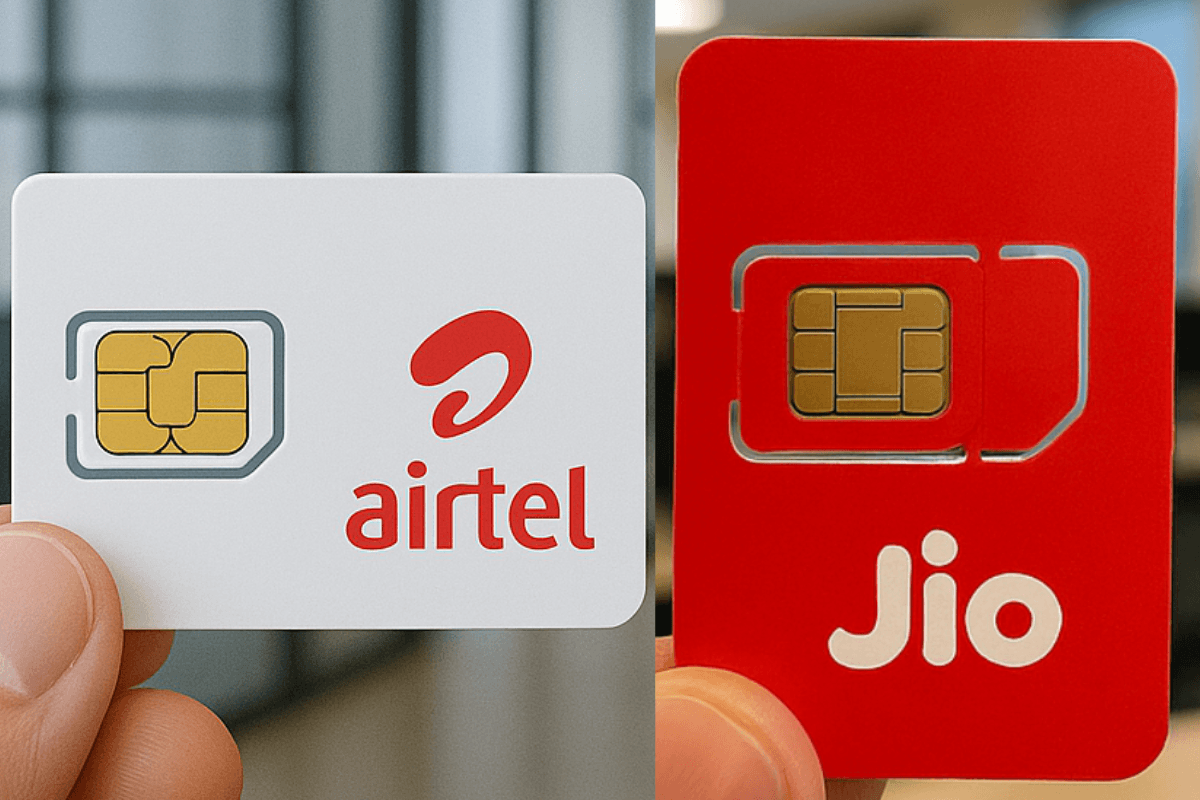
TRAI Data Shows Jio Losing Ground to Airtel in Delhi and Mumbai’s Subscriber Race
Companies Mentioned
Why It Matters
The shift signals Airtel’s stronger appeal among premium urban customers, which can boost ARPU and enterprise revenue, while Jio may need to recalibrate its metro strategy to protect market share in high‑value segments.
Key Takeaways
- •Airtel leads Jio in Delhi with 3.92 cr vs 2.06 cr subscribers.
- •Airtel added 3.02 lakh users in Delhi, Jio added 1.78 lakh.
- •In Mumbai, Airtel's 1.60 cr base outpaced Jio's 1.34 cr.
- •Airtel added 4.38 lakh metro users; Jio added 2.67 lakh.
- •Metro lead shows Airtel's premium focus over Jio's mass-market scale.
Pulse Analysis
India’s telecom sector hinges on performance in its most lucrative metros, where premium data consumption, post‑paid plans, and enterprise connectivity drive profitability. TRAI’s April 2026 figures show Airtel commanding a decisive lead in Delhi and Mumbai, two circles that together account for a disproportionate share of high‑value revenue. While Jio remains the nation’s largest operator by total wireless subscriptions, its slower subscriber additions in these urban hubs suggest a divergence between national scale and metro‑level growth.
Airtel’s advantage stems from a strategic emphasis on network quality, aggressive 5G rollout, and bundled services that resonate with business users and affluent consumers. The carrier’s focus on indoor coverage, post‑paid incentives, and enterprise solutions translates into higher average revenue per user (ARPU) in metros, where customers are less price‑sensitive and more demanding of performance. Conversely, Jio’s mass‑market model, while effective for broad penetration, may encounter saturation in dense urban markets, prompting a need to refine its value proposition for premium segments.
For investors and industry watchers, the metro gap signals potential shifts in competitive dynamics. Airtel’s momentum could translate into stronger earnings growth, especially as it leverages its premium positioning to upsell broadband, cloud, and IoT services. Jio, meanwhile, may accelerate targeted campaigns or network upgrades to reclaim urban share, a move that could involve significant capex but also open higher‑margin revenue streams. Notably, Jio’s recent ₹200 million (≈ $2.4 million) OTT content add‑on illustrates its effort to diversify offerings, yet the metro subscriber trends underscore that network‑centric differentiation remains paramount in India’s high‑value markets.
TRAI Data Shows Jio Losing Ground to Airtel in Delhi and Mumbai’s Subscriber Race
Comments
Want to join the conversation?
Loading comments...