Analysts: Non-Sports Programming Is Becoming `Irrelevant’ to Broadcast TV Viewership
Companies Mentioned
Why It Matters
The shift redefines revenue models for broadcast networks, threatening traditional ad‑supported entertainment and prompting a strategic pivot toward sports‑centric and streaming‑focused content.
Key Takeaways
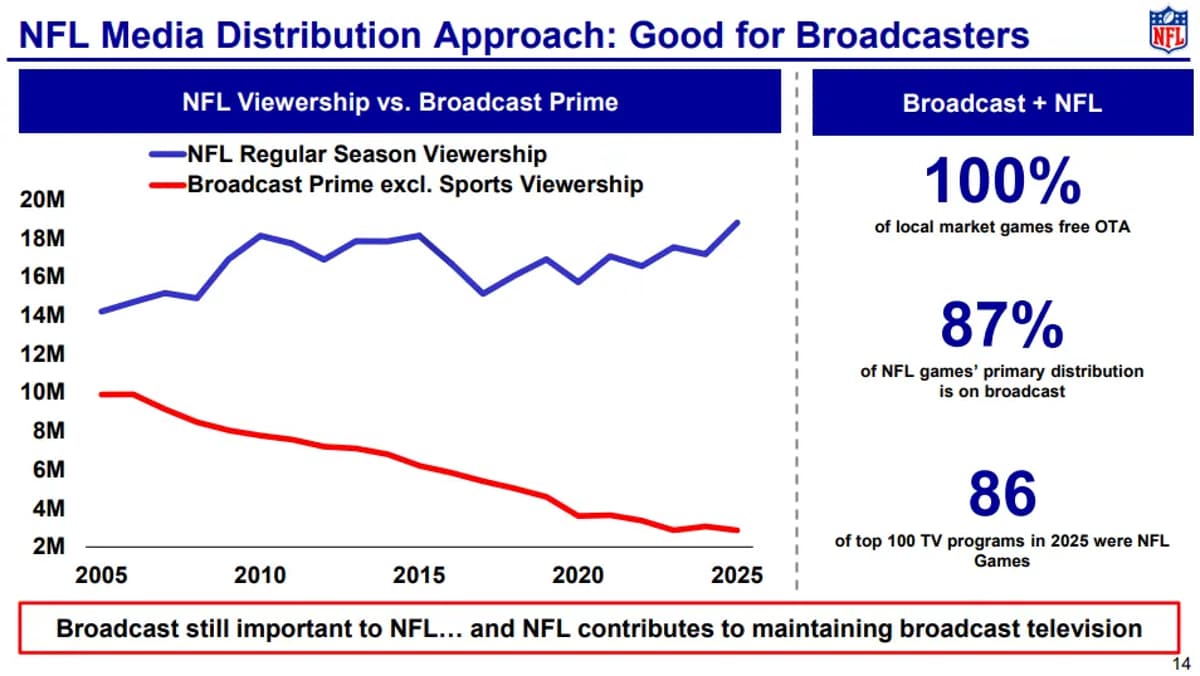
- •Non‑sports primetime viewership fell >75% in two decades.
- •NFL regular‑season audience grew >30% over same period.
- •Broadcast retransmission fees now driven primarily by NFL rights.
- •Networks may shift entertainment production to streaming or AI tools.
- •Disney’s linear TV relevance questioned amid NFL dominance.
Pulse Analysis
The erosion of non‑sports viewership is not a sudden blip but the culmination of long‑term audience fragmentation, cord‑cutting, and the rise of on‑demand platforms. Over two decades, broadcast primetime audiences for dramas, sitcoms, and reality shows have slumped by more than three‑quarters, while the NFL’s live‑event appeal has surged, delivering a 30% increase in regular‑season ratings. This divergence underscores a broader industry truth: live sports remain one of the few appointment‑viewing experiences that can still command mass audiences in an era of fragmented consumption.
Financially, the implications are stark. Retransmission‑consent fees—traditionally a stable revenue stream for broadcasters—are now increasingly tied to sports rights, with NFL contracts generating the lion’s share of the $5 per subscriber monthly fees cited by analysts. As networks renegotiate higher licensing fees, the margin pressure on non‑sports programming intensifies, forcing stations to evaluate whether entertainment shows can cover production costs through advertising and syndication. The result is a potential reallocation of budgets toward cheaper, AI‑assisted content or outright migration of scripted series to streaming services where subscription models can offset lower ad revenues.
Strategically, the analysis puts pressure on legacy media conglomerates, especially Disney, to reassess the value of linear TV assets. If sports continue to dominate the revenue pie, the justification for maintaining costly broadcast entertainment divisions weakens. Companies may accelerate the shift of original series to over‑the‑top platforms, explore hybrid sports‑entertainment formats, or double down on exclusive sports rights to protect their cash flow. Ultimately, the broadcast landscape is poised for a realignment that privileges live sports and digital distribution, reshaping how advertisers, creators, and viewers engage with television.
Analysts: Non-Sports Programming Is Becoming `Irrelevant’ to Broadcast TV Viewership
Comments
Want to join the conversation?
Loading comments...