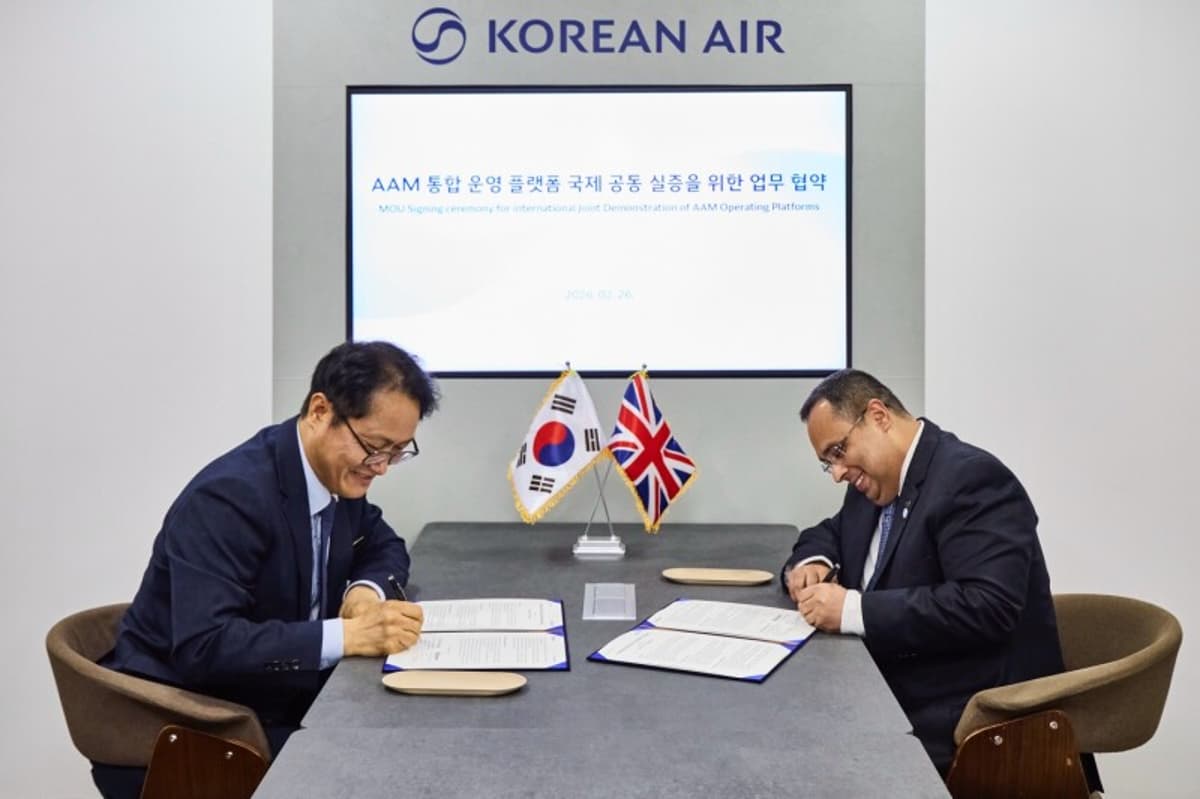
Korean Air and Skyports Sign MoU to Advance Air Mobility Tech Integration
Why It Matters
The collaboration could set a global standard for Advanced Air Mobility, accelerating commercial eVTOL services and unlocking new revenue streams for both aviation and infrastructure operators.
Key Takeaways
- •Korean Air, Skyports sign MoU for eVTOL platform.
- •Integrates Skyports VAS with Korean Air ACROSS system.
- •Joint pilots target Dubai vertiport network by 2026.
- •Aims to set global AAM operational standards.
- •Supports commercial eVTOL services launch in Korea by 2028.
Pulse Analysis
Advanced Air Mobility (AAM) is moving from concept to commercial reality, but fragmented technology stacks have slowed adoption. By pairing Korean Air’s deep expertise in flight‑operations control with Skyports’ Vertiport Automation System, the new partnership tackles a core industry bottleneck: seamless coordination between aircraft and vertiport infrastructure. This integration promises a single, scalable platform that can manage everything from take‑off sequencing to low‑altitude traffic deconfliction, reducing operational complexity for emerging eVTOL operators.
The technical alignment focuses on merging Skyports’ VAS, which automates ground handling, charging, and passenger flow at vertiports, with Korean Air’s ACROSS, a sophisticated air‑traffic‑management suite designed for low‑altitude corridors. Joint pilots in Dubai—where Skyports plans its first full‑scale commercial eVTOL service—will validate real‑world performance, while a parallel rollout on Jeju Island will test the system in a different regulatory environment. These demonstrations are expected to generate data that refines algorithms, improves safety margins, and accelerates certification pathways for both hardware and software components.
If successful, the unified platform could become the de‑facto standard for AAM operators worldwide, encouraging airlines, infrastructure providers, and municipalities to adopt a common operational language. This would lower entry barriers for new market entrants, stimulate investment in vertiport construction, and enable airlines like Korean Air to diversify into urban air transport services. Ultimately, the MoU signals a maturing ecosystem where legacy carriers and specialized infrastructure firms collaborate to unlock the commercial potential of eVTOLs.
Korean Air and Skyports Sign MoU to Advance Air Mobility Tech Integration
Comments
Want to join the conversation?
Loading comments...