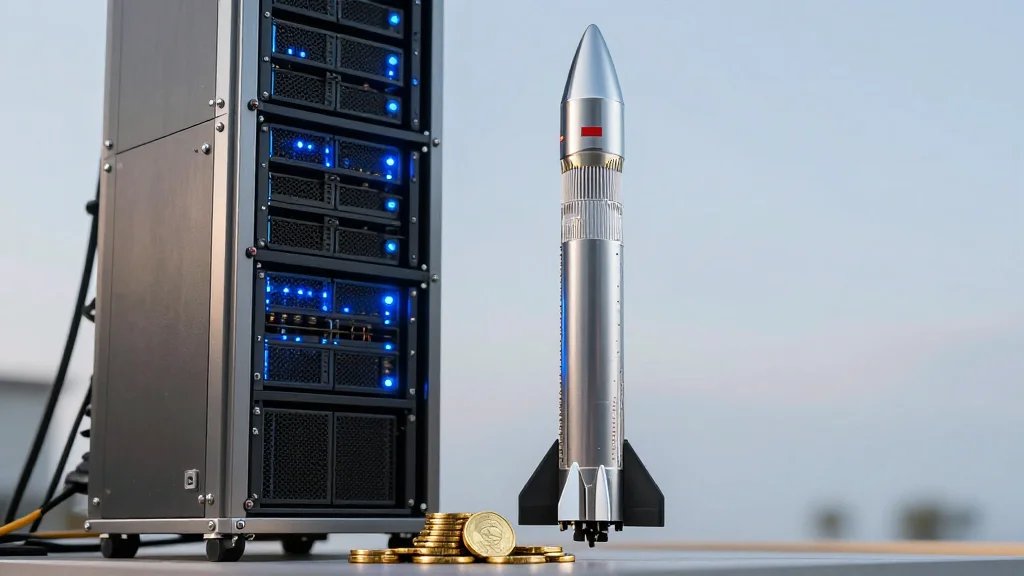
SpaceX’s AI Spend Triples Rocket Budget, $6.3B Loss Raises Investor Alarm

Companies Mentioned

Why It Matters
SpaceX’s AI‑centric strategy illustrates how a leading technology firm can prioritize future market dominance over immediate profitability, a trade‑off that CIOs across industries must assess. The $6.3 billion loss underscores the capital intensity of training frontier models and the potential for energy‑related cost overruns, prompting executives to scrutinize AI project ROI more rigorously. If SpaceX’s orbital data‑center concept proves viable, it could redefine the economics of AI compute, offering a low‑carbon alternative that may attract enterprises seeking sustainable AI solutions. Conversely, failure to monetize the AI spend could dampen investor appetite for similarly aggressive AI capex, influencing funding cycles and partnership structures in the broader AI ecosystem.
Key Takeaways
- •SpaceX’s AI operating loss was $6.3 billion in 2025, versus a $657 million loss in rockets.
- •AI capex reached $7.7 billion in Q1 2026, more than three times the rocket budget.
- •The company secured a $1.2 billion‑per‑month cloud agreement with Anthropic through 2029.
- •SpaceX plans to move AI workloads to orbital data centers powered by solar energy.
- •Jeff Bezos warned that the timeline for orbital data centers is "probably a little ambitious."
Pulse Analysis
SpaceX’s aggressive AI investment marks a rare instance where a launch‑focused company is willing to incur multi‑billion‑dollar operating losses to secure a strategic foothold in AI infrastructure. Historically, firms like Alphabet and Amazon have funded AI research out of existing cash flows, but SpaceX is betting on a future market that it believes could be worth $26.5 trillion. This reflects a broader shift where AI is no longer a peripheral add‑on but a core revenue engine, prompting CIOs to treat AI spend as a long‑term capital project rather than a discretionary expense.
The orbital data‑center concept, while visionary, introduces a new set of risk variables: regulatory approval for satellite constellations, the engineering challenge of cooling high‑density compute in space, and the capital intensity of launching and maintaining such assets. CIOs must weigh these uncertainties against the potential upside of near‑constant solar power and reduced terrestrial energy costs. In the near term, the more immediate concern is the $1.2 billion‑per‑month revenue stream from Anthropic, which may serve as a proof point that external customers are willing to pay premium rates for SpaceX’s AI compute capacity.
Looking ahead, the upcoming IPO will be a litmus test for how the market values AI‑heavy balance sheets. If investors reward SpaceX’s long‑term vision despite the current loss, it could embolden other firms to accelerate AI capex, potentially inflating the sector’s valuation multiples. If the market penalizes the loss, CIOs may be forced to adopt a more conservative AI budgeting approach, emphasizing incremental upgrades over moonshot projects. Either outcome will reshape capital allocation strategies across the tech industry for years to come.
SpaceX’s AI Spend Triples Rocket Budget, $6.3B Loss Raises Investor Alarm
Comments
Want to join the conversation?
Loading comments...