Berkeley Center for Law & Technology (BCLT) - Latest News and Information
Technology Pulse
EMAIL DIGESTS
Daily
Every morning
Weekly
Tuesday recap
EMAIL DIGESTS
Daily
Every morning
Weekly
Tuesday recap

The panel examined AI’s expanding role as an inventing tool and its ripple effects on patent law, moving the conversation beyond who is listed as inventor. Professors Peter Lee and Ali Alemozafar highlighted how AI accelerates prior‑art searches, influences novelty and non‑obviousness analyses, and forces a re‑evaluation of the “ordinary skill in the art” standard. Key insights included the proliferation of AI‑generated prior art—both inadvertent and deliberate—making novelty thresholds harder to meet, while also expanding the pool of accessible references that could narrow the analogous‑art limitation. Non‑obviousness may become more challenging as AI bridges gaps between prior art and claim scope, prompting courts to consider hybrid human‑AI skill levels. Disclosure obligations differ sharply between inventions that merely use AI for assistance and those that embed AI models, with the latter demanding detailed algorithmic, training‑data, and possibly model‑deposit disclosures. Professor Lee illustrated these points with examples such as an AI‑generated synthetic protein image that lacks enabling disclosure, and AlphaFold’s breakthrough, which serves as objective evidence of non‑obviousness. He also referenced the “obvious to try” doctrine, noting that AI‑driven trial runs can be both obvious and non‑obvious depending on parameter selection. Dr. Alemozafar emphasized strategic choices between patenting and trade‑secret protection in the fast‑moving ML landscape. The discussion underscores a looming need to adapt patent doctrine to AI‑augmented invention, balancing incentives for genuine innovation with practical commercial considerations. Firms will likely continue to rely on patents to lower transaction costs and facilitate licensing, even as AI lowers the barrier to invention, making strategic IP management—especially around disclosure and skill standards—critical for future competitiveness.

The panel examined how AI tools upend the traditional notion of inventorship in patent law, focusing on the requirement that a natural person be named as inventor under the Paris Convention and U.S. statutes. Speakers highlighted that U.S. law, unlike copyright’s...
The inaugural Yuan Global Talk examined how generative AI challenges traditional copyright doctrines, contrasting recent rulings in China and the United States. Host Yuan Hao introduced the technology’s rapid rise and set the stage for a comparative legal analysis of...

The session examined the growing ethical and legal challenges posed by wearable health technologies, focusing on privacy, personal health information (PHI), and intellectual‑property considerations. Speakers highlighted how these devices have evolved from simple pedometers to medical‑grade sensors that collect continuous...
The webinar examined the rapidly evolving landscape of AI‑generated content and copyright law, centering on the landmark UK trial between Getty Images and Stability AI. The case, heard in the Patents Court—a specialist IP forum within the Chancery Division—originally featured...
The Berkeley Center for Law & Technology hosted Jim Dempsey to explain California’s newly adopted cybersecurity audit rule, part of a broader package that also addresses automated decision‑making technology and risk assessments. Adopted on July 24 by the California Privacy Protection...

The Berkeley Center for Law & Technology hosted a webcast featuring Greenberg Traurig partners Brent Sokol and Alex Linhardt, dissecting exclusivity provisions in technology agreements. The session clarified how such clauses function, highlighted judicial interpretations that define their permissible scope, and outlined...
Vince Juraliman, director of the Life Sciences Law and Policy Center at UC Berkeley’s Center for Law & Technology (BCLT), outlines the center’s mission to equip students, legal professionals, and the public with resources on technology law and policy. BCLT...
The Berkeley Center for Law and Technology webcast featured Baker Botts partner Matt Avery presenting a Harvard Tech Law Journal paper that examined how the length of patent prosecution—measured by the number of office actions before allowance—correlates with litigation outcomes....
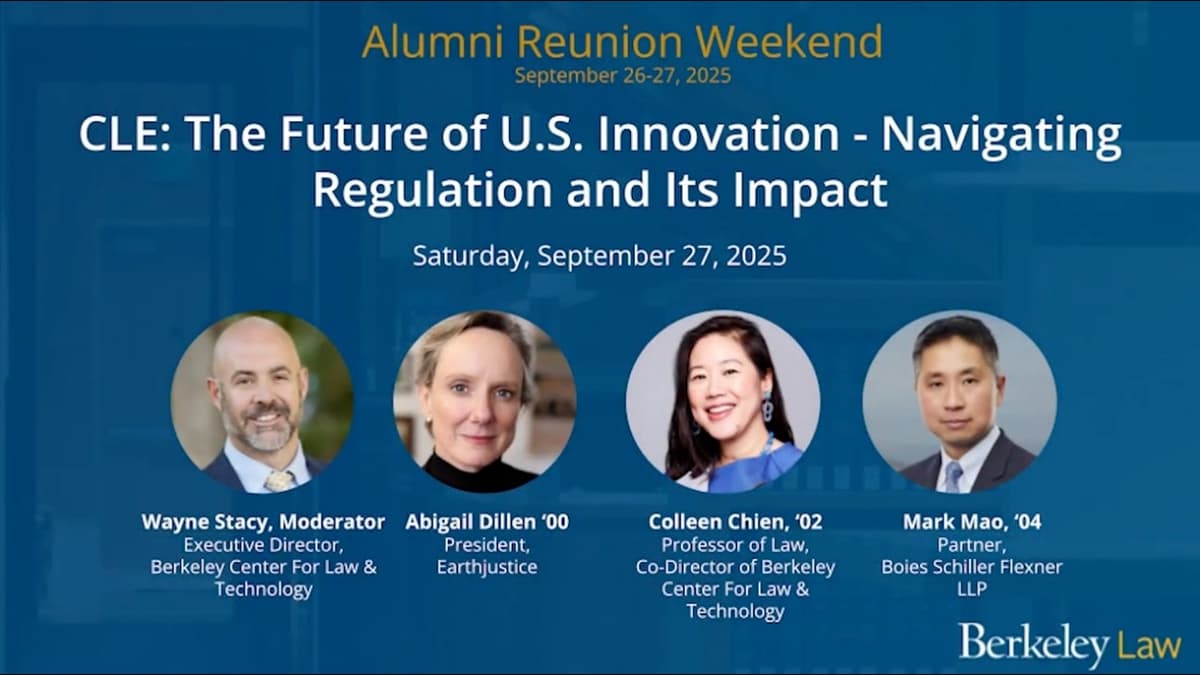
The panel convened by Berkeley Law’s Center for Law and Technology examined the intersecting forces shaping U.S. innovation—namely the power grid, semiconductor supply chains, and artificial intelligence—while probing how regulation will either enable or constrain progress. Speakers highlighted that electricity demand,...


