Bob McNally - Latest News and Information

I did not say there's nothing we can do to open the Strait of Hormuz. I said there are no policy options that can offset the loss of flow from the Strait of Hormuz.

So to speak.... “Even the possibility that a hostile power could choke traffic in Hormuz—by far the world’s most vital energy and commodity artery—was considered to be absurd,” McNally told Fortune, largely because it hadn’t happened before. “When I would tell...

Not nasty — prescient. Our Battlespace and Barrel Flow report modeled 7- and 30-day Hormuz closure scenarios (among others) in June 2025 because the risk was real and our clients needed to be prepared. No one's enjoying this.

Thank you @JMathieuReports and @tylerskendall for having me on @business Balance of Power yesterday, just before Secretary Burgum, to talk about oil, Iran, SPR, pump prices, and the federal government intervening in oil futures markets. @RapidanEnergy https://t.co/0RqDeHN4qa

If Hormuz flows do not resume for a month, that's the worst-case disruption duration my colleagues at @RapidanEnergy and I modeled last June when we mapped out a US-Iran conflict on global oil and LNG markets and prices. We modeled disruption...
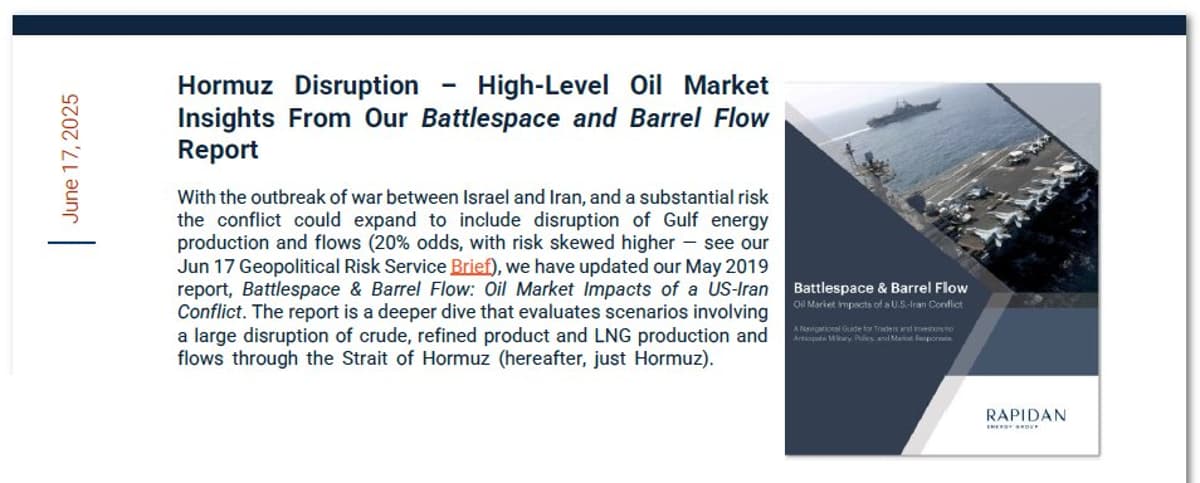
US political leaders, the oil industry, and traders are waking up to what we advised clients in June: restoring oil and LNG flow in the Strait of Hormuz won't be quick or easy. A load-bearing assumption in global energy is...

Well attended @RapidanEnergy Iran update huddle this morning for our Geopolitical Risk Service clients. If you're managing risk in energy and macro markets and don't know us yet, this might be a good time to become acquainted. info@rapidanenergy.com. https://t.co/qRL4heI0Si
For the history enthusiasts like my friend @Andrewtabler: During WWII US spare capacity actually went negative. In 1944, the oil industry pushed the fields beyond MSC to produce fuel for the final major offensives in the Pacific and Atlantic.
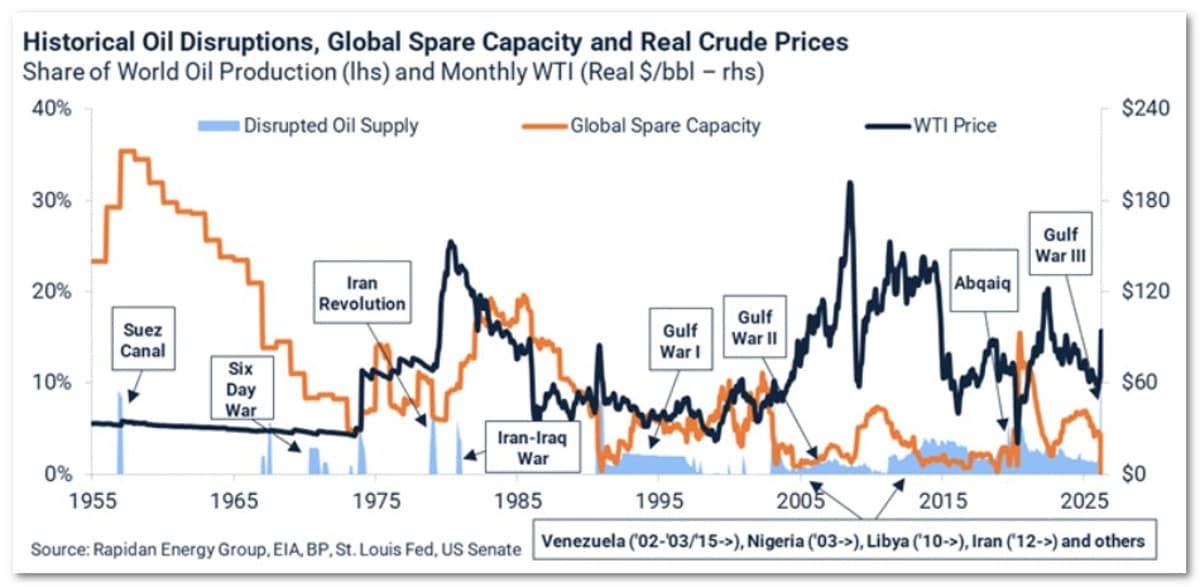
Here's the promised historical data perspective on how Gulf War III compares in terms of disruption size and available spare capacity. @RapidanEnergy https://t.co/7BQidJY0Qa https://t.co/cgajo5h4cD

Compared to the last maximum disruption during the 1956-1957 Suez Crisis (as a percentage of total liquids demand), this represents the largest oil supply loss in history, by a factor of two. Worse, unlike in past crises, there's zero spare capacity...
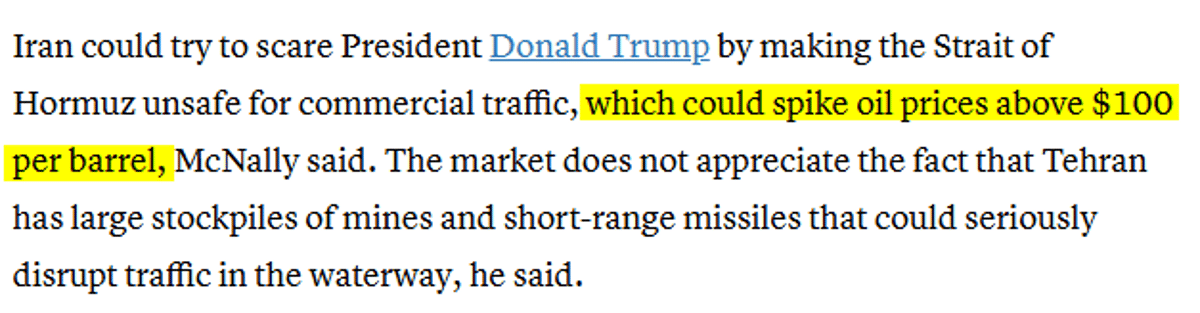
This interview with @CNBC's @spencekimball from 8 days and $45 per barrel crude ago aged well..... @RapidanEnergy https://t.co/JOm9ZToDld https://t.co/vPPaedvNrV
Looking forward to discussing the Iran conflict and oil markets on @CNN at 5:40pm ET. @RapidanEnergy


