

How a U.S.-China War Would Unfold
The video “How a U.S.-China War Would Unfold” asks retired three‑star General Charles Hooper to map a full‑scale crisis, from cyber strikes to a possible nuclear exchange, with Taiwan at the center of any direct clash. Hooper outlines a spectrum of options: low‑level PLA flights, cyber attacks on banking and communications, anti‑satellite strikes, maritime blockades, and, at the extreme, a massive amphibious invasion. He stresses that weather, tides and satellite availability dictate kinetic timing, and that U.S. forces stationed in Japan would be immediate targets, pulling allies into the fight. A memorable exchange illustrates Chinese bluntness: a senior PLA officer warned that U.S. arms sales to Taiwan would always be opposed. Hooper also recalled a banquet joke about “Chinese transparency” wrapped in silver paper, underscoring the opacity that complicates crisis management. He notes the last large amphibious landing was in 1950, making such an operation both logistically daunting and a clear signal. For policymakers and businesses, the analysis signals the need for layered cyber resilience, reinforced regional alliances, and contingency planning for supply‑chain disruptions. As the shadow of conflict reshapes military postures, firms must monitor defense spending, semiconductor flows, and geopolitical risk premiums.

Israeli Security Doctrine: Challenges for the Region
The panel examined Israel’s evolving security doctrine, which has moved from a deterrence‑based posture to a “forever war” strategy centered on pre‑emptive strikes, buffer zones, and the systematic degradation of adversaries. Speakers traced the shift to the October 7 Hamas...
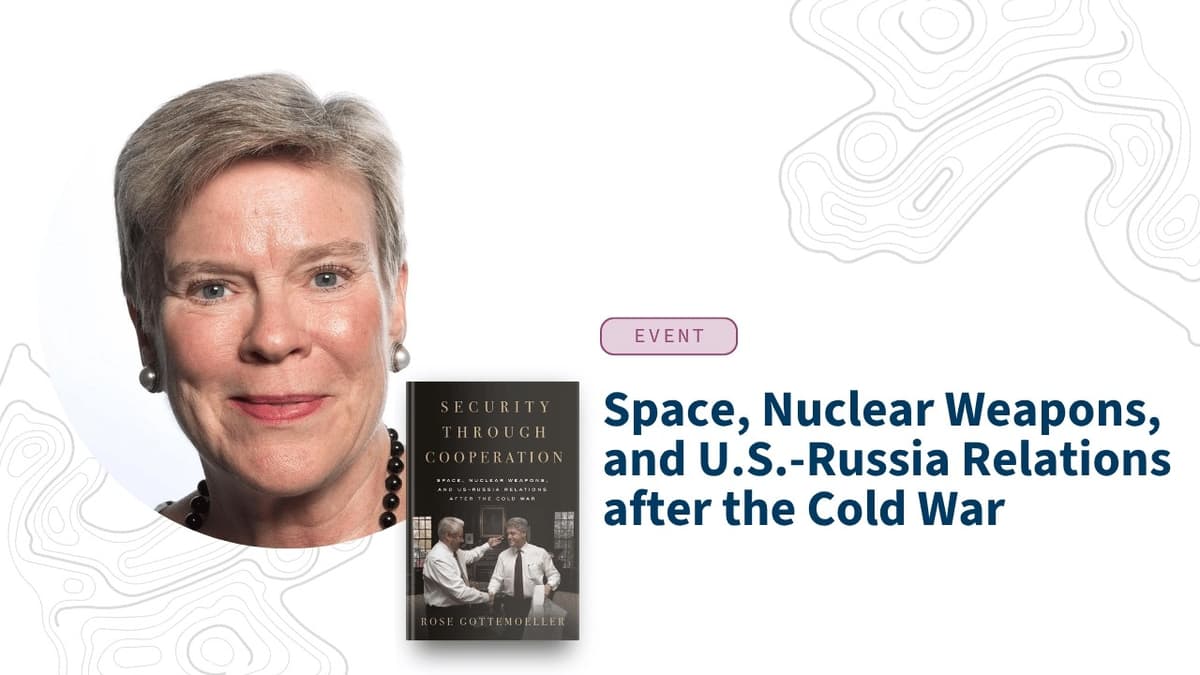
Space, Nuclear Weapons, and U.S.-Russia Relations After the Cold War
The event centered on Rose Gottemoeller’s new book, *Security Through Cooperation: Space, Nuclear Weapons and U.S.-Russia Relations After the Cold War*, and a discussion with NPR journalist Michelle Kellerman. Gottemoeller, a former U.S. under‑secretary for arms control and NATO deputy...
Rethinking India’s Growth Story
The podcast "Rethinking India’s Growth Story" spotlights a new working paper that argues India’s official GDP numbers have been systematically mis‑measured. Using the 2011 base‑year revision as a dividing line, the authors find that growth from 2005‑2011 was under‑stated,...

China: Trump Term 1 Vs. Trump Term 2
A senior Chinese official told the speaker that Beijing’s perception of Donald Trump has shifted sharply since his first term. In 2016–20 they saw a transactional president constrained by China hawks; now they view him as unrestrained, surrounded by loyalists...

How Will AI Transform Work?
The video examines how artificial intelligence could reshape the labor market, outlining three dominant expert perspectives and proposing immediate policy actions. The ‘alarmed’ camp argues that accelerating AI capabilities and massive data‑center investments could soon automate a wide swath of white‑collar...

Cuba Vs. Venezuela
The video examines the prospect of a U.S. military incursion into Cuba, contrasting it with the earlier Venezuelan scenario. It argues that Cuba has long cultivated a "fortress" mindset, keeping a sizable but largely untested armed force ready for any...

Why Is Cuba Important to Trump?
The video examines why Cuba occupies a prominent spot on the Trump administration’s agenda, tracing the issue back to longstanding U.S. security anxieties articulated by Secretary of State Marco Rubio. Rubio argues that Havana functions as a conduit for left‑wing populist...

What to Know Before Trump Attacks Cuba
The video examines President Donald Trump’s renewed rhetoric about using force against Cuba, a move that would mark the third unilateral threat to a sovereign nation in a single year. Unlike previous actions against Iran and Venezuela, the Cuban proposal...

I Can’t Tell If You’re Real Anymore…
The video opens with a podcaster’s confession that the flood of AI‑generated comments has made it impossible to tell genuine audience feedback from bots, prompting a broader discussion about digital trust. He introduces Nick Pickles, chief policy officer at Tools...
India’s Youth Boom Meets a Jobs Bust
The fifth edition of the State of Working India report, released by Azim Premji University, examines how India’s youthful population is faring in the labor market as the country approaches the tail‑end of its demographic dividend. By focusing on...

The Indian Who Helped Build Silicon Valley
The podcast “Grand Tamasha” features Kanwal Rekhi, the Indian‑American pioneer who wrote “The Groundbreaker,” chronicling his rise from a modest IIT Bombay student to the first Indian‑American founder‑CEO to list a venture‑backed company on Nasdaq and a key architect of...

Birthrate Decline Isn't Just a Culture War Issue
The video highlights a worldwide decline in birth rates coupled with rapidly aging populations, creating a demographic shift that reduces the proportion of working‑age individuals. This trend is not merely a cultural debate about family choices; it represents a structural...

Why Orbán's Loss Matters
The video examines why the defeat of Hungarian Prime Minister Viktor Orbán matters beyond Hungary’s borders, highlighting his outsized role in Europe’s far‑right resurgence and his strategic importance to Moscow and Beijing. Orbán’s 16‑year tenure made him a bellwether for hard‑right...
The U.S. and Israel’s War With Iran: Where Do We Go From Here?
The Carnegie Connects panel examined the rapidly evolving U.S.–Israel conflict with Iran, now seven weeks old, and the looming diplomatic overtures that could reshape the war’s trajectory. Host Aaron Miller framed the discussion around the unexpected durability of Iran’s political...