Closer To Truth - Latest News and Information
Technology Pulse
EMAIL DIGESTS
Daily
Every morning
Weekly
Tuesday recap
EMAIL DIGESTS
Daily
Every morning
Weekly
Tuesday recap

The video explores evolutionary developmental biology (evo‑devo) as the bridge between molecular embryology and Darwinian evolution. Alex Rosenberg explains how the rise of molecular genetics turned developmental biology from a catalog of stages into a mechanistic science, highlighting Nobel‑winning work on Drosophila gene regulation that revealed precise on‑off switches guiding embryo formation. Key insights include the notion that evolution operates on traits hard‑wired in the genome—both structural and regulatory genes—and that the developmental program determines a lineage’s capacity for variation, or "evolvability." Rosenberg cites Darwin’s observation that variation concentrates in reproductive organs and argues that modern evo‑devo seeks to decode how embryonic pathways embed flexibility, allowing descendants to meet novel environmental challenges. Illustrative examples feature the Drosophila developmental cascade, Stephen J. Ghoul’s description of the embryo as a "blueprint" later sculpted by selection, and the broader implication that without such developmental malleability, lineages could fail to adapt to rapid changes like climate warming. The discussion underscores that mutation and drift alone are insufficient without a robust developmental architecture. The significance lies in recognizing developmental biology as indispensable for forecasting evolutionary outcomes, informing conservation strategies, and guiding synthetic biology. By mapping the genome‑encoded construction plan, scientists can better anticipate how species might respond to emerging threats or be engineered for desired traits.

The video titled “What is Closer To Truth?” introduces the series’ mission to explore fundamental cosmological questions, emphasizing the mystery of why we exist in this particular universe. It outlines concepts such as the multiverse, multiple Big Bang events, and the...

The video centers on a deep‑cut philosophical‑scientific exchange about why there is something rather than nothing, using Stuart Kauffman’s perspective on quantum mechanics. Kauffman contrasts Aristotle’s res extensa—definite, actual objects—with Heisenberg’s res potentia, a realm of possibilities that only become...

Alan C. Love opens the discussion by emphasizing that classification remains a foundational activity in biology, even if the traditional Linnaean hierarchy is less frequently invoked. He argues that scientists constantly sort traits, proteins, and organisms into categories to make...

The discussion, hosted by James Hughes, probes whether artificial intelligence can achieve genuine consciousness and how Buddhist philosophy informs that debate. Hughes outlines the Buddhist analysis of mind, emphasizing the illusion of self ("rupa") and the role of embodied perception...

In a recent Closer to Truth interview, astrophysicist Priya Natarajan explains how massive galaxy clusters act as natural telescopes, producing thousands of duplicated images of a single background galaxy through gravitational lensing. She describes Einstein’s general‑relativity picture of spacetime as a...

In a recent talk, theoretical physicist Raphael Bousso addressed the question of whether multiple universes exist, emphasizing that the idea has moved from fringe speculation to a near‑consensus working hypothesis among cosmologists. He argued that the observed values of vacuum energy,...

The video features an interview with Michael James, a longtime scholar and translator of Shri Ramana Maharshi, who outlines the sage’s central teaching that ultimate reality is discovered by turning inward and questioning the very experience of self. James argues that...

Peter Godfrey‑Smith argues that Darwinian evolution demands a gradualist view of mind, emotion, and consciousness rather than sharp, binary distinctions. He contends that evolutionary processes produce continuous variations, making it unlikely that consciousness appears abruptly at a specific point in...

The video centers on a speculative yet pressing question: could artificial intelligence ever achieve consciousness, and what would that mean for autonomous weapon systems? Host Mark Bailey probes the moral and strategic ramifications, while acknowledging the lack of consensus on...

Samir Okasha explains that population genetics formed the backbone of the modern synthesis, integrating Darwinian natural selection with Mendelian inheritance. He outlines how population genetics abstracts a population into allele frequencies and predicts their change under selection, mutation, drift, and migration,...
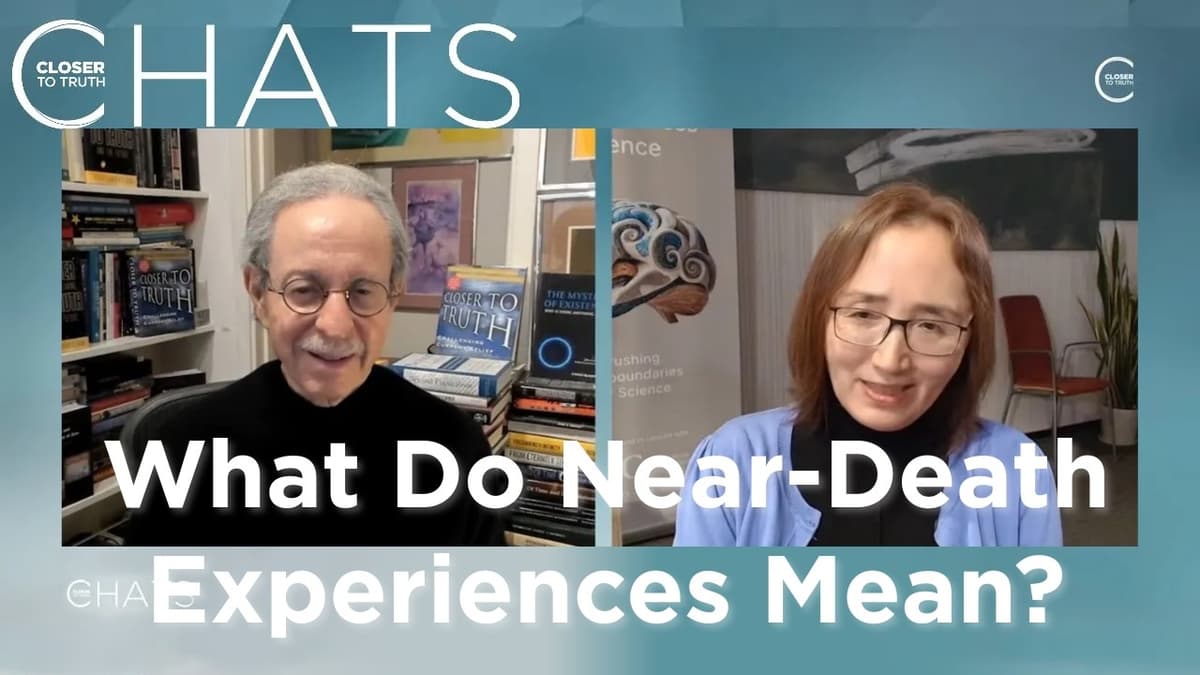
The video features neuroscientist Jimo Borjigin discussing a decade‑long investigation into the neural correlates of near‑death experiences (NDEs). Starting from an accidental observation of a massive serotonin surge in rats euthanized for stroke experiments, Borjigin pivoted to systematic recordings...

The video explores how scientists tackle the notoriously elusive problem of defining and measuring consciousness. Liad Mudrik explains that his lab presents stimuli that are sometimes visible and sometimes invisible, then compares behavioral and neural responses to isolate the processes...


