CNCF (Cloud Native Computing Foundation) - Latest News and Information
Technology Pulse
EMAIL DIGESTS
Daily
Every morning
Weekly
Tuesday recap
EMAIL DIGESTS
Daily
Every morning
Weekly
Tuesday recap

The CNCF on‑demand webinar marked the one‑year anniversary of Cordant, an open‑source platform that orchestrates multi‑cluster Kubernetes environments. Hosted by CNCF ambassador Priti Raj and a core team of developers, the session highlighted Cordant’s evolution from a prototype to a production‑ready solution, now at version 1.7 after an accelerated release cadence that began with the 0.1 launch in February 2025. Key milestones were outlined: the community has expanded to roughly 150 members across CNCF, K0, and platform‑engineering Slack channels; the project now bundles three core components—Cluster Manager (KCM), State Manager (KSM), and the observability/PHOPS suite (COF). Under the hood, Cordant leverages Cluster API, K0S, Cosmonaut for control‑plane provisioning, Flux for add‑on management, and integrates OpenCost, OpenTelemetry, and custom dashboards for full‑stack visibility. The templated YAML model enables operators to define cluster specifications, node configurations, and compliance policies across public, private, edge, and air‑gap environments. Speakers emphasized Cordant’s role as a “super control plane,” providing a single source of truth for thousands of clusters while supporting multi‑tenant, multi‑cloud, and compliance requirements such as DORA. Real‑world examples included enterprises managing workloads across AWS, on‑prem bare metal, and edge sites, all unified under Cordant’s observability stack. The roadmap previewed Cordant 2.0, promising richer state‑management capabilities, tighter security controls, and deeper integration with emerging cloud‑native tools. For platform engineers and DevOps leaders, Cordant offers an enterprise‑grade, community‑driven alternative to proprietary multi‑cluster solutions, promising lower operational overhead, cost transparency, and extensibility. As organizations accelerate their shift to hybrid and edge deployments, the project’s open‑source nature and rapid iteration cycle position it as a strategic asset for building resilient, observable, and compliant cloud‑native platforms.

Kyverno has matured into a battle‑tested policy engine for Kubernetes, with a year of enhancements and a broader umbrella of related projects on GitHub. The session showcases real‑world production adoption across diverse industries, highlighting new mutation, validation, and webhook capabilities....
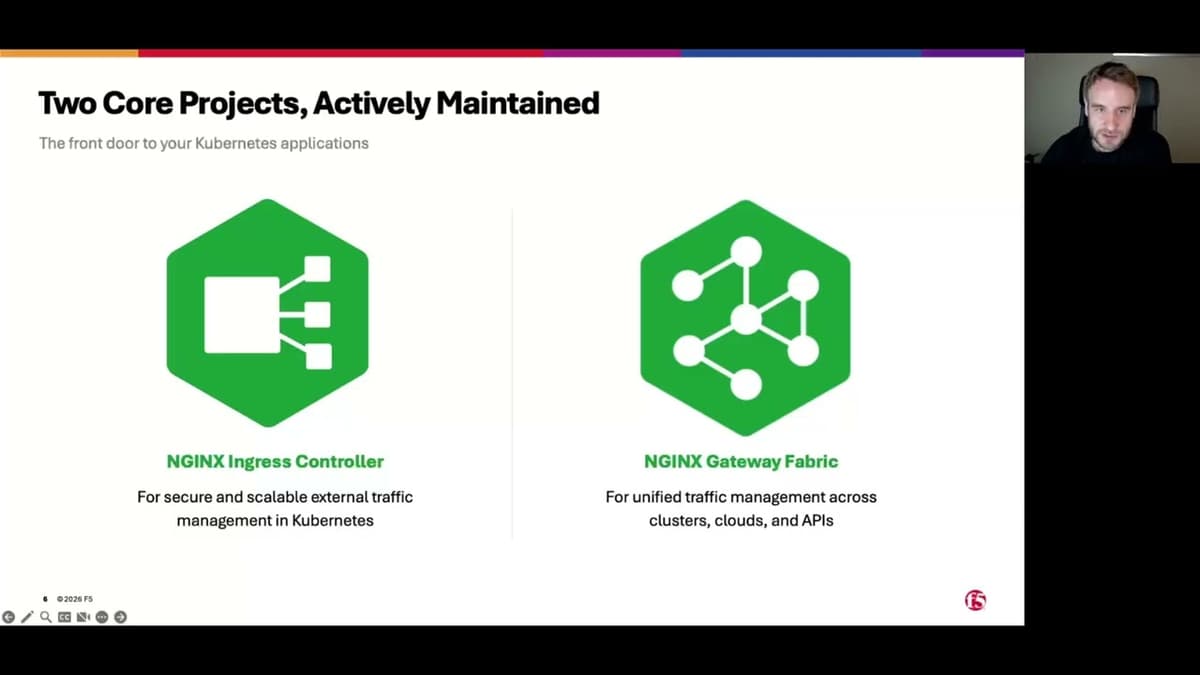
During a recent CNCF On‑Demand session, the community clarified that the ingress‑nginx project is being retired, not the broader NGINX ecosystem. While the open‑source ingress‑nginx controller will be archived, commercial and CNCF‑backed offerings such as the NGINX Ingress Controller and...

Crossplane 2.0 introduces new primitives, notably the Operations resource, enabling AI‑driven control loops on Kubernetes. The platform demonstrates how large language models can power zero‑code, plain‑English controllers and an AI‑guided database control plane that makes conservative, auditable scaling actions based...


