
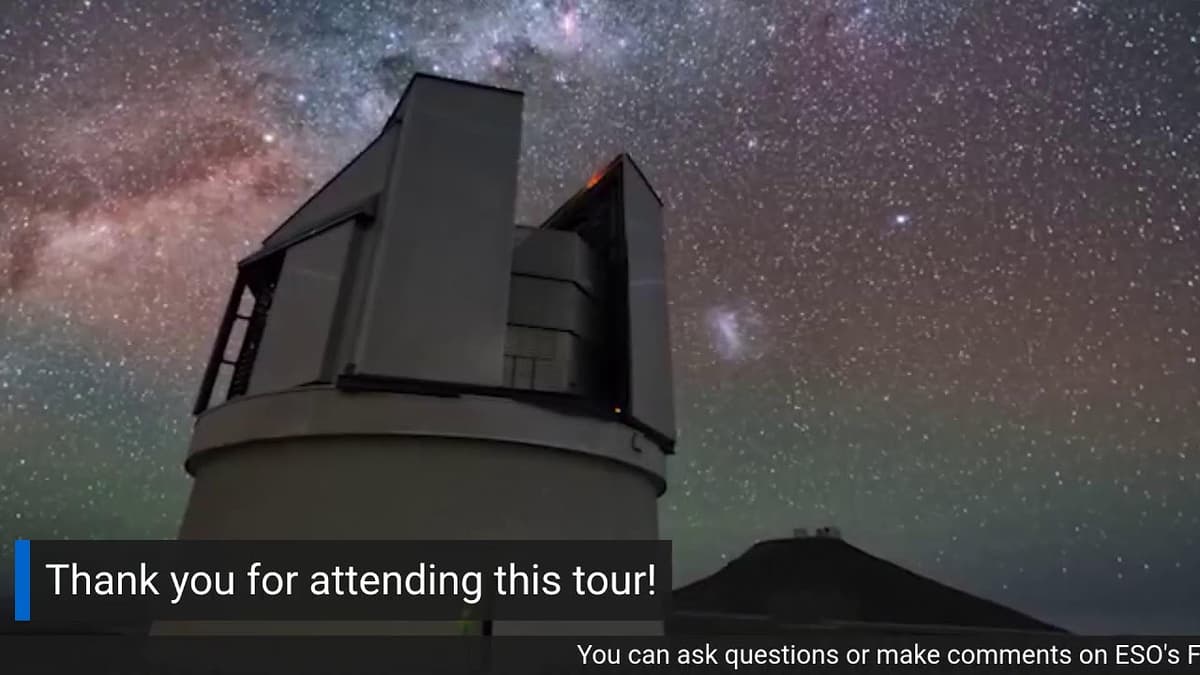
Virtual Guided Tour ESO's Paranal Observatory. Saturday, April 11th, 17:00h CEST.
The video offers a live‑style virtual tour of the European Southern Observatory’s Paranal site, led by veteran guide Farid Char and producer‑student Hector Salas. They introduce ESO’s multinational framework, its three Chilean locations, and focus on Paranal, home to the Very Large Telescope (VLT) and the future Extremely Large Telescope (ELT). Viewers learn that the VLT comprises four 8.2‑meter Unit Telescopes (UTs) named Antu, Kuyén, Melipal and Yepun in the Mapudungun language, plus several 1.8‑meter Auxiliary Telescopes (ATs) that can be repositioned on a rail system. By combining light through interferometry, the array can mimic a 200‑meter aperture, delivering resolution up to sixteen times finer than a single dish. The tour also explains the active‑optics system: 115 computer‑controlled actuators continuously reshape the 22‑ton Zerodur primary mirror to counteract gravity‑induced deformations. A striking detail is the layered optical path—primary, secondary and tertiary mirrors directing starlight to interchangeable instruments that convert photons into digital data for astronomers in the control building. Engineers perform daily calibrations, while night‑time observations are conducted by scientists worldwide, illustrating the seamless blend of high‑tech hardware and human expertise. The showcase underscores Paranal’s strategic location in the Atacama’s ultra‑dry, low‑light‑pollution environment, which yields over 300 clear nights annually. As ESO prepares the ELT, the site’s proven infrastructure and cutting‑edge optics position it to remain a global hub for breakthrough discoveries in exoplanets, cosmology and high‑energy astrophysics.

Two Planets Spotted Forming Around a Young Star | ESO News
Astronomers using the European Southern Observatory’s Very Large Telescope interferometer have confirmed a second planet forming around the young star WISPIT 2, offering an unprecedented glimpse of a nascent planetary system. The two newborn worlds carve out clear, circular gaps in the...

Virtual Guided Tour ESO's La Silla Observatory. Saturday, March 21st, 15:00h CEST
ESO will host a live virtual guided tour of its La Silla Observatory on Saturday, March 21 at 15:00 CEST (11:00 CLT). The event streams simultaneously on ESO’s Facebook page and YouTube channel, and will not be archived after the broadcast....