

Surgeon General's Warning: Screen Time Harms Children & Teens
The U.S. Surgeon General released a formal advisory warning that excessive screen time poses significant health risks for children and adolescents. The announcement, championed by the Trump administration and the Maha Commission, represents the first federal health guidance specifically targeting digital media exposure among youth. The advisory cites emerging neuroscience that the pre‑frontal cortex—critical for decision‑making, impulse control and executive function—continues maturing until roughly age 26. Studies compiled in the report link prolonged screen use to delayed cortical development, poorer sleep quality, reduced physical activity, and heightened anxiety and depression rates. Officials highlighted that generations Z and Alpha have never known a world without smartphones or tablets, a stark contrast to earlier cohorts who learned primarily from books and outdoor play. The Surgeon General’s toolkit offers concrete recommendations for parents, educators, and policymakers, including screen‑free zones, daily outdoor time, and age‑appropriate usage limits. The guidance signals a shift for the education technology market, health insurers, and consumer‑device manufacturers, who may face new regulations or demand for parental‑control features. For families and schools, it underscores the urgency of balancing digital learning benefits with the long‑term cognitive health of children.
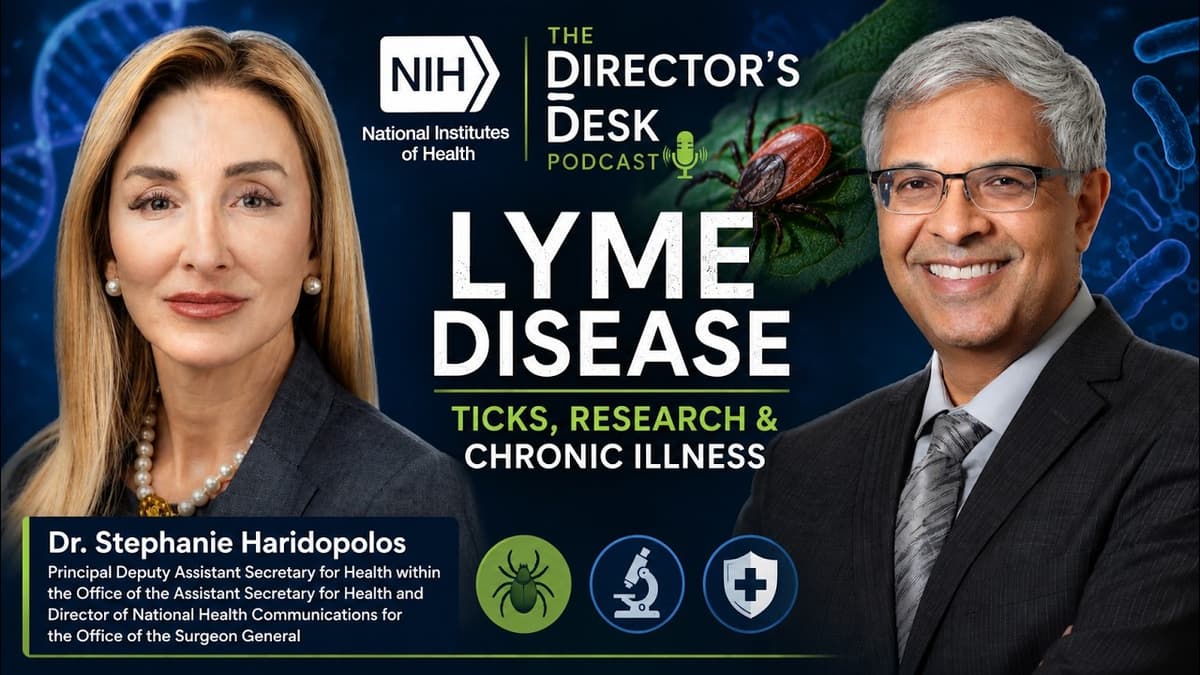
Director's Desk: Lyme Disease, Ticks & Chronic Illness | NIH and HHS Leaders Discuss New Research
The Director’s Desk podcast featured NIH Director Dr. Jay Badacharia and Acting Surgeon General Dr. Stephanie Herodopoulos discussing the latest public‑health priorities emerging from HHS. While the episode title references Lyme disease, the conversation centered on a new Surgeon General...

Keeping Cancer Locked Up
The video spotlights Wakako, a post‑baccalaureate fellow at the National Institutes of Health, who is investigating the earliest mechanical steps of cancer metastasis. She explains that most cancer fatalities stem from tumor cells breaking away from the primary site, forming...

Magic Lifescience at NIH POCTRN | Shark Tank Pitch for Point-of-Care Diagnostics
Magic Lifescience, a Stanford spin‑out, delivered a Shark‑Tank‑style pitch at the NIH POCTRN showcase, positioning its platform as a next‑generation point‑of‑care (POC) diagnostic solution. The founders, CSO Elaine Ng and CFO Tianhao, explained how their original cancer‑focused research was re‑engineered...

Inside NIH’s “Shark Tank” For Health Tech | NIBIB Innovation & POCTRN
The National Institutes of Health hosted its Research and Innovation Technology Partnerships and Collaborations (RITPC) showcase, marking its eighth year and expanding to feature digital health and point‑of‑care technologies. A highlight of the event was the Emerging Technologies session, styled...

NIH SciBites: A Smarter Way to Silence Inflammation
NIH postdoctoral researcher Matteo Pavan unveiled a novel therapeutic strategy aimed at chronic inflammation, a condition implicated in roughly 60% of worldwide deaths and a driver of heart disease, cancer, diabetes and Alzheimer’s. Current anti‑inflammatory drugs act like a sledgehammer, suppressing...

Lower Blood Pressure Fast? NIH Study Shows Simple Team-Based Care Works
A new NIH‑funded trial shows that a low‑cost, team‑based care model—combining health coaching, home blood‑pressure monitoring, and care coordination—significantly lowers blood pressure in high‑risk patients. The study reported measurable reductions in systolic pressure and a decline in heart‑attack and stroke...

NIH SciBites: Turning Down the Dial on Hearing Loss
The video features Jack, a post‑baccalaureate fellow at the NIH, describing his lab’s effort to curb noise‑induced hearing loss, a condition that stems from chronic exposure to everyday sounds and is currently irreversible. He explains that while brief, extremely loud bursts...

NIH-Led Research Discovers New Way Lung Cancer Can Emerge
The NIH‑led study unveiled a previously unknown pathway by which certain lung cancers develop, driven by retrotransposon elements—mobile DNA sequences that can copy and paste themselves throughout the genome. Using whole‑genome sequencing, researchers mapped mutational signatures that pointed to this...

NIH Scientific Freedom Lecture – Viral: The Search for the Origin of COVID-19
The NIH inaugurated its Scientific Freedom Lecture series with a focus on the contentious origins of COVID‑19. Host Jay Bazacharia framed the event as a platform for rigorous, non‑judgmental inquiry, inviting British science writer Matt Ridley—co‑author of the bestseller "Viral:...

NIH SciBites: Using Itch to Fight Ticks
The NIH’s SciBites team, led by post‑bac researcher Ronja, unveiled a discovery that harnessing the body’s itch response could accelerate tick removal and curb transmission of tick‑borne illnesses such as Lyme disease. Ticks often go unnoticed for the 24‑ to 48‑hour...

NIH SciBites: Pursuing Lab-Grown Organs Through Stem Cell Studies
The video spotlights NIH post‑baccalaureate fellow Jack’s work on engineering lab‑grown organs, focusing on how stem cells must be coaxed through differentiation to become functional heart, lung or other tissues. Jack explains that differentiation hinges on the three‑dimensional arrangement of DNA....