Paul Barnhurst - Latest News and Information

The episode of FPNA Unlocked spotlights a growing CFO dilemma: AI and new software promise efficiency, yet traditional ROI metrics fail to justify the spend. Hosts Vincent Msina, a veteran software‑sales CPA, and Alana Eststerich, a three‑time nonprofit CFO, argue that the root cause is a lack of consensus and an over‑reliance on static ROI calculations that ignore the transformational nature of modern technology. Both guests emphasize that successful projects begin with a "Return on Change" mindset—identifying what processes will be altered, stopped, or enhanced before any financial model is built. They illustrate this with a banking‑reconciliation example: without clear workflow redesign, automation tools are rejected, leading to wasted investment. The conversation also underscores that FP&A’s role must shift from data‑gathering and spreadsheet crunching to delivering strategic insight and influencing cross‑functional decisions. The dialogue culminates in a preview of their forthcoming book, which blends historical analysis of ROI failures with a step‑by‑step framework for achieving consensus, mapping change, and ultimately delivering measurable ROI. The authors promise practical tools, real‑world case studies, and a formulaic roadmap that CFOs can apply immediately, positioning the book as a bridge between theory and actionable change management. For finance leaders, the takeaway is clear: reframe technology spend through the lens of change, secure buy‑in at every organizational tier, and leverage FP&A as a strategic partner rather than a reporting silo. Doing so not only improves project success rates but also restores confidence in the financial justification of digital transformation initiatives.

Jeff Greenfield, CEO of Provalytics, discusses how cookie‑less attribution can prove the ROI of upper‑funnel channels such as CTV and podcasts. He explains the growing responsibility of FP&A teams to understand marketing data models and align budgets with measurable outcomes....

The video highlights a pervasive issue in the machine‑learning community: an influx of overconfident amateurs who lack the professional safeguards that govern fields like law, accounting, and medicine. Because ML is largely unregulated, distinguishing genuine expertise from hype becomes a...

The Future Finance episode features John Thomas Foxworthy, founder and CEO of the Global Institute of Data Science, discussing how finance leaders can avoid AI project failures by embracing augmented intelligence rather than viewing AI as a replacement. Foxworthy cites an...

In this Financial Modeler’s Corner episode, Amber Johnson explains how logistics forecasting intertwines with financial forecasting, emphasizing that operational nuances can ripple into significant financial outcomes. She stresses the importance of measuring forecast accuracy and bias to refine decision‑making. Johnson...

The video discusses why relying on default chart settings—particularly in Excel—can undermine effective data communication. The speaker recalls using the 3‑D pie chart defaults early in his career and questions when to stick with defaults versus customizing visualizations. He notes that...
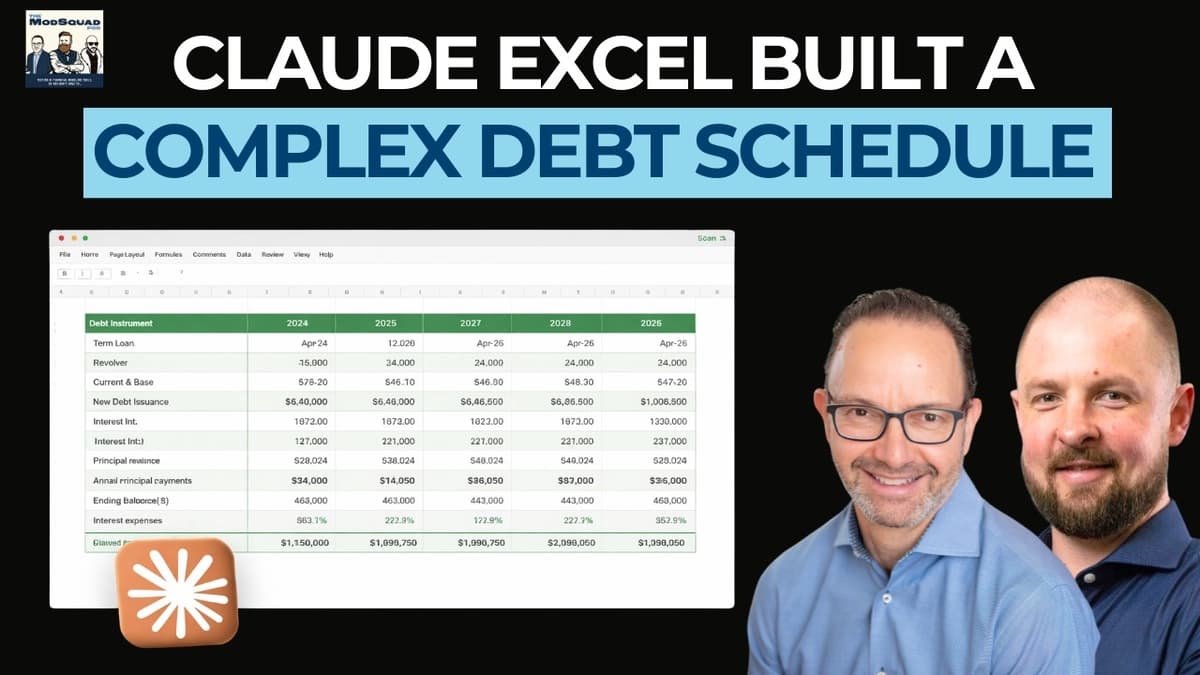
The video demonstrates how Claude, an AI language model, was tasked with constructing a complex debt‑service schedule for the CFM program’s Blackrat case study. Using only the Word document and Excel worksheet provided, Claude generated a full‑featured quarterly financial model...

In the FP&A Unlocked episode, host Paul Barnhurst and Nick Desbarats argue that data visualization functions more like writing than a technical art. They explain that charts exist solely for human interpretation and should follow clear, language‑based structures. By applying...

In the latest FPAC podcast, data‑visualisation specialist Nick Desbarats explains how finance teams can turn charts into strategic tools. He stresses that a chart’s "job"—the message it serves—trumps raw data or software features. Desbarats outlines the core skills needed, common...

The video demonstrates how Claude, integrated via Excel’s agent, can build and fully document a deferred‑revenue schedule, a common financial‑modeling task. The presenter walks through prompting Claude to generate formulas, link sheets, and produce a separate documentation tab that explains...

The conversation centers on why structure and design are essential to trust and credibility in financial modeling, featuring Nick Boowberg, a seasoned consultant who has built and reviewed hundreds of models for New Zealand’s largest firms. Boowberg emphasizes that a well‑structured...

During a recent FP&A webinar, Paul Barnhurst and ApprovalMax’s corporate controller Rafaella Torres explained that spend problems originate from poor underlying data rather than the expenditures themselves. They highlighted how delayed visibility and incomplete inputs lead to forecast errors and...

Future Finance hosts Paul Barnhurst and Glenn Hopper discuss with Riya Grover, CEO of Sequence, how unifying Configure‑Price‑Quote (CPQ) and billing eliminates revenue leakage between CRM and ERP systems. The episode highlights that contract details often get lost when sales...

In a recent FP&A Unlocked episode, CHRO Cynthia Kenny and HR leader Deborah Hill discussed how close collaboration between HR and FP&A drives organizational success. They highlighted that aligning corporate, team, and individual goals creates actionable insights, improves decision‑making, and...
Future Finance hosts Paul Barnhurst and Glenn Hopper interview Riya Grover, CEO of Sequence, about AI‑driven order‑to‑cash automation. Sequence, backed by a16z with $40 million Series A, offers an agentic platform that combines deterministic billing engines with AI workflow agents to handle...


