
Jim Al Khalili Explains Einstein's Battle with Quantum Mechanics
In a recent lecture, physicist Jim Al Khalili revisits Albert Einstein’s lingering resistance to quantum mechanics, framing it around the enduring challenge of reconciling gravity with the quantum world. He outlines the 1935 Einstein‑Podolsky‑Rosen (EPR) paper, which argued that quantum theory could not fully describe physical reality because entangled particles seemed to possess definite properties before measurement. Using a simple photon‑pair thought experiment, Al Khalili shows how measuring one photon’s wavelength or position instantly determines the other's corresponding attribute, regardless of distance. Al Khalili illustrates the paradox with the classic glove‑in‑two‑boxes analogy and notes the paper’s splash on the 1935 New York Times front page—though the manuscript was actually drafted by Boris Podolsky, not Einstein, who later complained about its publicity. The discussion underscores why the EPR debate remains pivotal: it seeded Bell‑type experiments, informs today’s quantum‑communication and computing platforms, and highlights the unfinished quest to embed gravity within a quantum framework.

Your Smartphone Chip Operates at a Power Density Comparable to that Inside a Nuclear Reactor #shorts
The video highlights a striking comparison: modern smartphone processors operate at a power density of roughly 100 watts per square centimeter, a figure traditionally associated with the cores of nuclear reactors. By juxtaposing the tiny silicon die of a phone...
AI Is Transforming Science — but Does It Understand Any of It? | with Claire Malone
The talk explores how artificial intelligence, especially generative models and transformers, is reshaping scientific research—from particle physics at CERN to climate modeling—while questioning whether machines truly grasp the meaning behind their predictions. Claire Malone frames the discussion with a nod...
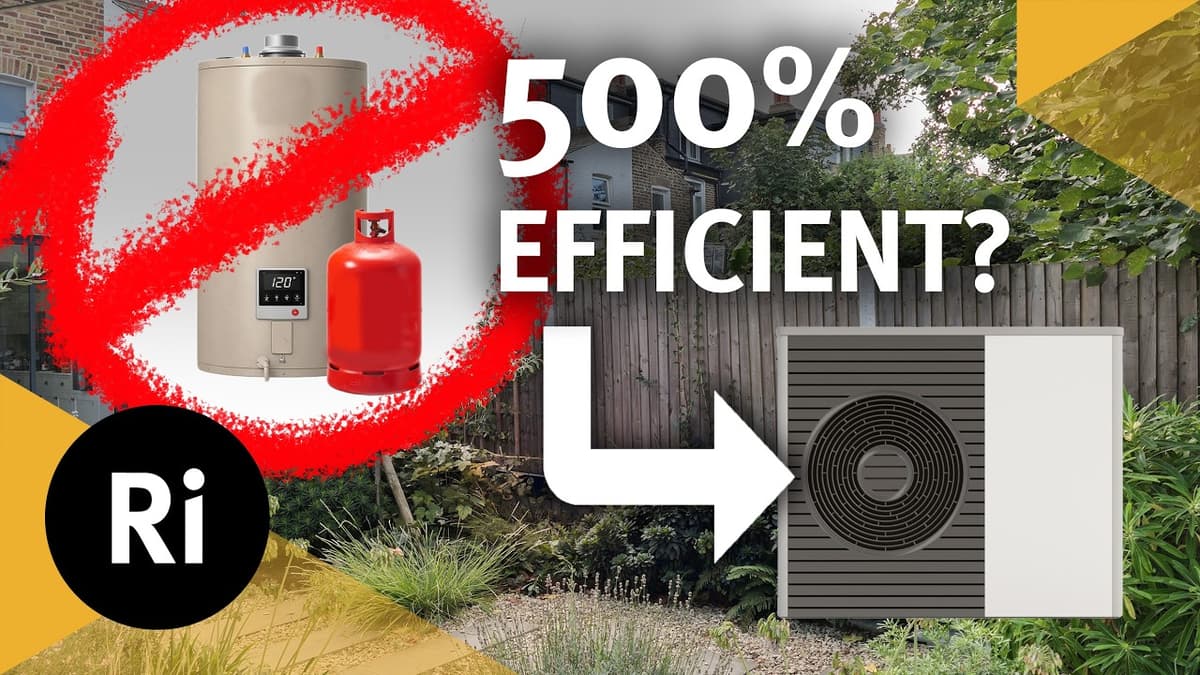
How Do You Heat a Home With Cold Air? The Physics of Heat Pumps
The video explains how air‑source heat pumps can warm homes even when the outside air is below freezing, positioning the technology as a cornerstone of the United Kingdom’s push to replace carbon‑intensive gas boilers. By circulating a low‑boiling refrigerant, the system...
Why the Sky Is Blue, How Butterflies Migrate & the True Story of Halley's Comet | with Lucy Rogers
The video weaves together three sky‑bound wonders – aurora displays, monarch butterfly migrations, and the physics of balloons – to illustrate how curiosity drives scientific inquiry. Host Lucy Rogers contrasts "wonder" and "awe," using personal anecdotes about aurora sightings in...
How Nanoparticles Are Quietly Revolutionising the World | with Ivan Parkin
The lecture revisits the origins of nanoscience, beginning with Michael Faraday’s 1857 ruby‑gold experiments that first revealed gold nanoparticles’ vivid colors. It then connects that historic curiosity to today’s nanomaterial breakthroughs, especially titanium dioxide (TiO₂) coatings that render glass self‑cleaning...

How Do Particle Accelerators Work? With Suzie Sheehy
The video explains how particle accelerators employ time‑varying electric and magnetic fields to propel charged particles to velocities approaching the speed of light. It highlights the fundamental challenge of beam stability: a static magnetic or electric field can focus a...
Antimatter and Why We Exist with Tara Shears #shorts #antimatter #science #whyweexist #physics
The video features physicist Tara Shears explaining why the universe is dominated by matter despite Dirac’s equation predicting perfect symmetry between matter and antimatter. She outlines how the hot, dense conditions of the Big Bang produced equal amounts of particles...
What Makes Magnus Carlsen Unbeatable? The Psychology Behind Chess – with Fernand Gobet | Part 1
The video explores why Magnus Carlsen has dominated chess for fifteen years, framing his superiority through five psychological dimensions: thinking (anticipation), intuition, practice, early start age, and talent. The speaker, Fernand Gobet, reviews classic and recent research that dissects how...
Optical Illusions and How We Percieve Colour with Andrew Hansen #shorts #opticalillusion #science
The video explores how humans perceive color through optical illusions and after‑images, using a simple experiment where viewers stare at an elephant image and then observe the complementary hue that appears when the picture is removed. Andrew Hansen explains that prolonged...
David Attenborough Explains Why some Animals Glow in the Dark #shorts #davidattenborough #lecture
David Attenborough’s short lecture explores the mystery of animal bioluminescence, illustrating how certain species generate light. He describes a fluid‑based chemical system housed in specialized glands that, when mixed, emit a visible glow. The process relies on luciferin reacting with oxygen...
The Visual 'Stories' Of Equations with Jim Gates #shorts #science #mathematics #jimgates #physics
Physicist Jim Gates frames equations as visual “stories,” likening them to musical scores that encode complex physical phenomena. He argues that, for those trained, equations are not intimidating symbols but familiar notations that can be “heard” mentally. Gates explains that this...
Do Humans Have More Genes than a Banana? With Phillip Ball #shorts #genetics #science #phillipball
The video asks whether humans have more genes than a banana and uses the comparison to illustrate how gene counts have been misunderstood. It notes that a banana carries roughly 36,000 genes, while current estimates place the human protein‑coding complement at...
What Is Chirality? Mirror-Image Forms with Jess Wade #shorts #science #chirality #scienceexplained
The video explains chirality using a green beetle’s shell and 3D cinema glasses, showing how the insect’s coloration depends on the handedness of light. The shell is built from nanoscopic layers that are each slightly twisted relative to the one below,...
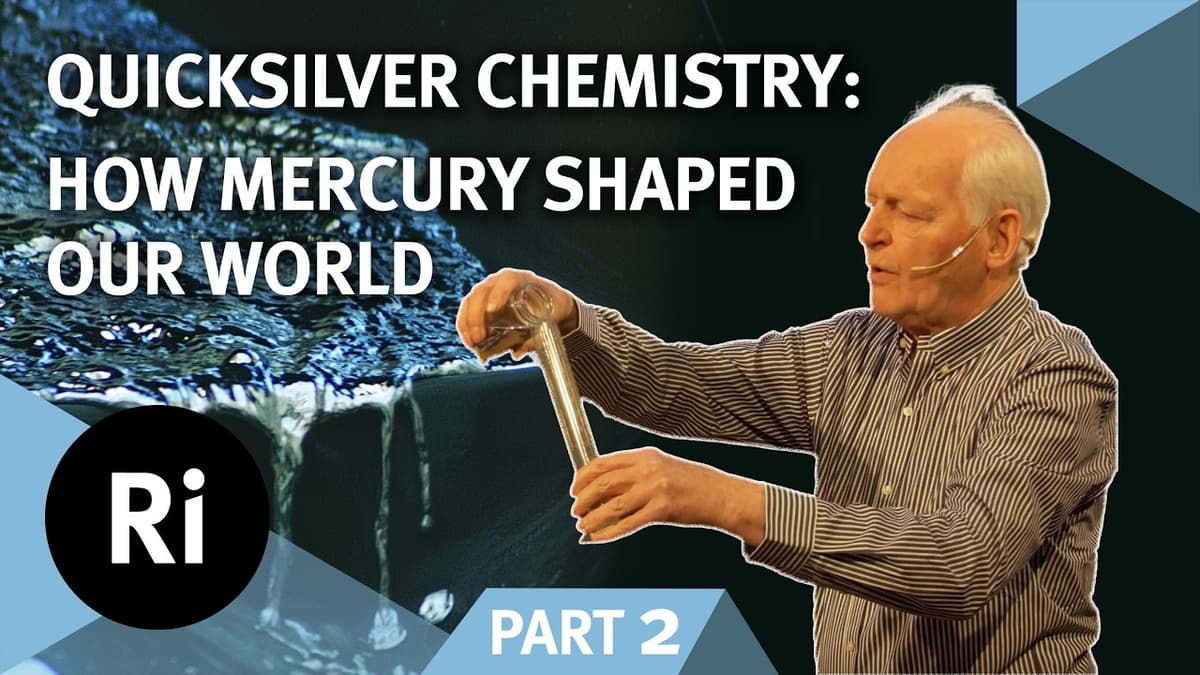
Quicksilver, Alchemy & Faraday's Motor – Part 2 with Andrew Szydlo
The video demonstrates a classic chemistry demonstration where elemental mercury is dissolved in concentrated nitric acid, generating nitrogen dioxide gas. The brown fumes are captured and neutralized with dilute ammonia, yielding white ammonium nitrate smoke, while the reaction’s by‑product, mercury...