Software Architecture Monday (Mark Richards) - Latest News and Information
  • All Technology
  • AI
  • Autonomy
  • B2B Growth
  • Big Data
  • BioTech
  • ClimateTech
  • Consumer Tech
  • Cybersecurity
  • DevOps
  • Digital Marketing
  • Ecommerce
  • EdTech
  • Enterprise
  • FinTech
  • GovTech
  • Hardware
  • HealthTech
  • HRTech
  • LegalTech
  • Nanotech
  • PropTech
  • Quantum
  • Robotics
  • SaaS
  • SpaceTech
AllNewsDealsSocialBlogsVideosPodcastsDigests

Technology Pulse

EMAIL DIGESTS

Daily

Every morning

Weekly

Tuesday recap

Top Publishers

  • The Verge AI

    The Verge AI

    21 followers

  • TechCrunch AI

    TechCrunch AI

    19 followers

  • Crunchbase News AI

    Crunchbase News AI

    15 followers

  • TechRadar

    TechRadar

    15 followers

  • Hacker News

    Hacker News

    13 followers

See More →

Top Creators

  • Ryan Allis

    Ryan Allis

    194 followers

  • Elon Musk

    Elon Musk

    78 followers

  • Sam Altman

    Sam Altman

    68 followers

  • Mark Cuban

    Mark Cuban

    56 followers

  • Jack Dorsey

    Jack Dorsey

    39 followers

See More →

Top Companies

  • SaasRise

    SaasRise

    196 followers

  • Anthropic

    Anthropic

    39 followers

  • OpenAI

    OpenAI

    21 followers

  • Hugging Face

    Hugging Face

    15 followers

  • xAI

    xAI

    12 followers

See More →

Top Investors

  • Andreessen Horowitz

    Andreessen Horowitz

    16 followers

  • Y Combinator

    Y Combinator

    15 followers

  • Sequoia Capital

    Sequoia Capital

    12 followers

  • General Catalyst

    General Catalyst

    8 followers

  • A16Z Crypto

    A16Z Crypto

    5 followers

See More →
NewsDealsSocialBlogsVideosPodcasts
Software Architecture Monday (Mark Richards)

Software Architecture Monday (Mark Richards)

Creator
0 followers

Short lessons on architecture decisions/patterns

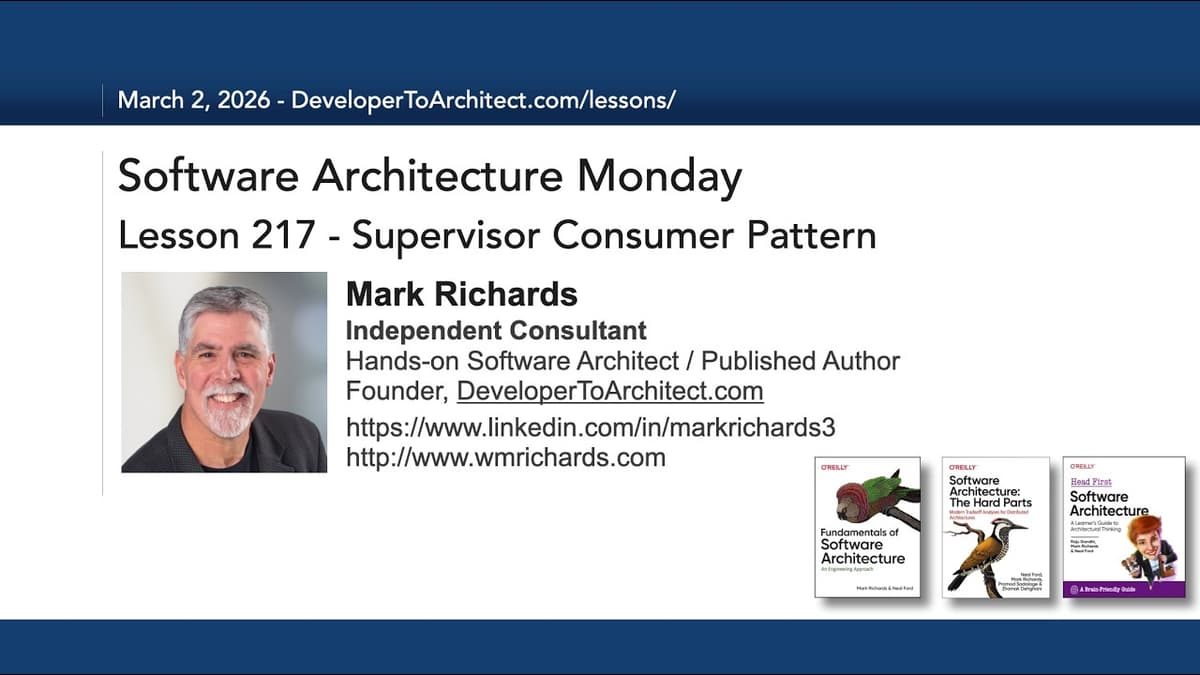
Lesson 217 - Supervisor Consumer Pattern
Video•Mar 1, 2026

Lesson 217 - Supervisor Consumer Pattern

The video introduces the Supervisor Consumer pattern, a scalability technique that lets a single service handle fluctuating loads by automatically spawning and retiring consumer threads. Mark Richards explains that a dedicated supervisor component continuously polls an event queue, assesses the queue depth, and determines the optimal number of consumer instances based on current service instances and predefined thresholds. The core algorithm divides pending messages by the number of service instances, caps the result at a maximum thread limit, and then either launches additional consumer threads or shuts excess ones down. Key parameters include idle consumer count, polling frequency (e.g., one second), and a hard ceiling on thread or memory usage. Pseudo‑code illustrates how the supervisor maintains a list of active consumers, computes required capacity, and iterates this logic until the service shuts down. Richards demonstrates the pattern with a customer‑service example where multiple downstream services request a customer name. By wrapping the message‑API calls in dynamically managed consumer threads, the service can process hundreds of requests in the same 300 ms latency as a single request. He notes that this approach avoids the overhead of launching new service instances, delivering near‑instant elasticity. While the pattern offers programmatic scalability, consistent latency, and efficient resource utilization, it also introduces complexity, risk of thread saturation, and potential out‑of‑memory scenarios. Practitioners must enforce strict thresholds and monitor system health to reap the benefits without compromising stability.

By Software Architecture Monday (Mark Richards)