UW CSE (Allen School) - Latest News and Information
Technology Pulse
EMAIL DIGESTS
Daily
Every morning
Weekly
Tuesday recap
EMAIL DIGESTS
Daily
Every morning
Weekly
Tuesday recap

In this Winter Robotics Colloquium, Marynel Vázquez from Yale University argues that the next wave of generalist robots must combine physical dexterity with social intelligence. Using the household robot Rosie as a touchstone, she illustrates how today’s manipulation‑focused systems are evolving toward agents that can interpret language, gestures, and contextual cues in real‑world settings such as homes, factories, and elder‑care facilities. Vázquez proposes a concrete definition of "social context" as the set of attributes of agents, environments, and their inter‑relationships that shape interaction outcomes. She highlights the massive combinatorial space of these factors, noting that unlike autonomous vehicles, human‑robot interaction lacks a clear rulebook, making long‑tail, rare events a central challenge. Large language models, she suggests, offer a pathway to endow robots with the nuanced understanding required for these open‑ended scenarios. The talk’s most vivid evidence comes from a series of lab experiments on robot abuse and social influence. When a robot displayed vulnerability—either by expressing emotion or briefly shutting down—participants were more likely to intervene against a mistreating confederate. In a collaborative task with multiple robots, the group’s collective sadness prompted even stronger human intervention, demonstrating that robots can leverage group dynamics to shape behavior. Vázquez concludes that designing truly generalist robots demands interdisciplinary work spanning robotics, psychology, and AI. As robots become embedded in everyday social spaces, engineers must embed contextual awareness and ethical reasoning, lest they deploy systems that fail in the very human environments they are meant to serve.

The colloquium centered on a fundamental question: why classical computers cannot efficiently describe quantum many‑body systems. Chin‑Mai highlighted the recent breakthrough on the No‑Low‑Energy‑Trivial‑States (NLTS) conjecture, which shows that even approximate low‑energy ground states of certain local Hamiltonians resist...

Anchel Shaw, a computing‑education researcher at UC San Diego, presented a colloquium on aligning university programming instruction with the realities of modern software development. He highlighted the persistent academia‑industry gap, where students learn green‑field coding and are graded solely on...

In his March 9, 2026 colloquium, Stanford PhD candidate Hong‑Xing (Koven) Yu introduced physics‑grounded world models that fuse deterministic physics engines with generative AI. The hybrid framework can reconstruct full 3‑D environments from a single image and simulate how those...

The colloquium introduced test‑time training, a paradigm where models continue to learn while being deployed. Yan, a post‑doctoral researcher at Stanford and Nvidia, traced the idea back to his 2019 PhD work and explained how it mirrors the "take‑home test"...

In this colloquium, Marynel Vázquez of Yale University argues that the next wave of generalist robots must combine sophisticated manipulation abilities with genuine social intelligence. Using the household robot "Rosie" as a running example, she illustrates how future robots will...
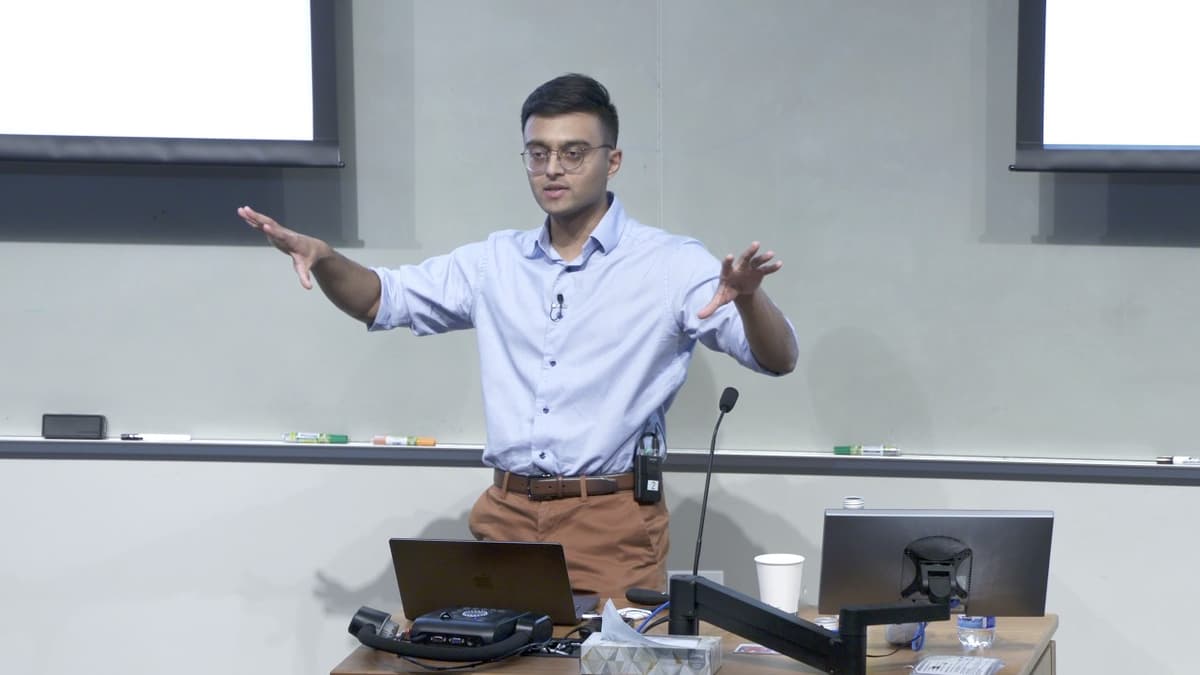
Rohan, a Stanford PhD and NVIDIA researcher, outlined his work on making high-performance accelerated and distributed computing systems easier to program as hardware grows more heterogeneous and complex. He described a full‑stack approach: high‑level composable distributed libraries that present familiar...
Aaron Borger, co‑founder and CEO of Orbital Robotics, presented the company’s vision for AI‑controlled robotic arms that can capture, refuel, repair, or de‑orbit spacecraft in orbit. The firm aims to provide space‑grade hardware and integrated software to any satellite...


