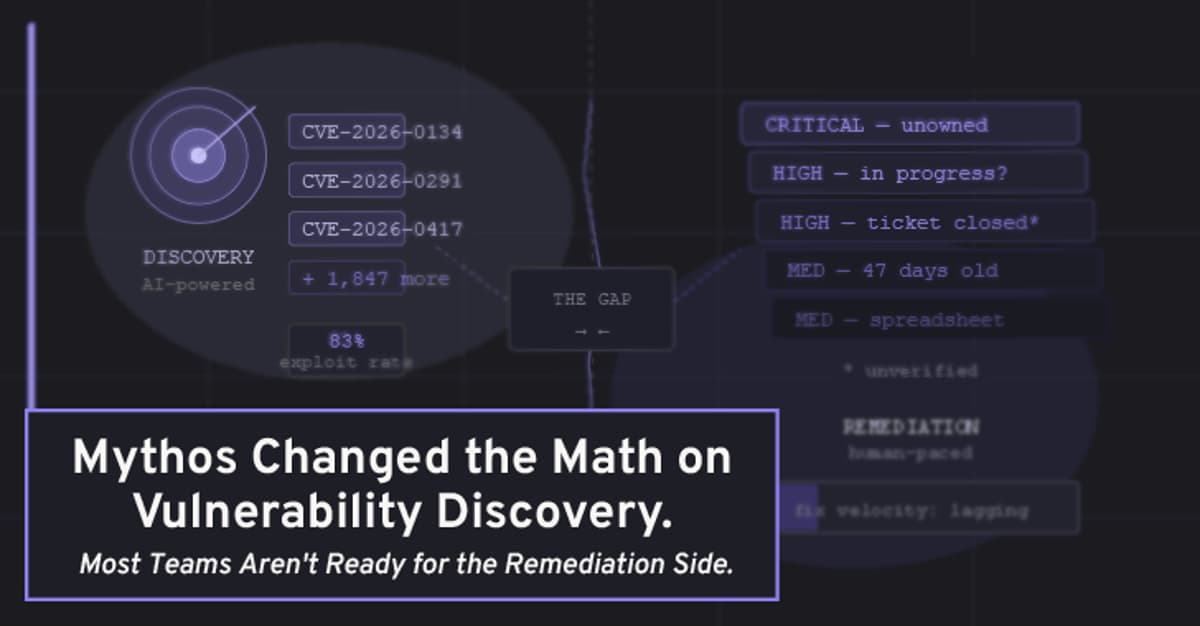
Mythos Changed the Math on Vulnerability Discovery. Most Teams Aren't Ready for the Remediation Side
Companies Mentioned

Why It Matters
Without robust remediation workflows, faster AI‑driven discovery merely inflates a backlog of critical vulnerabilities, increasing exposure for enterprises and especially for resource‑constrained firms. Closing the detection‑to‑remediation loop is essential to turn AI insights into real security improvements.
Key Takeaways
- •Mythos can generate vulnerabilities ten times faster than human pentests
- •Most teams lack centralized systems to ingest AI‑generated findings
- •Risk‑based prioritization beats raw CVSS scores for triage efficiency
- •Closed‑loop remediation tracking prevents undocumented, lingering vulnerabilities
- •SMEs face greater remediation challenges despite potential AI access
Pulse Analysis
The debut of Anthropic’s Claude Mythos has sparked a security‑industry buzz, positioning AI as a game‑changer for vulnerability discovery. By scanning codebases continuously, Mythos can surface high‑severity flaws at a scale no human red team can match, raising the prospect of near‑real‑time exposure awareness. Yet the technology’s promise hinges on an often‑overlooked factor: the organization’s ability to process, prioritize, and remediate those findings before they become exploitable.
In practice, the bottleneck lies in the remediation pipeline. Companies still rely on spreadsheets, ad‑hoc tickets, or static PDF reports to track vulnerabilities, leading to ambiguous ownership and missed fixes. The article stresses three pillars for a resilient workflow: a purpose‑built, queryable findings repository; contextual risk scoring that weighs asset criticality and exposure; and a closed‑loop system that verifies patches through continuous re‑testing. Platforms like PlexTrac embody this approach, turning raw AI output into actionable, trackable remediation tasks and preventing the backlog from ballooning.
The stakes differ across the market. Large enterprises with deep security teams can absorb higher discovery velocity, while SMEs and niche operators often lack the staff or tools to act on a flood of AI‑generated alerts. For them, the priority should be auditing current remediation metrics—time to fix, open high‑severity count, and verification practices—rather than waiting for broader Mythos access. Strengthening the remediation infrastructure now ensures that when AI discovery scales, organizations can translate insights into tangible risk reduction rather than accumulating invisible liabilities.
Mythos Changed the Math on Vulnerability Discovery. Most Teams Aren't Ready for the Remediation Side
Comments
Want to join the conversation?
Loading comments...