AI Solves the SKU Problem That Stalled Warehouse Automation
Companies Mentioned
Why It Matters
The breakthrough removes the SKU‑complexity barrier that has limited lights‑out warehouses, unlocking higher throughput and faster ROI for logistics providers. It signals a shift toward AI‑centric automation that can adapt to ever‑changing product assortments at scale.
Key Takeaways
- •Sereact robot picks 1,500 orders nightly without item-specific training
- •Payback achieved in nine months, driven by Swiss labor costs
- •Handles 60,000 SKUs, reducing manual picks at eight of nine ports
- •Model learns from real picks, achieving 1 in 53,000 human interventions
- •Amazon invests €10 bn (~$10.8 bn) in AI‑driven European fulfillment
Pulse Analysis
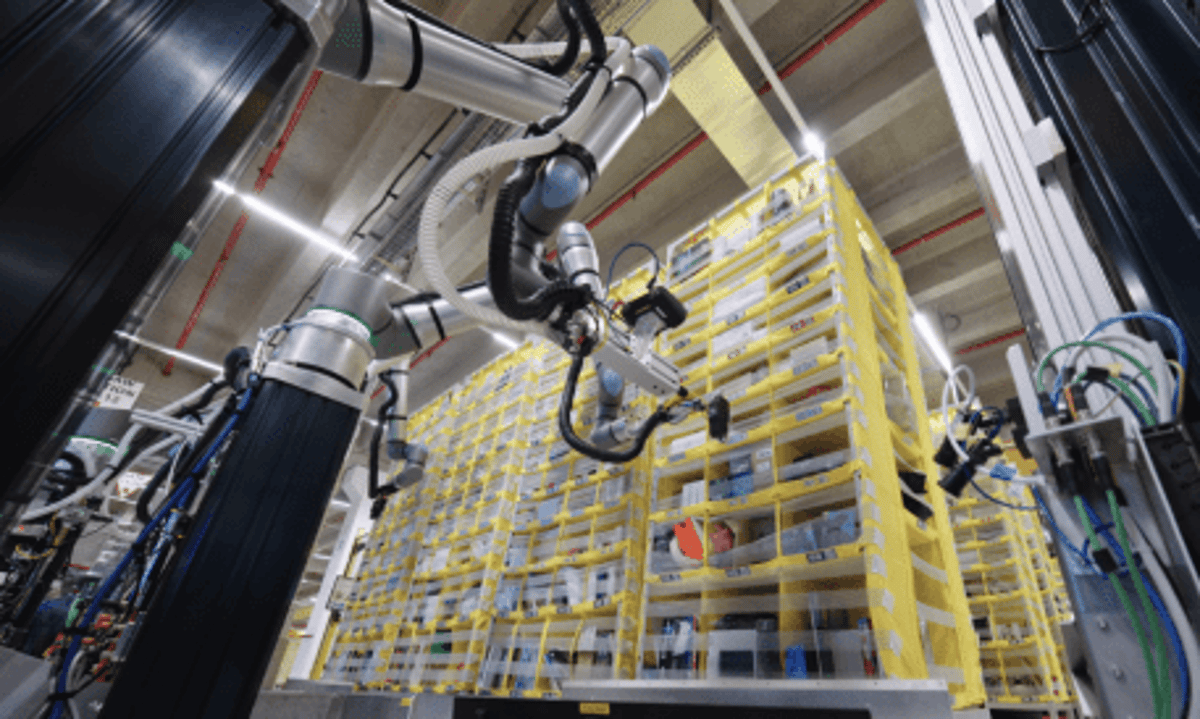
The SKU explosion in eCommerce has long been the Achilles’ heel of warehouse robotics. Traditional pickers rely on pre‑programmed grip instructions and image libraries, forcing operators to pause automation whenever a new product or packaging change appears. Sereact’s zero‑shot AI sidesteps this bottleneck by analyzing shape, material and color in real time, selecting the optimal grip on the fly. This capability not only accelerates deployment but also future‑proofs the system against the relentless churn of online catalogs.
At MS Direct’s Arbon hub, the AI robot has transformed a dormant night shift into a productive line, handling roughly 1,500 single‑item orders per night across a 60,000‑SKU inventory. The rapid payback—nine months—highlights the economic pressure of Swiss labor costs and demonstrates how AI can turn existing AutoStore infrastructure into a 24/7 asset without expanding headcount. Industry peers, from Sonepar to Amazon, are watching closely; Amazon’s €10 bn (~$10.8 bn) European expansion underscores the strategic importance of AI‑enabled picking in its fulfillment roadmap.
Beyond the immediate efficiency gains, Sereact’s approach to continuous learning—capturing every pick, failure and recovery to refine its model—sets a new standard for robotic adaptability. With over a billion real‑world picks logged across more than 200 installations, the data moat is substantial. As the company rolls out its Cortex model and opens a U.S. office, the technology is poised to accelerate the shift toward fully autonomous, lights‑out warehouses, reshaping the economics of last‑mile delivery and inventory management worldwide.
AI Solves the SKU Problem That Stalled Warehouse Automation
Comments
Want to join the conversation?
Loading comments...