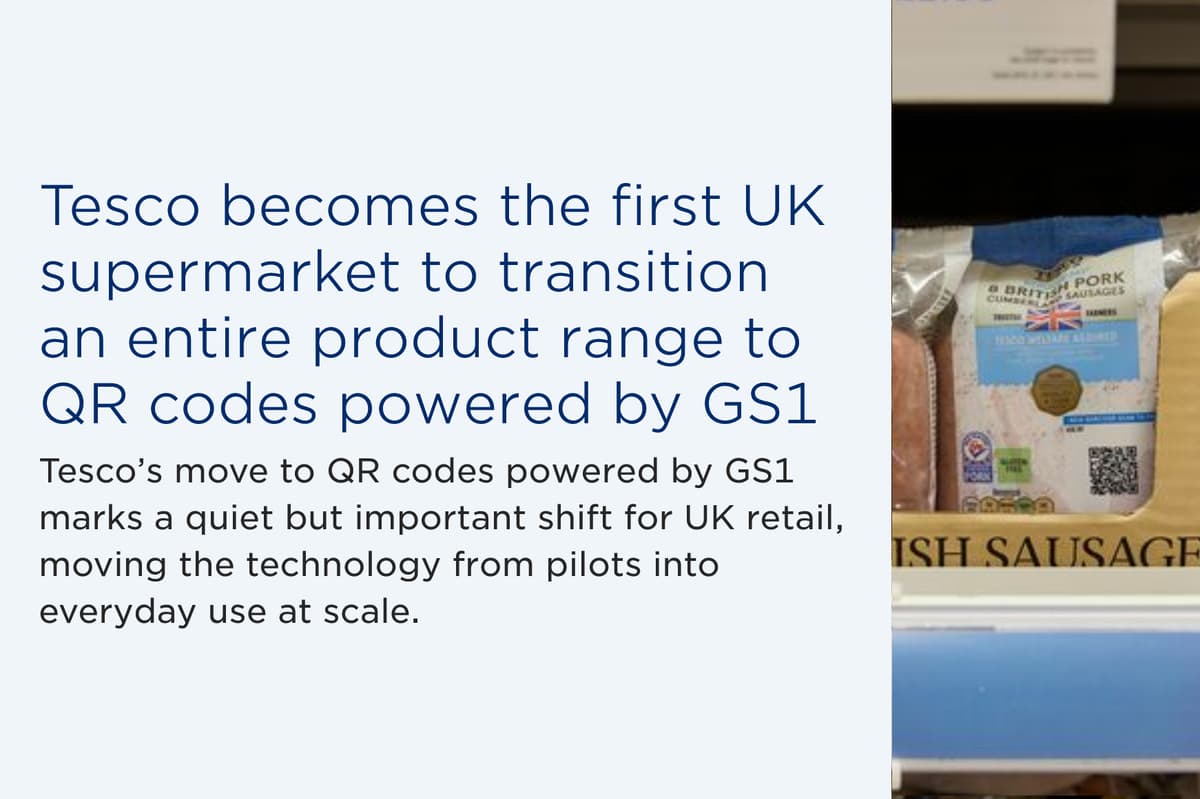
What Tesco’s Transition to QR Codes Powered by GS1 Means for You
Companies Mentioned
Why It Matters
QR‑enabled product data gives retailers granular visibility that cuts waste, streamlines recalls, and meets emerging regulatory demands such as the EU Digital Product Passport. The rollout sets a practical precedent that other retailers and marketplace sellers are likely to follow.
Key Takeaways
- •Tesco launches QR codes on core sausage range.
- •QR codes link to GS1 GTINs for real‑time product data.
- •Enhanced batch tracking reduces waste and improves recall precision.
- •Retailers gain richer data for inventory and sustainability reporting.
- •Amazon and EU Digital Product Passport accelerate QR code adoption.
Pulse Analysis
The adoption of QR codes powered by GS1 represents a natural evolution from static linear barcodes to dynamic data carriers. Unlike traditional UPCs, QR symbols can store a URL that points to a cloud‑based product profile, allowing manufacturers and retailers to update information such as expiration dates, sourcing details, or sustainability certifications without reprinting labels. Tesco’s pilot‑to‑production shift demonstrates that the technology can be integrated into existing point‑of‑sale systems while delivering the richer data sets demanded by modern supply‑chain analytics.
Operationally, the new QR labels give Tesco and its partners unprecedented batch‑level visibility. Real‑time access to production dates and lot numbers enables more accurate stock rotation, reducing the likelihood of out‑of‑date items reaching shelves and cutting food waste. In recall scenarios, the ability to pinpoint affected batches rather than whole product lines minimizes disruption, protects brand reputation, and safeguards consumer health. These efficiencies translate into measurable cost savings and support compliance with emerging regulations that require detailed traceability.
The ripple effect extends beyond Tesco. At recent industry gatherings such as Interpack, major players like Amazon highlighted the synergy between QR‑based labeling and the EU’s Digital Product Passport, a regulatory framework that will soon mandate standardized digital product information. As marketplace platforms and regulators converge on QR‑enabled data standards, retailers that adopt early gain a competitive edge in supply‑chain intelligence and customer transparency. The Tesco rollout thus serves as both a proof point and a catalyst for a broader shift toward data‑rich, QR‑driven product ecosystems.
What Tesco’s transition to QR codes powered by GS1 means for you
Comments
Want to join the conversation?
Loading comments...