Energy News and Headlines
  • All Technology
  • AI
  • Autonomy
  • B2B Growth
  • Big Data
  • BioTech
  • ClimateTech
  • Consumer Tech
  • Crypto
  • Cybersecurity
  • DevOps
  • Digital Marketing
  • Ecommerce
  • EdTech
  • Enterprise
  • FinTech
  • GovTech
  • Hardware
  • HealthTech
  • HRTech
  • LegalTech
  • Nanotech
  • PropTech
  • Quantum
  • Robotics
  • SaaS
  • SpaceTech
AllNewsDealsSocialBlogsVideosPodcastsDigests

Energy Pulse

EMAIL DIGESTS

Daily

Every morning

Weekly

Sunday recap

NewsDealsSocialBlogsVideosPodcasts
EnergyNewsBaltic BESS and TES: Estonia’s 1.1GWh District Heating Accumulator, Nidec PCS-Transformer Deal in Lithuania
Baltic BESS and TES: Estonia’s 1.1GWh District Heating Accumulator, Nidec PCS-Transformer Deal in Lithuania
Energy

Baltic BESS and TES: Estonia’s 1.1GWh District Heating Accumulator, Nidec PCS-Transformer Deal in Lithuania

•February 12, 2026
0
Energy Storage News
Energy Storage News•Feb 12, 2026

Companies Mentioned

Rolls‑Royce

Rolls‑Royce

Why It Matters

Thermal and battery storage increase renewable integration and energy security across the Baltic region, supporting EU decarbonisation goals and grid synchronization.

Key Takeaways

  • •Estonia launches 1.1 GWh thermal storage for district heating.
  • •Project cost €8 million, €675k EU co‑funding.
  • •Lithuania's Ignitis to deploy 291 MW/582 MWh BESS by 2027.
  • •Nidec Conversion supplies PCS and transformer for all three sites.
  • •EU aid caps support at €100k per MWh for storage.

Pulse Analysis

The inauguration of Utilitas’ Väo thermal storage marks a milestone for the Baltic energy transition. With an 80 MW output and 1,100 MWh capacity, the facility can hold 20,000 cubic metres of hot water, buffering heat from two CHP plants and solar PV installations. By shifting excess heat to periods of peak demand, the accumulator improves the reliability of Tallinn’s district‑heating network while cutting fuel consumption. Co‑financed by the EU’s NextGenerationEU programme and Estonia’s Environmental Investment Centre, the €8 million project demonstrates how modest public support can unlock large‑scale decarbonisation of heating.

Lithuania is moving in parallel with a €130 million battery‑energy‑storage portfolio slated for 2027. Ignitis Group’s three sites—Kelmė, Mažeikiai and Kruonis—total 291 MW/582 MWh and will be equipped with Rolls‑Royce’s mte EnergyPack modules. Nidec Conversion adds a compact power‑conversion system, transformer and MV switchgear, streamlining integration and reducing footprint. The initiative benefits from EU state‑aid rules that cover up to 30 % of eligible costs, capped at €100 000 per MWh, reinforcing the region’s push toward renewable‑linked storage and grid flexibility.

Together, the thermal and battery projects illustrate the Baltic states’ strategy to detach from the BRELL network and align with the Continental European grid. Large‑scale storage provides the ancillary services needed for high renewable penetration, stabilising both electricity and heat sectors. As the EU tightens emissions targets, investors see storage as a cost‑effective bridge to carbon‑neutral supply, while policymakers gain a tool for energy security. Continued financing, cross‑border cooperation, and technology partners such as Rolls‑Royce and Nidec are likely to accelerate similar deployments across northern Europe.

Baltic BESS and TES: Estonia’s 1.1GWh district heating accumulator, Nidec PCS-transformer deal in Lithuania

By Andy Colthorpe · February 12 2026

Inauguration of the 80 MW/1,100 MWh TES plant in Tallinn, Estonia. Image: Utilitas.

A 582 MWh battery storage project and a gigawatt‑hour‑scale thermal energy storage (TES) system are the latest big developments in the emerging Baltic region, north‑eastern Europe.

The Baltic States of Estonia, Lithuania and Latvia uncoupled their electricity grids from the BRELL network formerly shared with Russia and Belarus last year. Energy storage has been seen as a key strategic enabler for synchronisation and harmonisation with Europe’s transmission network, along with goals such as increasing the adoption of renewable energy.

Utilitas brings online 1,100 MWh TES system for district heating network

So far, much of the excitement has been justifiably focused on opportunities for battery energy storage systems (BESS), with ancillary services prices in the Baltics currently “through the roof,” according to some commentators.

In Estonia earlier this month, however, the Baltic region’s largest thermal energy storage (TES) system was inaugurated by renewable‑energy producer and district‑heating and cooling network provider Utilitas.

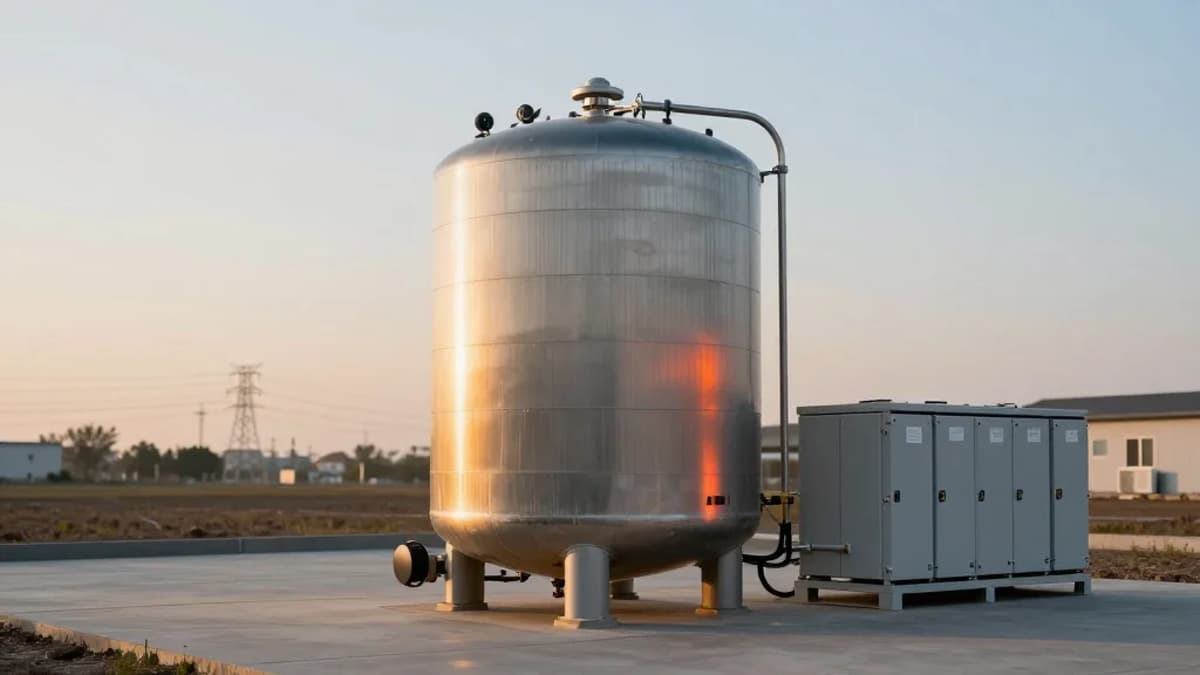
Väo thermal storage facility is a large‑scale heat accumulator, built at an energy complex in the Estonian capital Tallinn. The second of four such facilities planned for construction by the heating utility in Estonia this year, the TES facility has been built with 80 MW output and 1,100 MWh energy storage capacity.

“The established thermal storage unit allows heat to be stored and used when heat consumption is high, thereby helping to strengthen the reliability of the district heating network,” said Mayor of Tallinn Peeter Raudsepp.

“Greater flexibility and a more stable district heating network are in the interests of every resident of Tallinn.”

It stores 20,000 cubic metres of water in tanks 42 metres high and 26 metres in diameter and was built for Utilitas by industrial services company Bilfinger’s subsidiary Granitor Rodoverken. Power to ‘charge’ the 1.1 GWh system with heat comes from two high‑efficiency combined heat and power (CHP) plants and two solar PV plants at the Väoenergy complex.

Utilitas CEO Priit Koit said the storage facility enables better response to variability in energy consumption, increases production efficiency and enhances the security of energy supply.

Co‑financed by Estonia’s Environmental Investment Centre and supported with €675,000 (US$801,300) through the European Union (EU) NextGenerationEU economic recovery mechanism, the project’s total cost was around €8 million.

“Investments must be continued, and the thermal storage facility that has been built is an example of how investments made in the interests of consumers and to increase security of supply are also economically expedient,” said Tallinn mayor Raudsepp.

The scope and scale of the heat storage facility are similar to other projects invested in elsewhere in northern Europe, perhaps most notably large‑scale TES plants for district heating purposes built in Finland using a ‘Sand Battery’ technology from startup Polar Night Energy.

Market experts and trade associations, including Energy Storage Europe, have tipped thermal energy storage as a technology to watch closely, given its strong role in decarbonising heating, particularly in industry, alongside parts of northern Europe with residential district heating networks.

Nidec Conversion partners Rolls‑Royce on state‑owned Lithuania BESS portfolio

The Utilitas project’s inauguration comes shortly after the official opening of Estonia’s largest BESS plant, Hertz 1, through joint‑venture developer Baltic Storage Platform (BSP) earlier in the month.

All three Baltic States are seeing a rise in BESS investment. In Lithuania, state‑owned energy holding company Ignitis Group is building a three‑site portfolio of battery storage systems totalling 291 MW/582 MWh. The company took a final investment decision (FID) on the trio in July last year, revealing that the portfolio, scheduled to start commercial operations in 2027, would require a total investment of around €130 million.

That includes funding via EU state aid, with the Ministry of Energy of Lithuania aiming to enable the deployment of 1.5 GW/3.2 GWh of energy storage through capex funding support capped at 30 % of eligible costs and a maximum funding per megawatt‑hour of €100,000.

Ignitis Group has already ordered BESS equipment for the projects from the system‑integrator arm of Rolls‑Royce. Rolls‑Royce Power Systems will supply its mte EnergyPack BESS solution for the projects: two close to wind power plants in north‑west Lithuanian cities (Kelmė, 147 MW/294 MWh and Mažeikiai, 45 MW/90 MWh) and one in central Lithuania close to a pumped‑hydro energy storage plant (Kruonis, 99 MW/198 MWh).

Yesterday, power‑electronics, energy‑storage‑system (ESS) and engineering firm Nidec Conversion said it is partnering with Rolls‑Royce and providing a combined power‑conversion system (PCS), transformer and medium‑voltage (MV) switchgear solution for the three sites.

Nidec Conversion’s Power Unit is, the company claims, a compact, high‑power‑density, low‑noise, integrated skid‑mounted solution.

Read Original Article
0

Comments

Want to join the conversation?

Loading comments...