Energy News and Headlines
  • All Technology
  • AI
  • Autonomy
  • B2B Growth
  • Big Data
  • BioTech
  • ClimateTech
  • Consumer Tech
  • Crypto
  • Cybersecurity
  • DevOps
  • Digital Marketing
  • Ecommerce
  • EdTech
  • Enterprise
  • FinTech
  • GovTech
  • Hardware
  • HealthTech
  • HRTech
  • LegalTech
  • Nanotech
  • PropTech
  • Quantum
  • Robotics
  • SaaS
  • SpaceTech
AllNewsDealsSocialBlogsVideosPodcastsDigests

Energy Pulse

EMAIL DIGESTS

Daily

Every morning

Weekly

Sunday recap

NewsDealsSocialBlogsVideosPodcasts
EnergyNewsReal-World RV Towing With The Silverado EV
Real-World RV Towing With The Silverado EV
Energy

Real-World RV Towing With The Silverado EV

•February 9, 2026
0
CleanTechnica
CleanTechnica•Feb 9, 2026

Companies Mentioned

Tesla

Tesla

Google

Google

GOOG

Maverik

Maverik

Why It Matters

The test proves that full‑size electric pickups can safely tow mid‑size RVs, expanding the use‑case for EVs beyond daily commuting and signaling broader market adoption. It also highlights the importance of accurate range planning and charging infrastructure for electric towing scenarios.

Key Takeaways

  • •Silverado EV tows 5,680‑lb trailer safely
  • •0.9 mi/kWh consumption over 130‑mile trip
  • •Range drops to 23 % after 130 miles towing
  • •Charging stops 15‑20 min suffice for long trips
  • •Truck maintains rail‑like stability even on steep grades

Pulse Analysis

Electric pickups are finally being put to the test in real‑world towing scenarios, and Chevrolet’s Silverado EV is leading the charge. By meticulously measuring hitch drop, tongue weight, and axle loads on a CAT scale, the author ensured the rig stayed within the vehicle’s Gross Vehicle Weight rating. This level of preparation mirrors best practices for diesel trucks, but adds an EV twist: the low‑center‑of‑gravity battery pack improves traction and reduces front‑end squat, eliminating the need for a weight‑distribution hitch on loads under 7,000 lb. The result is a stable platform that feels as steady as a rail car, even on steep New Mexico grades.

During the 130‑mile highway run, the Silverado’s 650 hp electric motor and 750 lb‑ft of torque delivered seamless acceleration and regenerative braking without the gear‑shifting concerns of internal‑combustion engines. The vehicle logged a consumption of roughly 0.9 mi/kWh, depleting the 170 kWh pack to 23 % and confirming the accuracy of A Better Routeplanner’s predictions. By planning 15‑20 minute top‑up stops at 800‑volt chargers, the driver could maintain a comfortable cruising speed while the family stretched their legs, effectively turning charging time into a rest break.

These findings have broader implications for the emerging electric RV market. As more manufacturers roll out high‑capacity battery packs and fast‑charging networks expand, the range penalty associated with towing will shrink, making electric travel trailers a viable alternative to gasoline‑powered rigs. Coupled with auxiliary solar and battery systems on the trailer itself, owners can achieve near‑zero‑fuel camp stays. The Silverado EV’s performance demonstrates that electric trucks are ready for family adventures, provided planners account for realistic range and charging cadence, paving the way for wider consumer confidence in electric towing solutions.

Real-World RV Towing With The Silverado EV

If you’ve never towed a medium or large travel trailer, it might sound like it’s an easy task. I mean, you can just hook the trailer onto the back of a capable pickup truck and drive off, right?

Sadly, it’s never that simple, even for a diesel truck. On top of the normal rigors of making sure everything is safe, EV towing requires a little more homework. In this article, I’m going to cover what I did to make sure we’ll have a safe and reliable towing experience as we get back to visiting national parks and proving that EVs have what it takes.

Checking Squat & Heading To The CAT Scale

While you can’t just hook up and drive off on a long adventure, hooking the trailer up is the first step. Even heavier‑duty trucks like the Silverado EV (it’s basically a 3/4‑ton truck hauling a bunch of batteries), there’s going to be a certain amount of “squat” that happens when you put the trailer onto the ball.

We don’t have the RST Silverado with the self‑leveling air suspension, so we had to measure that to make sure we got the correct hitch drop to keep the trailer level and happy going down the road. It turned out to be a pretty standard 2‑inch drop we needed, so we ran down to Tractor Supply Co (a surprisingly good place to get trailer stuff) and picked up a hitch rated for 8,000 lb with the correct drop.

The great news: we didn’t get that much squat. Even without a weight‑distribution hitch, the truck’s front wheel wells only sit about a half inch higher above the tires than the rear. The Silverado’s manual says that for weights under 7,000 lb, WDH is optional. This is great for EV towing because unhooking and re‑hooking at charging stops is a LOT easier without having to hook those bars back up.

Once we were confident in hitch setup, we took the truck and the trailer to the CAT scales that truckers rely on to stay out of legal trouble on the highway. Our nearest scale is only a short distance away at a TA truck stop.

Image 1: CAT Scale ticket with ticket number 1070226035181, date 2‑04‑26, Scale 702, Travel Center of America, I‑10 Exit 139, Las Cruces NM, Steer Axle 4400 lb, Drive Axle 5320 lb, Trailer Axle 5000 lb, Gross Weight 14720 lb

After taking two weights (one with the fully‑loaded trailer and one with the truck loaded with family), we determined that the trailer’s weight is about 5,680 lb with 680 lb of tongue weight. Some weight had been lifted from the truck’s front wheels, but not enough to matter. The truck’s heavy, low‑slung battery pack kept good traction on all wheels, and once I put some tools in the e‑Trunk (Chevy’s preferred term for a frunk), things should be about perfect.

We checked these numbers against the vehicle’s door sticker, and they’re all well within the safety limits. Gross vehicle weight (GVW), real axle weight, and trailer weight were all in great shape.

Real‑World Stability & Range Testing

With the safety numbers all checked out, it was time to see how the truck actually did on the highway. For an ICE truck, the important thing is that it’s stable and safe. But, when you’re towing with an EV, you also have to see what your efficiency numbers look like for trip planning to make sure you never get stranded.

To do this, we drove from Las Cruces to Deming, New Mexico, and back on I‑10. We forgot something at home and had to turn around right after climbing out of the Mesilla Valley, so we ended up towing up that steep grade twice, giving us a total of 130 miles with some extra terrain along the way. The temperature was about 40 °F (4 °C) and we set the cruise for 65 mph to get good numbers for A Better Routeplanner.

Stability was beyond excellent. Because our loaded truck is about 50 % heavier than the trailer and has a very low center of gravity, it rode like it was on rails. Passing semi‑trucks barely made it flinch, even with the stock tires.

The roughly 650 hp and 750 lb‑ft of torque made it feel like the trailer wasn’t there. Even the steep hill climbing out of Las Cruces was nothing for the Silverado EV. There was no need to worry about engine RPMs, damaging a transmission, or anything. The truck just steadily pulls the trailer up hills and holds a steady speed going down them with regenerative braking.

All in all, the experience was far, far better than towing with a half‑ton pickup truck or Suburban (what we usually tow with). You can basically just set the cruise and forget it.

The only aspect where the Silverado EV falls short of ICE trucks is range. Over 130 miles, we took our 170 kWh battery pack from 100 % down to 23 %, achieving 0.9 mi/kWh on the truck’s screen. Plugging this consumption figure into ABRP led to fairly accurate trip predictions compared to reality, so we’re now ready to plan longer trips confidently.

Image 2: Google Maps navigation plan showing a recommended route of 54 minutes and 56 miles to Maverik at 4625 E Pine St, with 56 % battery at the destination and 21 % battery at the current position, timestamp 12:47 AM, temperature 46 °F

An A Better Routeplanner (ABRP) trip plan that is slightly more pessimistic than what actually happened.

What These Real‑World Numbers Mean For Future Travels

We’ll probably get better range during the daytime, in warmer months, and with better‑inflated tires. Even with today’s numbers we’d be fine. With this trailer, the truck has:

  • About 153 miles of 100 %‑0 % range on the first leg leaving home

  • 135 miles leaving with 100 % and arriving somewhere with 10 %

  • About 90 miles added doing 10‑60 % rapid charges

  • About 105 miles added charging from 10‑80 %

At 65 mph, ideal charging spacing gives us the following cadence:

  1. Leave home and drive for two hours

  2. Charge for 15‑20 minutes at an 800‑volt station, or up to 30 minutes at most Tesla Superchargers

  3. Drive another hour and a half

  4. Rinse, repeat

  5. FREE fuel at RV parks that let us plug the truck in

Because we aren’t in the habit of wearing astronaut diapers on road trips, this is really not bad at all. Fifteen‑twenty minutes is enough time for the family to use the bathroom, stretch legs, and hit the road again fresh.

The Silverado EV would suck for OTR hot‑shot trucking, but it’s great for family RV trips and local hauling of all kinds.

Next Steps

Now that we know the truck is safe to tow, does an excellent job pulling the camper, and we know what range to expect, we’re ready to finish integrating the camper into the Silverado’s systems. The trailer already has 1,800 W of solar and 8.2 kWh of battery storage; I will be using automatic transfer switches and custom adapters to have the option of pulling power from the truck or from RV parks.

While I don’t have to deal with removing a weight‑distribution hitch to charge at non‑pull‑through stations, I am adding an electric jack to the trailer to make life easier, especially when unhooking to charge on hot, humid summer days.

Finally, I’m spending a lot of time in A Better Routeplanner cooking up some epic trips. My plan is for the truck to see most of North America over the next few years.

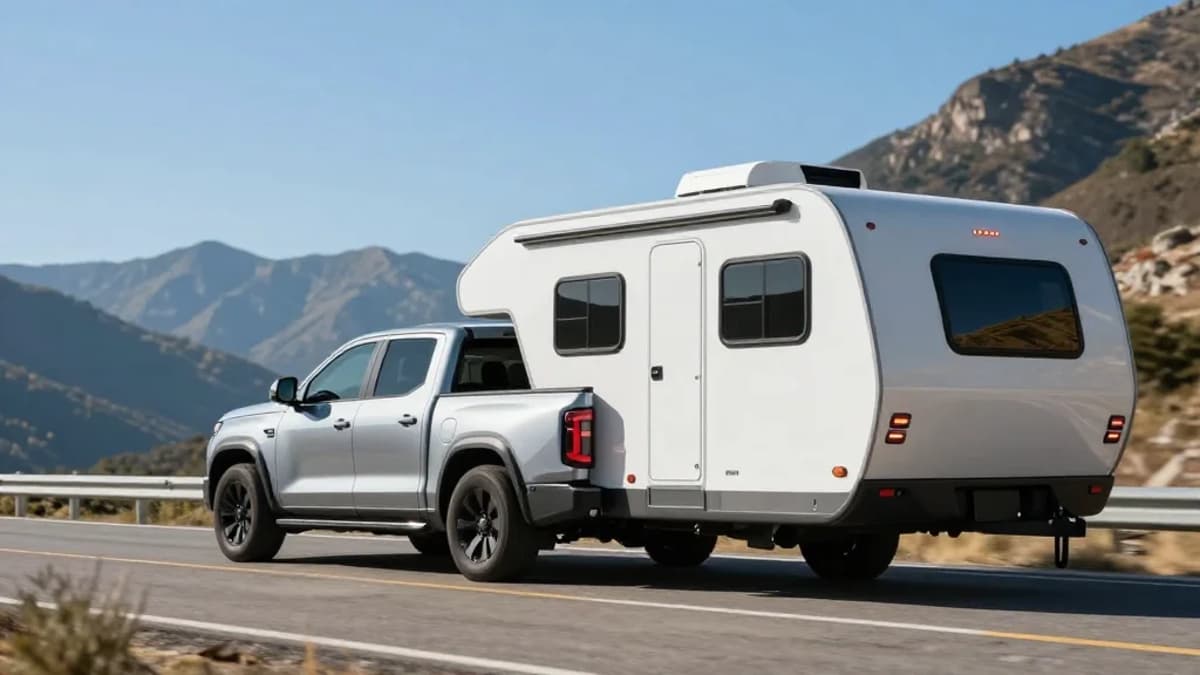
Featured image: My 2025 Silverado EV LT Extended Range at a truck stop with my all‑electric 24‑foot travel trailer attached. Image by Jennifer Sensiba.

Read Original Article
0

Comments

Want to join the conversation?

Loading comments...