OpenAI To 'Promote' Own Products Via Your Browser Cookies
Companies Mentioned

Why It Matters
By monetizing its massive user base through targeted ads, OpenAI opens a new revenue stream that could accelerate its path to profitability. However, the introduction of marketing cookies raises privacy and trust considerations that could affect user adoption and regulatory scrutiny.
Key Takeaways
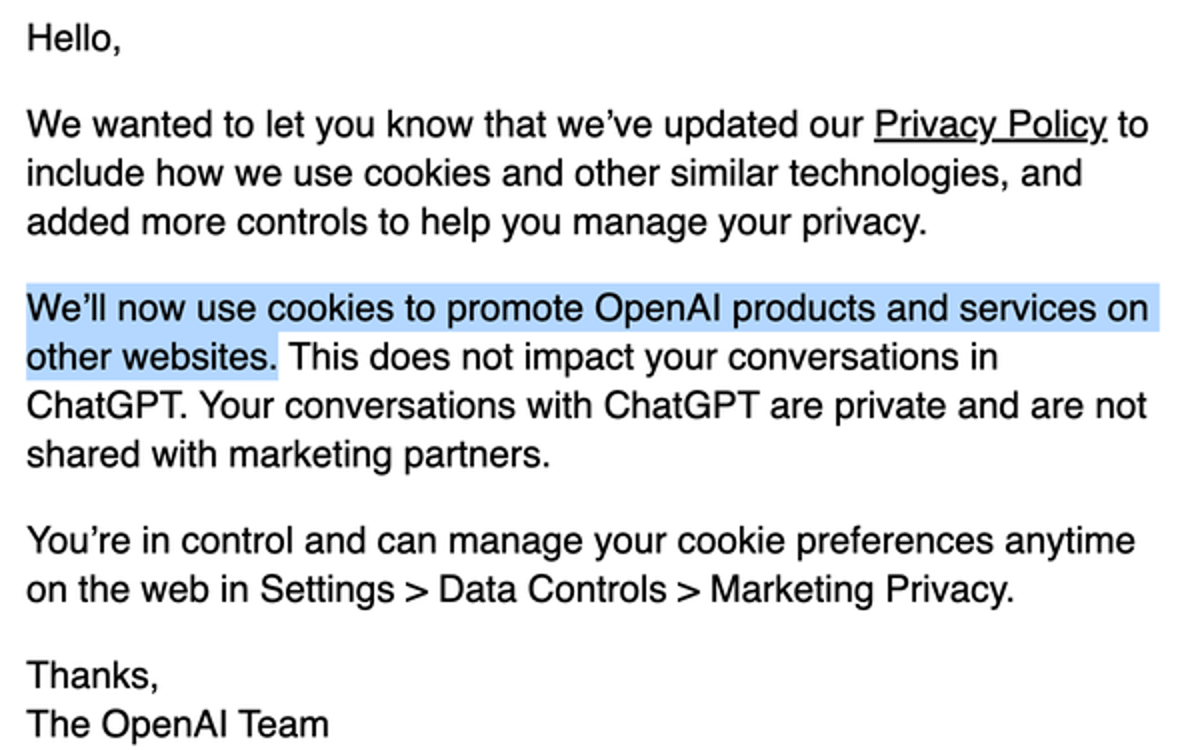
- •OpenAI will place marketing cookies on user devices
- •Ads will be personalized for free and Plus users
- •Users can opt out via account settings or footer link
- •Third‑party cookies and tracking pixels also deployed
- •ChatGPT conversation data remains private per policy
Pulse Analysis
OpenAI’s decision to embed marketing cookies into its web services represents a strategic pivot toward a more traditional advertising revenue model. After years of relying on venture funding and premium subscriptions, the company now aims to monetize its expansive user base by delivering personalized ads across the web. This approach mirrors tactics used by social media giants and could generate significant incremental revenue, especially as free‑tier usage continues to outpace paid subscriptions. By leveraging first‑party and third‑party cookies, OpenAI can track user behavior, measure ad effectiveness, and refine targeting algorithms, turning conversational AI interactions into a lucrative ad inventory.
The privacy implications of this shift are immediate and profound. While OpenAI assures that ChatGPT conversation content remains private, the broader collection of browsing data for ad personalization introduces new vectors for behavioral profiling. Regulators and privacy advocates are likely to scrutinize the policy, especially given the heightened sensitivity around AI‑driven data practices. OpenAI mitigates some concerns by offering granular opt‑out controls through account settings and a footer link, but the effectiveness of these tools will be tested as users become more aware of cross‑site tracking. Comparatively, the move aligns OpenAI with industry standards for ad tech, yet it also differentiates the company by integrating advertising directly into an AI conversational platform.
Competitively, the rollout could reshape the AI market’s economics. Rivals such as Anthropic, Google DeepMind, and Microsoft may feel pressure to adopt similar monetization tactics or double down on privacy‑first positioning. For advertisers, OpenAI’s user base offers a high‑engagement audience that is already accustomed to AI‑enhanced experiences, potentially driving higher conversion rates. However, any erosion of trust could prompt user churn toward privacy‑focused alternatives. As the ecosystem evolves, OpenAI’s ability to balance revenue generation with transparent data practices will be a key determinant of its long‑term brand equity and market dominance.
OpenAI To 'Promote' Own Products Via Your Browser Cookies
Comments
Want to join the conversation?
Loading comments...