SkatterBencher - Latest News and Information
Technology Pulse
EMAIL DIGESTS
Daily
Every morning
Weekly
Tuesday recap
EMAIL DIGESTS
Daily
Every morning
Weekly
Tuesday recap

The video provides an update on the author’s effort to overclock the Orange Pi RV2, an eight‑core RK3588‑derived board that Orange Pi sent after the creator’s earlier RK3588‑5 Max exploits. The presenter outlines the goal of producing a comprehensive scatter‑bench guide and admits the project has taken longer than expected. To achieve reliable overclocking, the author built a telemetry suite that reads frequencies, temperatures, voltages and governor states directly from Linux kernel subsystems, and a startup script that forces the CPU governor into performance mode (after a brief switch to powersave). Because the Spacemit P1 PMIC is managed by the kernel’s DVFS, a custom kernel module was written to expose an I²C interface, allowing runtime voltage tweaks via a Python driver and TUI. Key milestones include patching the KYX1 driver’s hard‑coded max‑frequency limit, which unlocked a 1.8 GHz operating point, though stability broke at SevenZip even at 1.25 V. Attempts to add a 2 GHz OP caused a kernel panic, and the PLL3 registers needed for higher clocks remain read‑only, limiting further gains. The work demonstrates that community‑driven tooling can push SBC performance beyond factory limits, but it also highlights the bottlenecks of incomplete vendor documentation and kernel‑level safeguards. Successful voltage and clock control could make the RV2 a more competitive platform for edge‑AI and hobbyist compute, encouraging other developers to contribute similar patches.
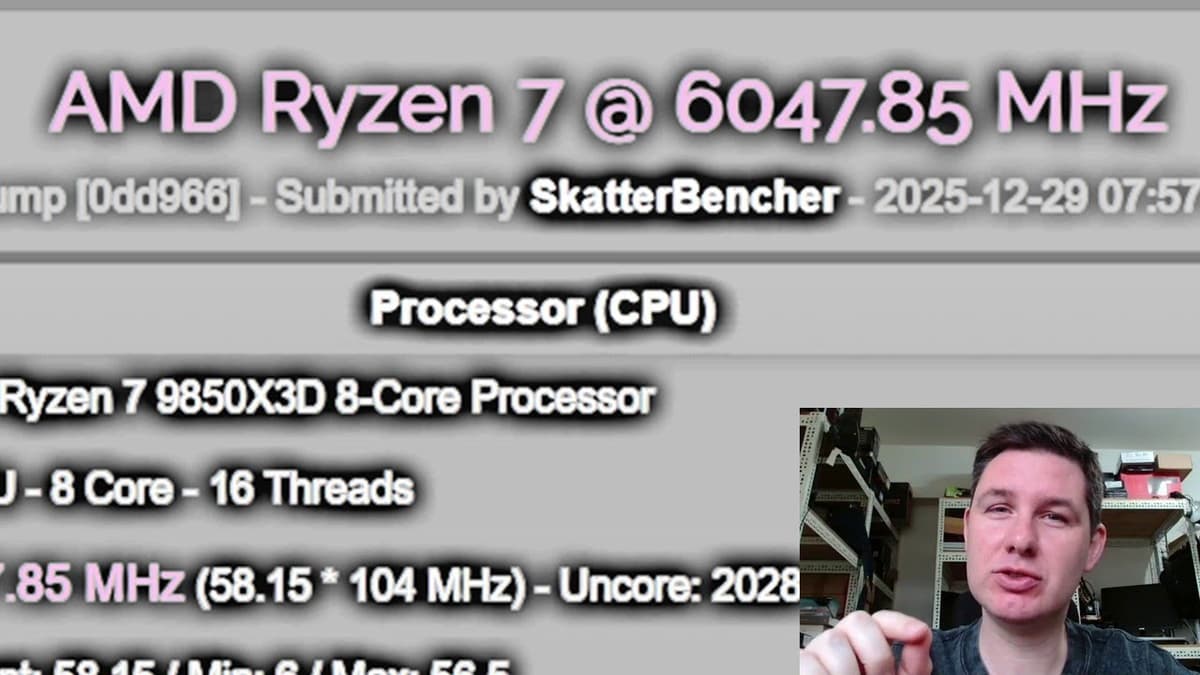
The video walks through how the creator pushed a Ryzen 7 9850X3D to a sustained 6 GHz using an AIO cooler and a series of BIOS and software tweaks. He starts from the OC Strategy 4 preset—enabling EXPO 1, switching to a synchronous E‑clock at 103 MHz...


