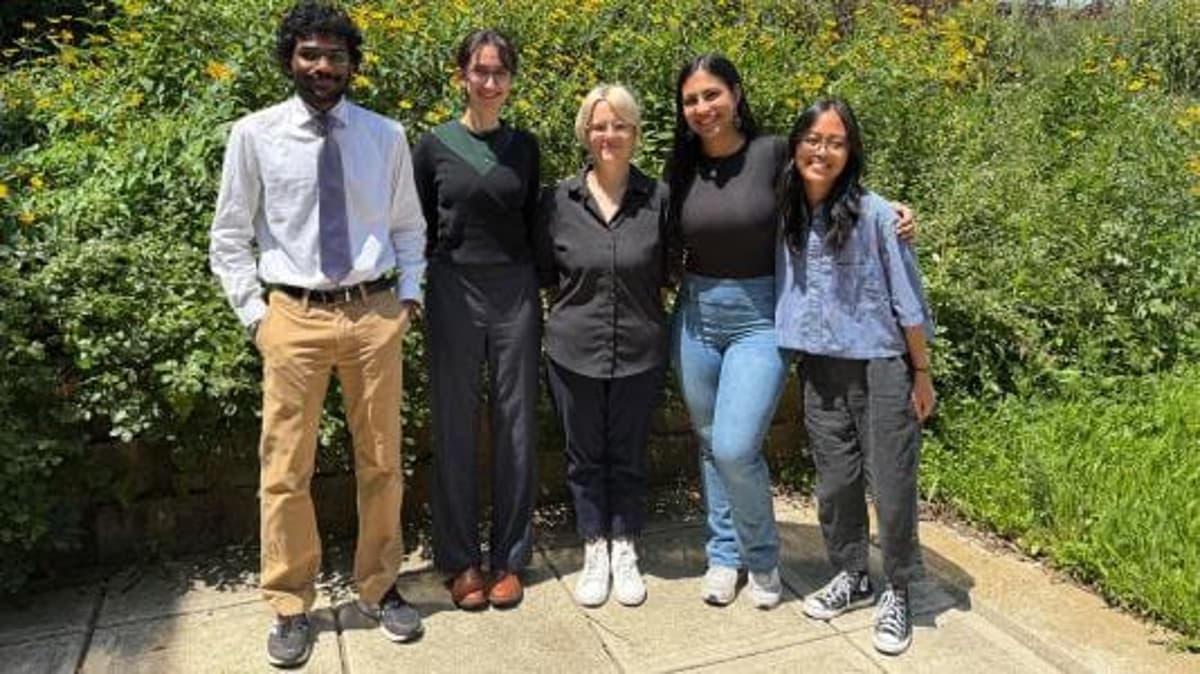
Argonne National Lab Hosts 27 Undergraduates Advancing Quantum Technologies
Key Takeaways
- •27 undergrads participated in Argonne’s 2025 OQI fellowship
- •Projects targeted erbium crystals, vacancy and NV-center qubits
- •Open‑source control reduced experimental costs for crystal studies
- •Custom microscopes enabled precise vacancy‑qubit measurements
- •Fellows gained industry exposure, expanding quantum workforce pipeline
Summary
Argonne National Laboratory hosted 27 undergraduates in its 2025 Open Quantum Initiative (OQI) Fellowship, immersing them in quantum information science projects such as erbium‑crystal control, vacancy‑qubit microscopy, and nitrogen‑vacancy center detection. Fellows built open‑source hardware, custom microscopes, and magnetic‑field measurement setups, gaining hands‑on experience across multiple qubit platforms. The program also included industry visits, linking academic research with commercial quantum efforts. Overall, the fellowship aims to develop a skilled quantum workforce for the rapidly expanding sector.
Pulse Analysis
The 2025 Open Quantum Initiative (OQI) Undergraduate Fellowship at Argonne National Laboratory brings together 27 undergraduate scholars from across the United States to work directly on cutting‑edge quantum information science projects. By embedding students in a national‑lab environment, the program bridges the gap between classroom theory and real‑world research, exposing participants to a spectrum of qubit technologies—from photonic and spin‑based systems to superconducting platforms. This hands‑on immersion not only accelerates skill acquisition but also signals a strategic effort to cultivate a robust quantum workforce capable of meeting the rapid expansion of the sector.
Among the fellowship’s technical achievements, Valeria Diaz Moreno developed an open‑source control suite for erbium‑doped crystals, slashing the cost of experimental setups that traditionally rely on expensive radio‑frequency hardware. Meanwhile, Cece DiSibio engineered a bespoke optical scanning microscope that automates the detection of crystal vacancy defects, delivering high‑resolution photoluminescence data essential for evaluating vacancy‑qubit viability. Krist Ha’s work focused on nitrogen‑vacancy (NV) centers, using magnetic‑field microscopy to capture microwave‑induced signal variations, thereby enriching the understanding of NV‑center dynamics. These contributions collectively lower barriers to entry for quantum materials research and improve measurement fidelity across multiple qubit platforms.
Beyond the laboratory, the fellowship integrates industry exposure through visits to firms such as PsiQuantum and Applied Materials, giving students a panoramic view of the commercial quantum ecosystem. The interdisciplinary skill set acquired—spanning hardware design, software programming, and data analysis—positions graduates for diverse career paths in academia, national laboratories, and emerging startups. As the United States races to secure leadership in quantum computing, programs like Argonne’s OQI fellowship serve as critical pipelines, ensuring a steady flow of talent equipped to translate scientific breakthroughs into scalable technologies.
Argonne National Lab Hosts 27 Undergraduates Advancing Quantum Technologies


Comments
Want to join the conversation?