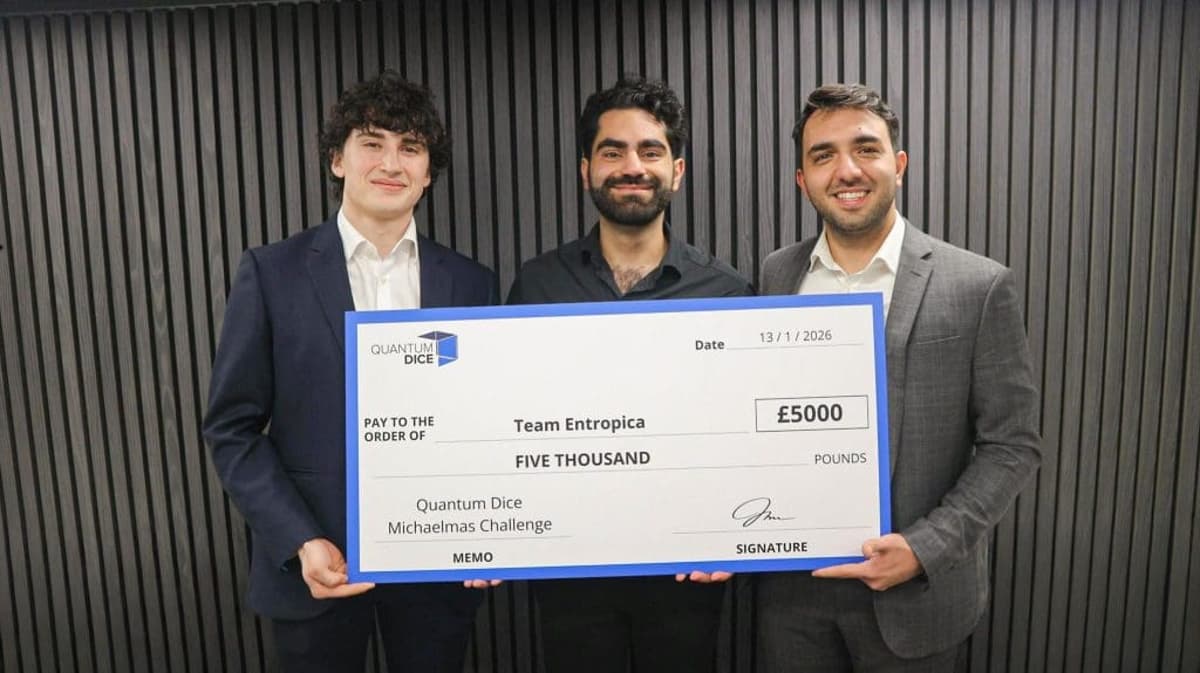
Quantum Dice Michaelmas Challenge: Students Tackle Risk, Energy & AI

Key Takeaways
- •Probabilistic computing applied to sports betting risk management.
- •Energy grid scheduling optimized via stochastic unit‑commitment solution.
- •Retrieval‑augmented generation improves AI information retrieval.
- •£8,000 prize pool attracted 29 interdisciplinary student teams.
- •Challenge validates probabilistic computing for complex real‑world problems.
Pulse Analysis
Probabilistic computing, once confined to academic labs, is gaining traction as a practical tool for tackling uncertainty‑laden problems. Quantum Dice’s inaugural Michaelmas Challenge provided a focused, eight‑week sprint where 29 multidisciplinary teams could prototype real‑world applications, signaling a maturing ecosystem that bridges theory and industry. By offering a modest £8,000 prize pool, the competition attracted top talent eager to demonstrate the commercial viability of stochastic algorithms, reinforcing the sector’s growing talent pipeline.
The winning projects illustrate the breadth of impact. Team Entropica’s risk‑management engine leverages probabilistic inference to optimise betting portfolios, a technique readily translatable to broader financial risk modelling. The Committed Units addressed the stochastic unit‑commitment problem, delivering cost‑effective power‑generation schedules that could enhance grid resilience amid renewable variability. Meanwhile, The Quantext Team’s retrieval‑augmented generation system showcases how probabilistic selection of context improves AI‑driven information retrieval, a step forward for enterprise search and knowledge management tools. Each solution underscores how uncertainty can be quantified and managed rather than avoided.
Looking ahead, the challenge’s success is likely to spur further investment in probabilistic hardware and software platforms. Enterprises facing volatile markets, renewable integration, and complex data environments are poised to adopt these methods, accelerating digital transformation initiatives. Moreover, the visibility of student‑led innovations signals to investors and corporates that a new generation of engineers is equipped to commercialise probabilistic technologies, potentially reshaping sectors that depend on predictive analytics and decision‑making under uncertainty.
Quantum Dice Michaelmas Challenge: Students Tackle Risk, Energy & AI


Comments
Want to join the conversation?