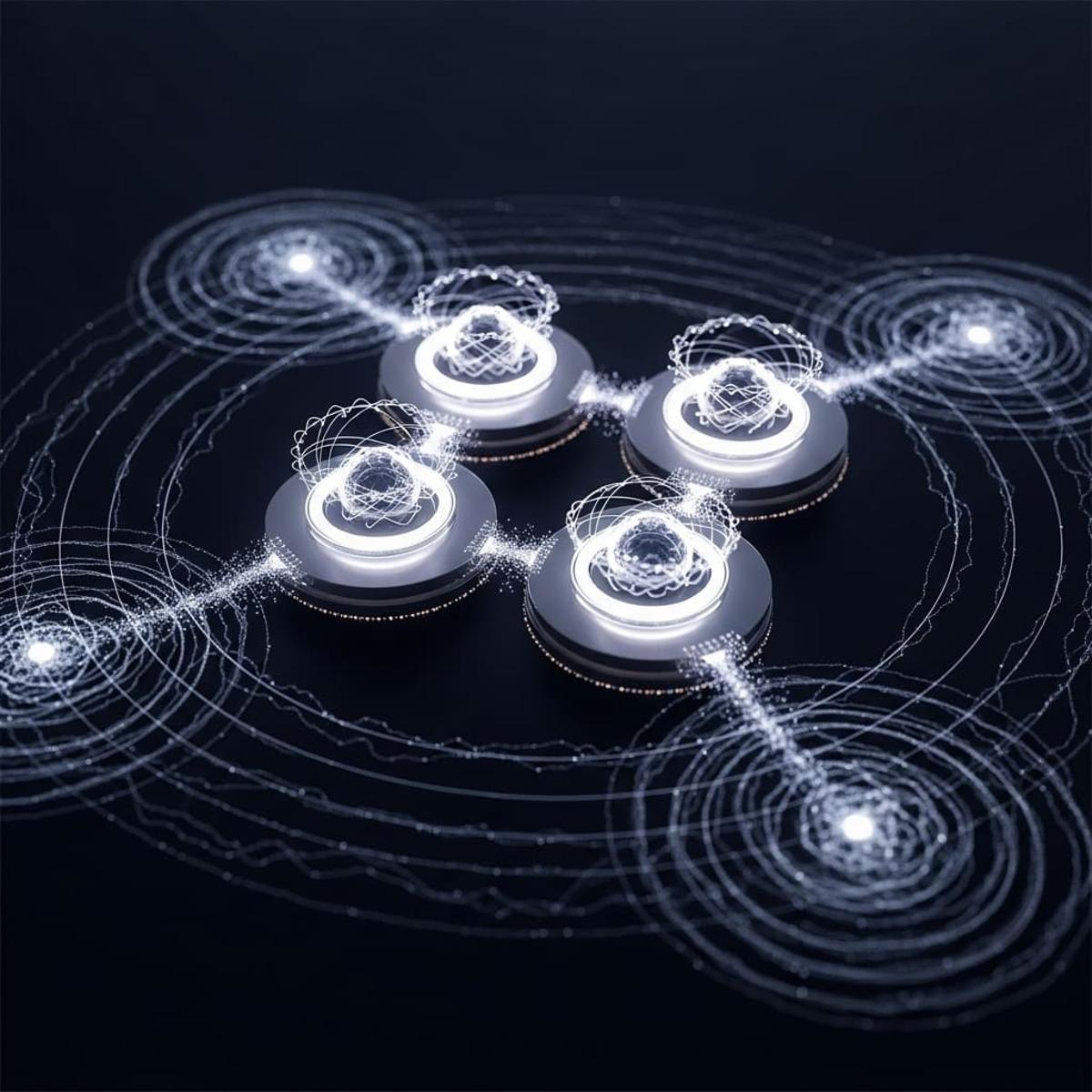
Quantum Neural Networks Achieve Faster Gravitational Wave Data Analysis with 4 Qubits
Key Takeaways
- •QNNs learn gravitational-wave patterns faster than classical nets
- •Cloud quantum runs cost £2k‑£1M per segment
- •99% fidelity achieved on 3‑qubit feature map
- •20% prediction accuracy on 4‑qubit segment
- •Software incompatibilities impede deployment on major cloud providers
Summary
Researchers evaluated cloud‑based quantum neural networks (QNNs) for LISA’s gravitational‑wave data analysis, testing hardware from IonQ, IQM, Amazon Braket and Microsoft Azure. The QNNs demonstrated markedly faster learning than classical networks, achieving 99% fidelity on a 3‑qubit feature map and 20% prediction accuracy on a 4‑qubit segment. However, cost analysis revealed steep fees ranging from £2,000 to over £1,000,000 per initial segment, highlighting financial barriers. Software incompatibilities and device availability further limited practical deployment for real‑time signal detection.
Pulse Analysis
Quantum computing is poised to reshape data‑intensive science, and the LISA mission’s need for rapid gravitational‑wave identification makes it a prime candidate. By deploying quantum neural networks on real cloud hardware, the research team moved beyond simulations, leveraging first‑order Pauli‑expansion encoding and Pauli Two‑Design ansätze. The experiments confirmed that shallow QNN circuits can reach near‑perfect fidelity, suggesting that quantum‑enhanced pattern recognition could eventually outpace classical deep‑learning pipelines in speed and resource efficiency.
The cost dimension proved decisive. Running the initial QNN segment on IonQ, IQM, Amazon Braket and Microsoft Azure incurred fees of £2,000, £60,000 and up to £1,000,000 respectively, reflecting divergent pricing models for quantum‑as‑a‑service. While the short QNN (sQNN) required modest training epochs, the long QNN (lQNN) demanded substantially larger datasets, amplifying both computational load and expense. Coupled with rapid fidelity loss in deeper circuits, these financial and technical constraints relegated current quantum hardware to proof‑of‑concept status rather than production‑grade analysis.
For stakeholders, the findings underscore a dual agenda: accelerate hardware reliability and develop pricing structures aligned with quantum‑machine‑learning workloads, which involve many short, high‑shot circuits. Streamlining SDK compatibility and access procedures will also be critical to broaden adoption. Until these ecosystem challenges are addressed, classical simulators will dominate LISA’s data‑analysis pipeline, but the demonstrated speed gains keep quantum QNNs on the horizon of next‑generation astronomical data processing.
Quantum Neural Networks Achieve Faster Gravitational Wave Data Analysis with 4 Qubits


Comments
Want to join the conversation?