
Key Takeaways
- •ARC‑AGI‑3 includes 135 handcrafted abstract environments.
- •Humans achieve 100% success; AI models under 1% score.
- •Scoring penalizes inefficient action sequences, discouraging brute force.
- •Prize pool $2 M on Kaggle, requiring open‑source solutions.
- •ARC‑AGI‑3 resets leaderboard, highlighting AI adaptability gap.
Pulse Analysis
The ARC‑AGI‑3 benchmark, released in March 2026, pushes the frontier of artificial general intelligence evaluation by stripping away language cues, external knowledge and predefined rules. Participants are dropped into 135 novel, turn‑based game‑like environments that require pure exploratory reasoning, goal inference and efficient planning. Human test‑takers solve every puzzle with perfect accuracy, establishing a 100 % baseline that the scoring system uses to measure fluid adaptive efficiency. By calibrating difficulty through extensive human trials, the benchmark creates a reliable yardstick for true agentic intelligence, beyond pattern‑matching.
Frontier models such as Gemini 3.1 Pro, GPT 5.4, Opus 4.6 and Grok‑4.20 all scored below one percent, revealing a stark gap between current deep‑learning pipelines and human‑level adaptability. The benchmark’s scoring algorithm heavily penalizes redundant actions—if a human solves a task in ten moves, an AI needing a hundred receives only one percent of the human score—thereby nullifying brute‑force compute advantages. This design forces researchers to prioritize internal world‑model construction, hierarchical planning and meta‑learning, areas where most commercial systems still rely on massive data and static inference.
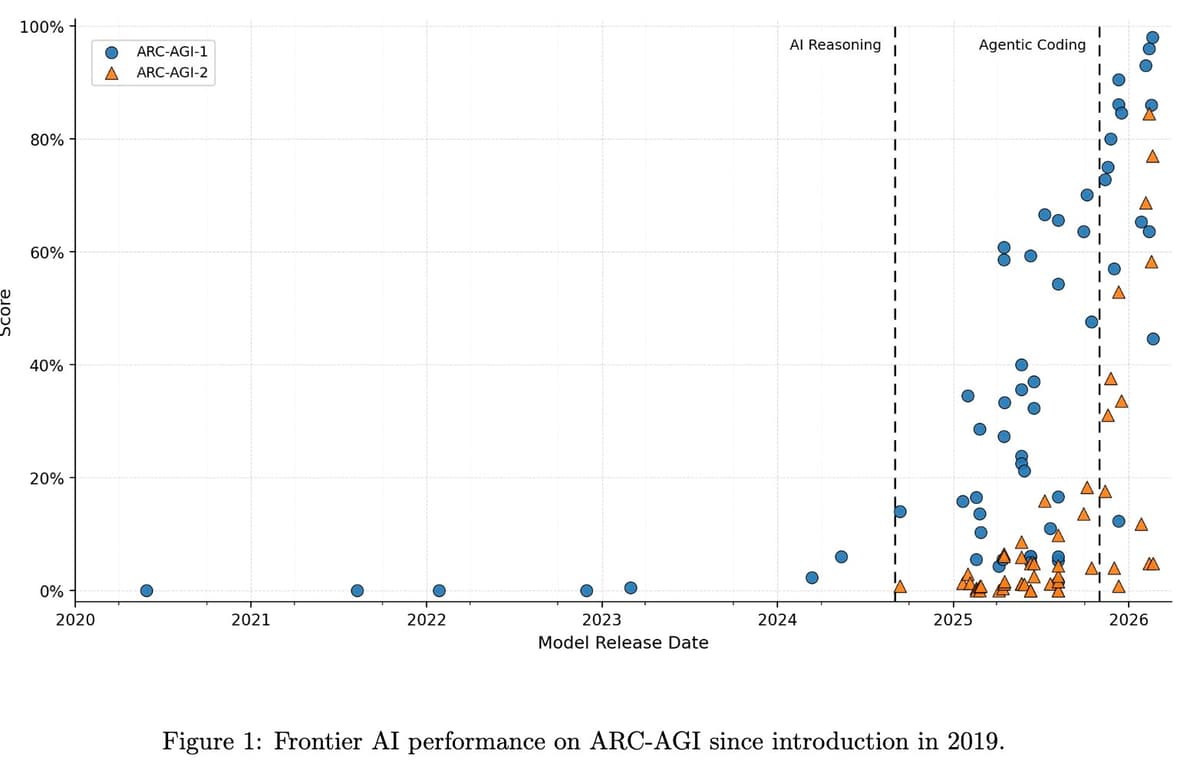
The $2 million prize pool announced on Kaggle, coupled with the requirement that winning code be open‑sourced, is intended to catalyze a new wave of research focused on true agentic reasoning. Investors and labs that poured millions into ARC‑AGI‑1 and ARC‑AGI‑2 now face a reset, prompting a shift from scaling parameters to engineering more efficient, goal‑driven architectures. If breakthroughs emerge, they could accelerate autonomous systems capable of real‑time problem solving in robotics, finance and defense, reshaping competitive dynamics across the AI industry. Such progress would also raise fresh regulatory and safety debates.
Third ARC AGI Test
Comments
Want to join the conversation?