

Anthropic and OpenAI Can Never Get Profitable?
The video examines a growing theory that leading generative‑AI firms such as OpenAI and Anthropic may never achieve sustainable profitability. It argues that both companies are employing an “Uber strategy”: offering free or heavily discounted access to build a user base before raising prices. Key points include Anthropic’s announced 50% workforce reduction and the potential fallout for its revenue model. A smaller labor pool could depress broader economic activity, limiting the pool of customers willing to pay premium subscription fees that could rise from $20 to $100 per month. The speaker cites the Anthropic CEO’s statement about cutting half the staff and the projected price hike as concrete evidence. He also highlights that Uber succeeded because its service did not directly impact end‑users’ costs, a condition that AI services may not replicate. If global growth stalls and enterprises tighten budgets, the high‑margin AI subscription model could falter, forcing investors to reassess valuations and prompting companies to explore alternative monetization paths beyond pure subscription pricing.
After 1 Year of Quitting Job | Introducing My Startup
Abhishek, a former full‑time employee, announced the launch of Escape Bash, a hands‑on learning platform for DevOps and cloud engineers, marking the culmination of a year‑long venture after quitting his job on April 16, 2025. Escape Bash structures its curriculum into three tiers—Lessons...

Top 5 Ways to Reduce Kubeneres Cluster Cost.
The video walks viewers through five proven tactics for slashing Kubernetes cluster expenses, whether the workloads run on public clouds or on‑premise hardware. Abhishek emphasizes that unchecked compute—especially GPU nodes running at single‑digit utilization—can bleed money, making cost discipline essential...

Redis Is Dead - Migrate to Valkey in 5 Minutes Using BetterDB for FREE
The video explains how Redis’ 2024 licensing shift from the open‑source SSPL to a dual‑license model forces cloud providers and SaaS users to pay higher fees for managed Redis services. Coupled with a broken RDB file format and the addition...

AWS Just Did the Impossible in Object Stores | S3Files Can Mount S3 on EC2
Amazon Web Services introduced S3 Files, a feature that lets customers mount an S3 bucket directly on an EC2 instance as if it were a traditional file system. The capability transforms object storage into a mutable, POSIX‑compatible volume, eliminating the...

Google Just Shocked the AI World with Gemma 4 | You Just Need 1 GPU
Google unveiled Gemma 4, its newest open‑source large language model, emphasizing that the entire suite can be run on a single consumer‑grade GPU with as little as 4‑6 GB of VRAM. The announcement positions Gemma 4 as a lightweight alternative to heavyweight proprietary...

Lack of DevOps Implementation Caused Anthropic Code Leak | Human Mistake or AI?
The video examines Anthropic’s accidental exposure of roughly 500,000 lines of its Claude CLI source code, traced to a simple DevOps oversight that left a source‑map file publicly accessible. When version 2.1.88 of the JavaScript‑based CLI was published on March 31, the build artifact...

Millions of Secrets Exposed - LiteLLM Compromised
The video details a supply‑chain breach affecting the open‑source Python library LightLLM. Versions 1.82.7 and 1.82.8 were published to PyPI with hidden malware that silently copies secrets from any system where the package is installed, giving attackers direct access to SSH keys,...

Build This DevSecOps AI Agent Workflow and Sell It for $5k | No Coding
In this tutorial Abhishek demonstrates how to construct a full‑stack DevSecOps AI workflow without writing a single line of code, leveraging the SIM.AI platform’s “mothership” prompt‑driven builder. The workflow is activated by a GitHub pull‑request webhook, extracts changed files, hands...

Best CyberSecurity Roadmap with Practical Learning.
The video outlines a structured roadmap for learning cyber security, emphasizing its growing relevance as AI accelerates both legitimate automation and malicious attacks. Presenter Abhishank argues that regardless of one’s primary role—developer, DevOps, or security professional—understanding core security concepts is...

Top 10 DevOps Concepts You Should Learn in 2026.
The video outlines the ten essential DevOps concepts every engineer should master in 2026, emphasizing that it is a conceptual guide rather than a step‑by‑step roadmap. Abhishek walks viewers through foundational skills—Linux, Git, and shell scripting—before moving to cloud‑native tools...

This FREE Utility Can Make You 10X Efficient with Kubernetes
The video introduces K9s, a free, open‑source terminal user interface that streamlines interaction with multiple Kubernetes clusters. Abhishek demonstrates that K9s replaces the myriad kubectl commands and custom aliases with a navigable UI. After a one‑line install via Homebrew, Chocolatey or...

DevOps to DevSecOps in 9 Hours | Practical Learning
The video is a ten‑hour, seven‑part series that walks DevOps engineers from zero to hero in DevSecOps, covering introductions, Git/GitHub, Terraform, container security, Kubernetes, emerging tools, and a capstone three‑tier project. Abishek stresses that DevSecOps is not a separate role but...

This AI Platform Creates Full Stack Apps with Auth + DB + Storage at Lowest Cost.
The video introduces Ins, an open‑source AI‑native backend platform that, when paired with a code‑generation tool such as GitHub Copilot, can spin up a complete production‑grade full‑stack application—including authentication, database, storage and AI‑powered features—using only natural‑language prompts. The presenter walks through...

Witness the Future of AI Before Everyone Else for FREE
The video is a brief promotional call‑to‑action urging viewers to register for Nvidia’s GPU Technology Conference (GTC) keynote, where founder Jensen Huang will present the next wave of artificial‑intelligence developments. It highlights last year’s landmark announcements – the Blackwell AI superchip...

How I Make Best PPTs in Just 15 Minutes Using AI (No One Will Tell You This).
The video walks viewers through a free, AI‑driven workflow that creates a complete, conference‑ready PowerPoint in under 30 minutes. Host Abhishek demonstrates how a simple prompt fed to a large‑language model can replace hours of manual slide drafting. First, he uses...

Ultimate End to End DevSecOps Project Implementation | 3 Hours Tutorial
The video walks viewers through an end‑to‑end DevSecOps implementation using a publicly available three‑tier blogging application called "journey." Abhishek explains the app’s architecture—React front‑end behind an Nginx reverse‑proxy, a Node.js/Express back‑end, and a PostgreSQL database—and shows how a DevSecOps engineer...

Run LLMs on CPU Based Machines for FREE in 3 Simple Steps.
The video walks viewers through a step‑by‑step method for running large language models locally on a CPU‑only laptop using the open‑source llama.cpp library. Abhishek emphasizes that no GPU, cloud API token, or paid subscription is required, and that a modest...

Kubernetes Local Setup Got Very Easy.
The video introduces VIND, a new tool from vCluster that dramatically simplifies running Kubernetes on a developer’s laptop. VIND can spin up multiple, fully‑featured Kubernetes clusters, each encapsulated within a single Docker container, eliminating the need for complex VM setups. Unlike...

This FREE Kubernetes Tool Is Insane | New DevOps Secret Weapon
The video introduces VIND (vCluster in Docker), a free tool that spins up fully functional Kubernetes clusters as Docker containers, targeting developers and DevOps engineers who need rapid, lightweight local environments for testing, CI/CD, and proof‑of‑concept work. Abhishek walks through...

AI Companies Don't Want You to Know This | VS Code + Continue
The video walks viewers through building a completely free, agentic integrated development environment (IDE) by pairing Visual Studio Code with the open‑source Continue.dev extension and locally hosted large language models (LLMs). Instead of relying on paid services such as GitHub...

Setup Claude Code for FREE in 3 Simple Steps.
In the tutorial, Abhishek Veeramalla demonstrates how to run Claude Code for free by integrating it with Ollama and leveraging open‑source LLMs such as gpt‑oss, Qwen3‑Coder‑Next, and DeepSeek. The three‑step process eliminates the need for paid API keys, allowing developers...
This FREE Tool Can Help You Backup and Restore Anything at Enterprise Level.
Plakar is an open‑source backup solution aimed at DevOps engineers who need enterprise‑level data resilience. The video explains how traditional object storage like S3 lacks point‑in‑time recovery and built‑in encryption, leaving critical workloads exposed to accidental deletion, ransomware, or corruption. Plakar...
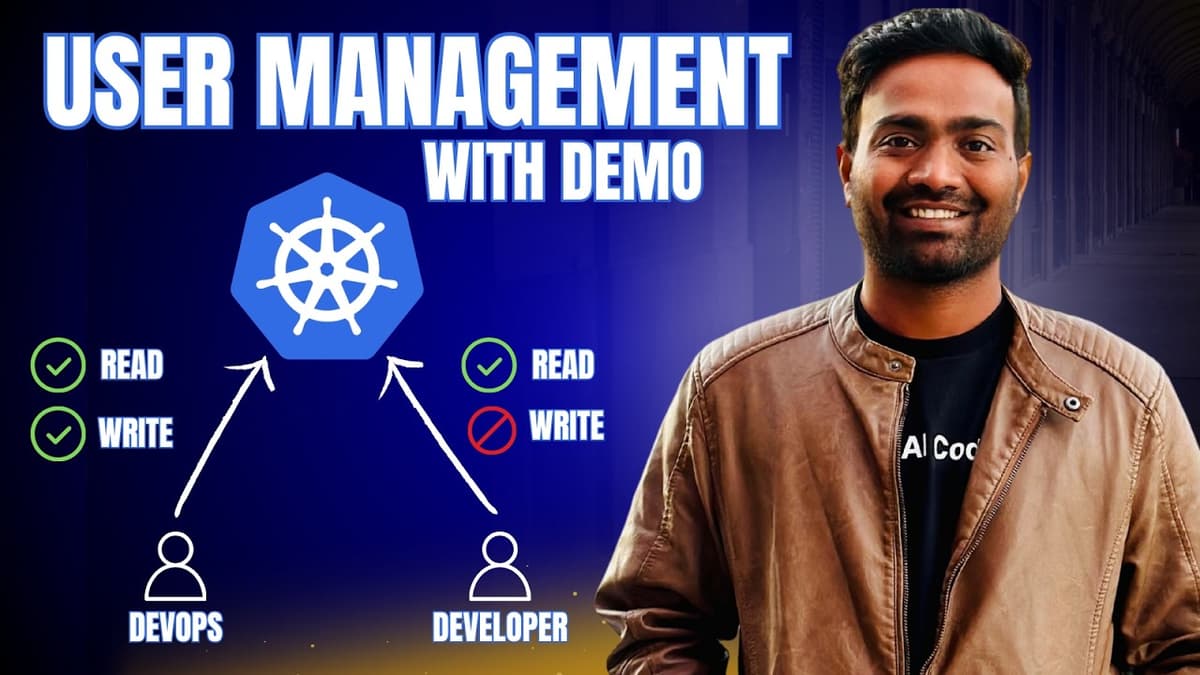
Realtime Kubernetes User Management with Demo | Must Watch
The video tackles the persistent pain points of Kubernetes user management, highlighting how authentication (kubeconfig) and authorization (RBAC) become unwieldy at scale. It explains that distributed kubeconfig files expose cluster IPs, certificates, and tokens, while the native RBAC model forces...
Complete FREE Practical Hands-On Labs | KodeKloud FREE Week
In 2026, mastering DevOps or cloud engineering hinges on a clear roadmap and hands‑on practice, which Abhishek highlights in his latest video. He promotes KodeKloud’s limited‑time Free Week, granting unrestricted access to its Standard plan for seven days without credit‑card...
I Tested 30 DevOps Tasks with AI to See if AI Can Replace DevOps.
The video documents a two‑day experiment where creator Abishank evaluated 20‑30 real‑world DevOps tasks—ranging from beginner to advanced—using several popular large language models (LLMs). He leveraged GitHub Copilot’s ability to switch among models such as Anthropic’s Opus 4.6, OpenAI’s Sonnet 4.5, and...