
Tom Griffiths | Mapping The Jagged Edges Of AI With The Tools Of Cognitive Science
Tom Griffiths frames the current AI landscape as a "jagged frontier" rather than a linear hierarchy of intelligence, contrasting the historic "great chain of being" with a modern view that organisms—and AI systems—occupy diverse, niche‑specific dimensions. He argues that large language models (LLMs) illustrate this frontier: they outperform humans on some tasks while falling short on others, creating a patchwork of strengths and weaknesses. Griffiths highlights the opacity of LLMs—complex neural architectures, proprietary training data, and inaccessible internal activations—making capability assessment a challenge for computer scientists. He proposes borrowing tools from cognitive science, a field accustomed to studying opaque minds, to map these AI‑human boundaries. Three core methods are discussed: measuring similarity, analyzing categorization strategies, and applying rational analysis. Using similarity judgments, researchers can construct matrices that, after multidimensional scaling, reveal representational spaces such as the human color wheel or the pitch helix. When LLMs are asked to rate similarity of colors or musical notes, they generate comparable structures, indicating alignment in those domains. However, for domains like taste or instrument timbre, the correlation drops, exposing gaps in the models' internal representations. The implication for businesses is clear: cognitive‑science techniques provide a systematic way to evaluate where AI can be trusted and where human expertise remains essential. By quantifying alignment across task dimensions, firms can better allocate AI resources, mitigate risks, and design products that leverage model strengths while compensating for their blind spots.
Philip Shiu | Towards Embodied, Whole Brain Emulations
Philip Shiu presented his work at Eon on using detailed connectome data to predict neural activity and ultimately build embodied whole‑brain emulations. The core goal is to infer firing patterns from the static wiring diagram of neurons, first demonstrated in...
Philip Linden and Ashley Kosak | From Epoch to Ecosystem: Growing Robust Lunar PNT Networks.
The talk by Philip Linden and Ashley Kosak outlines a shift from a centralized, Earth‑centric timing model to an open, incremental approach for building a robust lunar Positioning, Navigation and Timing (PNT) network. They argue that time, like calendar systems...
Ed Balaban | FLUTE (Fluidic Telescope): From Puddles to Giant Space Observatories
Dr. Ed Balaban of NASA Ames presented FLUTE, a fluidic telescope concept that replaces traditional segmented mirrors with large liquid‑based optics formed by surface‑tension forces in microgravity. The approach addresses the scaling bottleneck of current space telescopes, which rely on...

Deblina Sarkar | Autonomous and Surgery-Free Nano-Electronics for Brain-Computer Symbiosis
The talk introduced a new class of autonomous, surgery‑free nano‑electronics designed to create a seamless brain‑computer symbiosis. By shrinking electronic chips to subcellular dimensions and removing any supporting substrate, the devices can be injected intravenously, travel through the circulatory system,...

Andrew Trask | It’s Time to Harvest the Secure AI Tech Tree
Andrew Trask opened the session by presenting the "secure AI tech tree," a visual framework that maps the sprawling landscape where cryptography, deep learning, and distributed systems converge. The tree groups roughly five major subdivisions—privacy‑preserving collaboration, attribution control, trust mechanisms,...

Saturnin Pugnet | Different AGI Scenarios @ Vision Weekend Puerto Rico 2026
At Vision Weekend Puerto Rico 2026, Saturnin Pugnet discussed AI timelines, open‑source agent risks, and his dual for‑profit/non‑profit work with Project Omega. He emphasized unprecedented uncertainty, urging a probability‑distribution view rather than certainty. He warned that open‑source AI agents could become...

Levi Rybalov | Cybernetic Economies - Lightning Talk @ Vision Weekend Puerto Rico 2026
Levi Rybalov, founder of Archive, delivered a lightning talk at Vision Weekend Puerto Rico 2026 introducing cybernetic economies—feedback‑driven, real‑time marketplaces where autonomous agents exchange compute, storage, bandwidth, and energy assets. He framed these economies as the infrastructure for automated, agent‑driven...
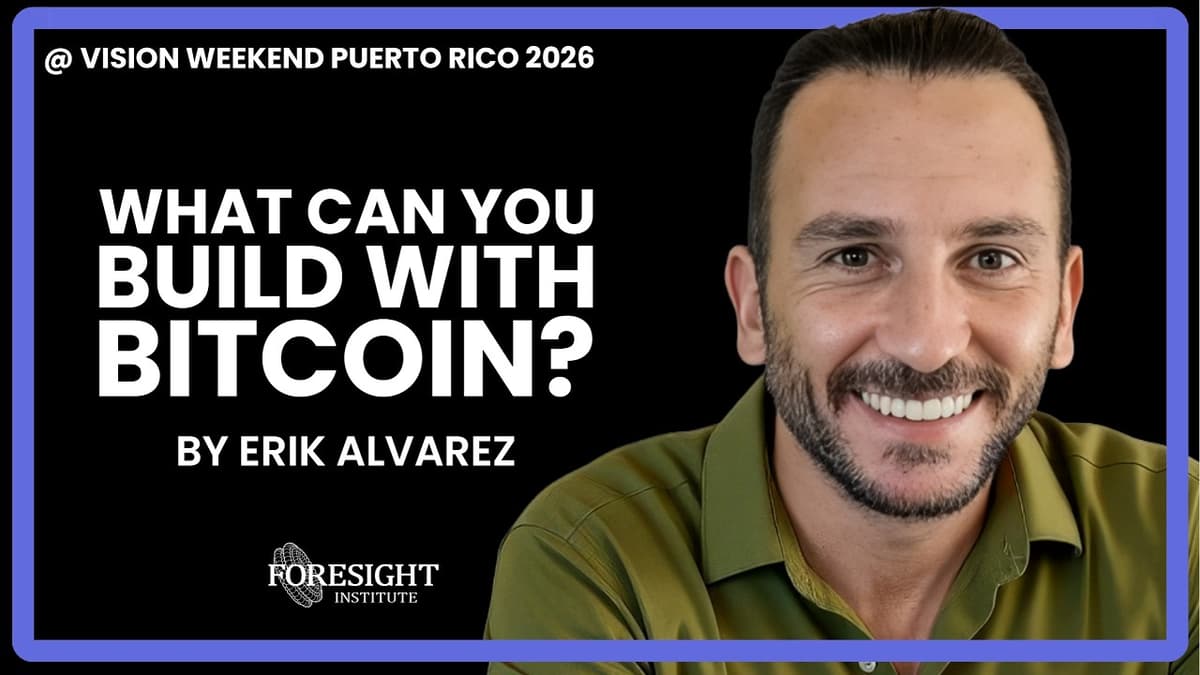
Erik Alvarez | What Can You Build with Bitcoin? - Lightning Talk @ Vision Weekend Puerto Rico 2026
At Vision Weekend Puerto Rico 2026, Erik Alvarez delivered a lightning talk titled “What Can You Build with Bitcoin?” while promoting his local meetup, San Juan Bitdevs, and his Bitcoin‑focused commerce startup, Vellis Commerce. Alvarez argued that Bitcoin’s permission‑less, open‑source protocol...

Frances Haugen | AI Governance in Education - Lightning Talk @ Vision Weekend Puerto Rico 2026
Frances Haugen’s lightning talk at Vision Weekend Puerto Rico 2026 warned that the fallout from her 2021 Meta whistle‑blowing has evolved from stock‑price shocks to a global wave of social‑media bans for minors. She highlighted Australia’s pioneering under‑16 ban and...

Riccardo Papa | On the Molecular Logic Underlying the Blueprint of Life - Lightning Talk @ VW 2026
In a five‑minute lightning talk at VW 2026, Riccardo Papa, a biology professor at the University of Puerto Rico, outlined his team’s ambitious quest to decipher the molecular “blueprint” of life. Using tropical butterflies as a tractable model, the project...

Dodam Ih | The Path to the Mouse Connectome @ Vision Weekend Puerto Rico 2026
At Vision Weekend Puerto Rico 2026, Totem E, founding engineer at Zeta AI, outlined the company’s roadmap to produce a complete wiring diagram of the mouse brain—a stepping stone toward the ultimate goal of mapping the 86 billion‑neuron human brain. Zeta’s end‑to‑end...

Philip Linden | Space Time Card @ Vision Weekend Puerto Rico 2026
Philip Linden presented the EPIC (Epoch of Time) initiative, a collaboration between the Open Lunar Foundation, Microchip and RIT, to develop a “space‑time card” – a compact, atomic‑clock‑based hardware module designed to provide precise timing on the Moon. The card,...

Taylor Tondelli | Innovation Needs More than Intelligence @ Vision Weekend Puerto Rico 2026
At Vision Weekend Puerto Rico 2026, Taylor Tandelli warned innovators that a massive, under‑tapped source of capital—philanthropic grant funding—could replace dwindling government R&D dollars for clean‑technology and climate solutions. He cited data showing U.S. foundations collectively dispense roughly $600 billion in grants...

ML Sudo | Project SOVereign @ Vision Weekend Puerto Rico 2026
The Vision Weekend Puerto Rico 2026 talk introduced Project SOVereign, a nonprofit effort to redesign chips from the ground up with security and transparency as core principles. ML Sudo warned that today’s secure enclaves—Intel SGX, AMD SEV, Nvidia Confidential Compute,...