

Revamp Seat Pricing: AI, Roles, Tiers, Credits
You don't need to stop pricing per seat in the age of AI. But you (probably) need to make seat-based pricing work harder. Seven routes to consider: 1. Seats can be used by people OR AI agents. If AI agents are doing work autonomously similar to a member of the team, and need access to a bespoke set of tools & data, why shouldn't they need their own seat license? 2. Seats can be be priced by role/job-to-be-done (see Tableau). Tableau, for example, has Viewers, Explorers & Creators. Creators cost 5x per seat versus Viewers & 80% more than Explorers. 3. Seats can unlock more product access (see Figma). Figma, for example, has Collab seats (FigJam & Figma Slides), Dev seats (+ Dev Mode & Figma Buzz), and Full seats (all products). 4. Seats can unlock the ability to buy special add-ons (see Chili Piper). The "Handoff Live" add-on is specifically for the Handoff tier & comes with a higher platform access fee (no change to the per-seat price). 5. Seats can be traded for AI credits (see Salesforce, image below). 6. Seats can unlock more power (see ChatGPT). The ChatGPT Pro tier, for example, comes with Pro reasoning, more memory & context, and faster speeds. 7. Seats can unlock more automation/scale (see monday dot com). More expensive seats come with more automation & integration power. --- In the words of Rob Litterst from PricingSaaS : "For many companies, the answer isn't to abandon seats. It's to make them work harder." Read more in the 2025 pricing year in review: https://lnkd.in/eptCbRBz

Craft Over AI: Mangomint’s High‑Touch Growth Model
Lately I’ve been thinking about how craft is the antidote to ubiquitous AI slop. Quality still matters, and it might even matter more than before when it’s easy to make something mid and hard to make something special. I’ve found...

Freemium Conversion Benchmarks: 3‑8% Good, 10‑25% Great
What's good free-to-paid conversion 👇 Back in 2023 I looked at data from 1,000+ products in what (I think) was the most in-depth product benchmarking survey to date. What I found: Freemium (self-serve) -- think: Canva 😊 Good = 3-5%...

Retention Drives Sustainable Growth; Low NRR Threatens Expansion
AI-native companies have been shattering growth records. The elephant in the room: what Cassie Young calls an impending "gross retention apocalypse". It becomes nearly impossible to sustain hypergrowth when you have a larger and larger install base that walks out...

Flexibility Over Credits: Salesforce Shifts to Employee‑Based AI Pricing
Many are predicting that 2026 will be the year of credit-based pricing. I think it'll also be the year of a backlash *against* credits. Salesforce makes a great case in point. They initially charged on a usage-based, per-conversation pricing model....

Intercom's AI Pivot Delivers 393% Growth, 30K Customers
The AI growth re-acceleration at Intercom is wild: 1. Fin went $1 to $12 million in a year -- more than a year ago. 2. On track to cross 30k paying customers by end of year. 3. Annualized growth is...

The Best Growth Tactics of 2025
The episode distills the top growth experiments of 2025, revealing that outbound/ABM, partner ecosystems, and events/community dominate despite AI hype, while tactics span content, PLG, launches, and paid ads. Readers shared 50+ real‑world tactics—from LinkedIn engagement outreach and intent‑based ABM...

Four AI Agent Pricing Models, One Dominates Adoption
Everyone seems to be talking about AI agents. The biggest problem not enough people are talking about: how to monetize & capture the value of them. Earlier this year Manny Medina (founder of Outreach & Paid ) analyzed patterns from...

PostHog Disrupts AI Pricing with Simple Cost‑Plus Model
What's new in AI pricing: giving up on the idea of value-based pricing? PostHog just announced new AI pricing that's disruptive in a way that might upset pricing experts. They're not trying to tie pricing to outcomes. They're not charging...

CEO Pushes AI, GTM Results Remain Disappointing
Everyone in B2B tech uses AI, relatively few see real GTM impact. Maja and I recently surveyed 195 B2B GTM leaders. Three-in-four said they feel top-down pressure from the CEO & Board to adopt AI. But the impact is a...

Cold Calling Drives $100M SaaS Growth Despite Low Price
You might not have heard of Housecall Pro, but it's a vSaaS juggernaut doing hundreds of millions in ARR. A surprising way they got there: Cold calling, even when the product started at only $4/mo 🤯. The math on that...
An Outbound Playbook for 2025
In this episode, Kyle talks with Fivos Aresti, co‑founder of Workflows.io, about the four‑pillar outbound playbook that drove their growth to $2M ARR in 2025. They stress a hybrid approach that blends manual cold outreach for Tier 1 accounts with AI‑enhanced,...

Shift From UI to Agent Experience with Prompt Guidance
Seemingly everyone is replacing point-and-click with a prompt bar. Design no longer differentiates. We're going to need to differentiate on the *agent* experience instead. One 🔥 example from Replit : The product helps you improve your prompt. Most of us...

M&A Surge Masks Low‑value, AI‑driven Seed Exits
I'm having some major cognitive dissonance about startup M&A. It *seems* to be 🌶️ with a record number of acquisitions according to Peter Walker . Yet Jason M. Lemkin & others are pointing out that in SaaS "the exits... are...

ChatGPT Leads Impactful GTM Tools; AI Agents Rise
If you're searching for GTM tech this Black Friday, start with these: Maja and I asked our communities about their favorite B2B GTM tools in 2025 including which were "most impactful" and which are "must try". 195 software GTM leaders...

Choosing the Right AI Pricing Model Drives Profitability
I thought there'd be consensus on how to monetize AI by now. I was (mostly) wrong. There's outcome-based pricing (see: Intercom, Crescendo, Chargeflow), credit pricing (see: Salesforce, Lovable), work-based pricing (see: Imagen, EvenUp), hybrid pricing (see: Monday, Clay), and lots...
The New UX Era
In this episode, Yaakov Carno examines the rise of the prompt‑bar as the new front‑door UX for AI‑enabled SaaS products, mapping over 40 real‑world examples from Canva to Notion. He explains how the traditional onboarding flow has shifted into a...

Reducing Churn Drives Biggest ARR Growth for SaaS
Churn isn't a Customer Success problem. It’s a *business* problem. And it might be why you miss the 2026 plan. Just look at the 3-year ARR impact of different growth initiatives^ for a typical $10M ARR SaaS co: - Increase...
How to Use AI Agents for Marketing
In this episode Kyle Poyar talks with Hamish Grant of SafetyCulture about how they built a suite of AI agents to super‑charge their marketing and sales operations. They detail four workflows—platform‑agnostic lead enrichment, an AI‑powered inbound BDR that drafts personalized...

EBooks Lose Spark: Emily Kramer’s 2025 B2B Channel Forecast
B2B marketing whisperer Emily Kramer from the beloved MKT1 newsletter dishes on which channels are hot or not in 2025. You might be surprised about eBooks. Do you agree? Chime in below. --- If you <3 this clip, you'll love...
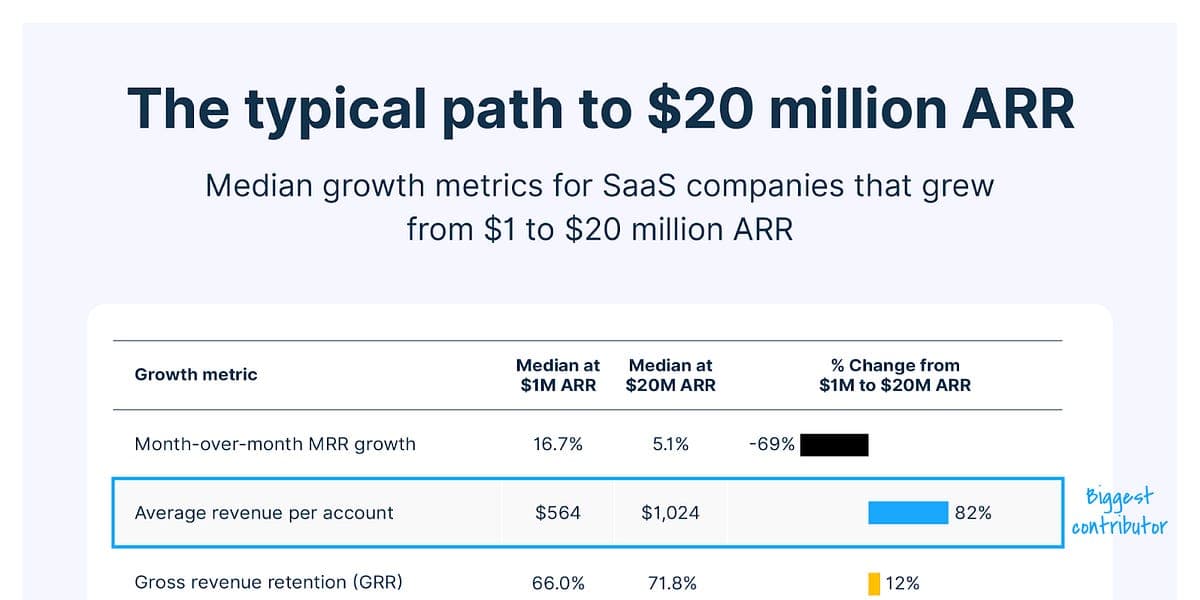
The Compounding Startup
Kyle Poyar analyzes ChartMogul data to show that the rare SaaS startups that break the $20 million ARR barrier do so by continuously improving their revenue mix—raising ARPA, boosting expansion and retention—rather than relying on early‑stage momentum alone. The outliers double‑digit...

Traffic Is No Longer a Reliable Growth Metric
Kyle Poyar argues that raw traffic is becoming a misleading growth metric as AI‑driven search, especially ChatGPT, delivers far higher‑intent leads that convert six times faster than Google. He shares seven insights from Webflow’s VP of Growth, including the need...
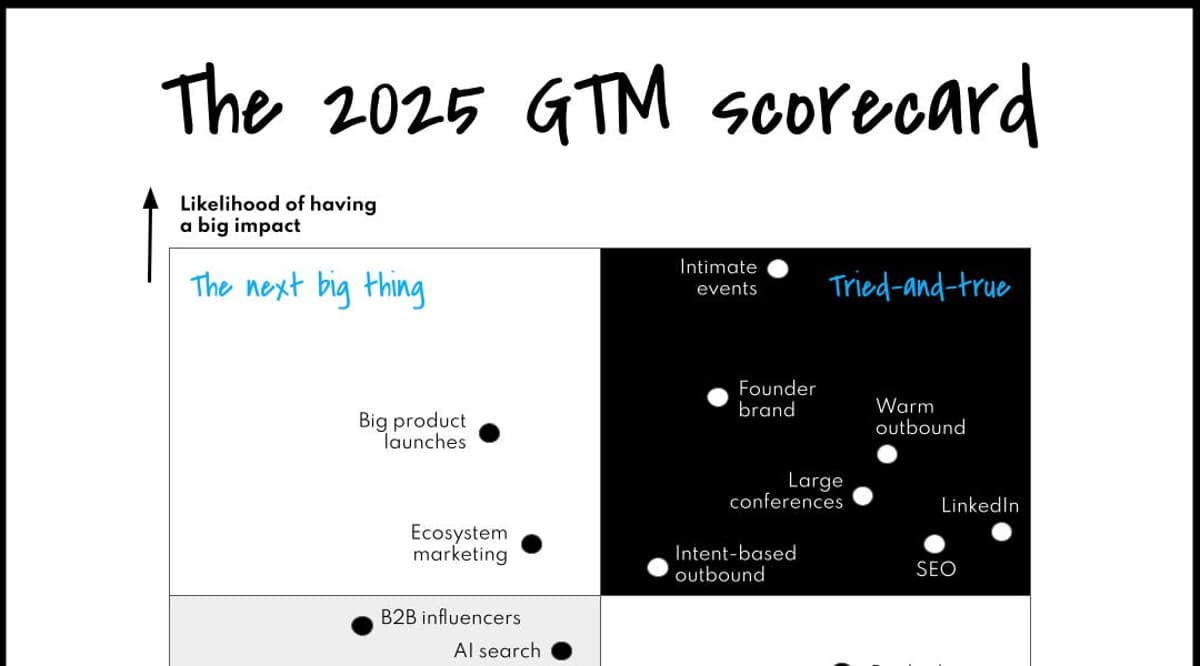
What’s Working in GTM Right Now
Surveying 195 software GTM leaders, the inaugural 2025 State of B2B GTM report finds companies juggling heavy channel experimentation—an average of five core GTM channels plus 5.5 experiments—while inbound (23%), outbound (19%) and account‑based GTM (18%) remain the most common...
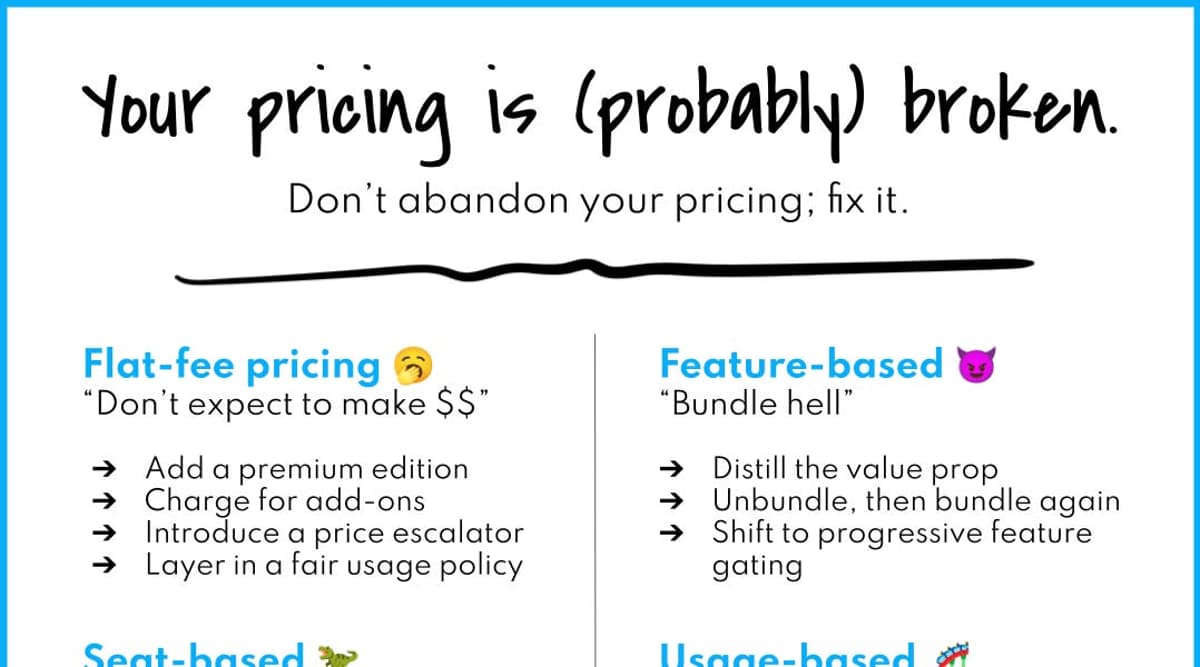
Your Pricing Is (Probably) Broken
SaaS and AI startups largely have broken pricing: founders default to flat fees, feature bundles, seat-based and usage models that misprice customers and leave revenue on the table. Poyar highlights concrete fixes — e.g., add premium editions (50–100% higher price...

AI Adoption Slips, Yet Spend and Retention Surge
Fascinating new data from Ramp: Paid AI adoption actually *declined* by 0.7% in September. This was the second decline of the year, but far more material than the one in June (0.1%). Other highlights from the data: - 73% of...

The Odds of Making It
A new look inside startup growth from zero to $25 million ARR