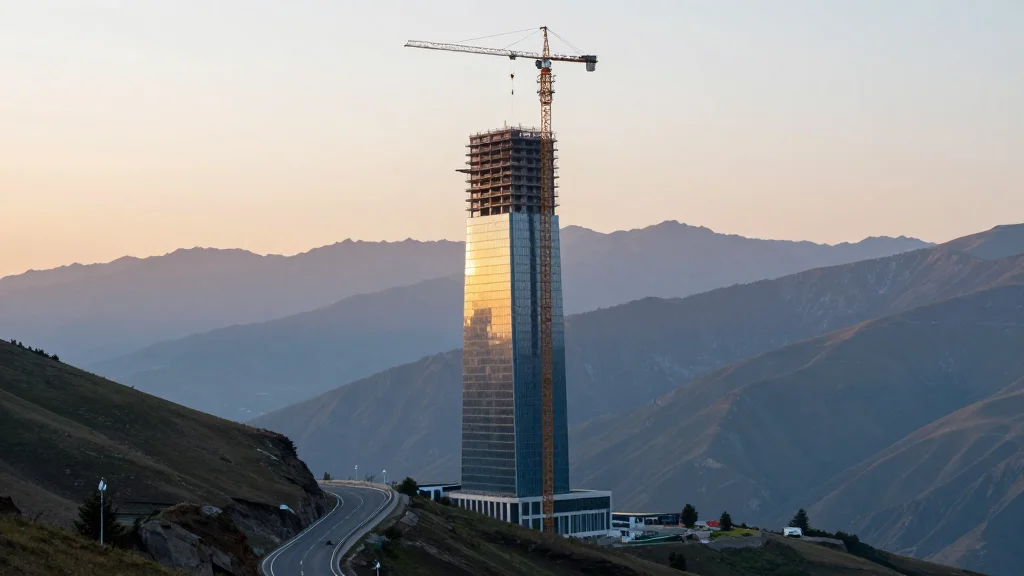
Azerbaijan Allocates $15 Billion to Rebuild Post‑War Regions, Boosting Emerging‑Market Outlook

Why It Matters
Azerbaijan’s $15 billion reconstruction agenda reshapes the economic landscape of a key emerging market by turning war‑damaged territory into a catalyst for growth. The scale of state‑driven investment, combined with a self‑reliant financing model, challenges the conventional reliance on donor aid in post‑conflict settings and could set a precedent for other emerging economies facing similar rebuilding tasks. The project also has broader geopolitical implications. By rapidly restoring infrastructure and repopulating liberated areas, Baku strengthens its claim over contested territories, potentially altering the balance of power in the South‑Caucasus. For investors, the initiative opens a pipeline of contracts in construction, engineering, and utilities, while also raising questions about fiscal risk, governance, and the long‑term sustainability of a reconstruction‑led growth strategy.
Key Takeaways
- •Azerbaijan allocated 22 bn manats ($8.4 bn) for 2021‑2025 reconstruction, with 3.5 bn manats ($1.3 bn) planned for 2026.
- •Projected 13.3 bn manats (~$7 bn) for 2027‑2030 will bring total state spending on Karabakh and Eastern Zangezur to roughly $15 bn.
- •More than 85,000 people have already returned to the rebuilt zones, indicating rapid repopulation.
- •President Ilham Aliyev emphasized a self‑reliant approach, avoiding reliance on international donor funds.
- •The reconstruction covers 11,000 sq km of infrastructure, including roads, power plants, pipelines and housing.
Pulse Analysis
Azerbaijan’s decision to fund its post‑war reconstruction entirely from the state budget is a bold gamble that could redefine how emerging markets handle large‑scale rebuilding. Historically, countries emerging from conflict have leaned on multilateral donors, concessional loans or private‑sector participation to spread risk and secure expertise. By contrast, Baku is betting on its fiscal capacity and political will to accelerate development, a strategy that could yield higher returns if the projects are delivered on time and at cost. The upside is clear: a modernized infrastructure network will lower logistics costs, attract foreign direct investment, and integrate the region more tightly into global trade routes linking Europe, the Middle East and Central Asia.
Nevertheless, the approach is not without pitfalls. The massive outlay will increase public debt and could strain the budget if oil revenues—Azerbaijan’s primary fiscal engine—face volatility. Moreover, the security environment remains fragile; any resurgence of hostilities could jeopardize the newly built assets and erode investor confidence. To mitigate these risks, the government may need to introduce transparent procurement processes and consider selective public‑private partnerships that bring in external capital while preserving strategic control.
In the longer term, Azerbaijan’s model could inspire other post‑conflict emerging economies to pursue home‑grown reconstruction, especially where donor fatigue limits external assistance. If successful, the country could emerge as a regional hub for construction and engineering services, leveraging its newly built infrastructure to become a logistics gateway. The coming months will reveal whether the ambitious budget translates into tangible economic momentum or becomes a cautionary tale of over‑extension in a volatile geopolitical setting.
Azerbaijan Allocates $15 Billion to Rebuild Post‑War Regions, Boosting Emerging‑Market Outlook
Comments
Want to join the conversation?
Loading comments...