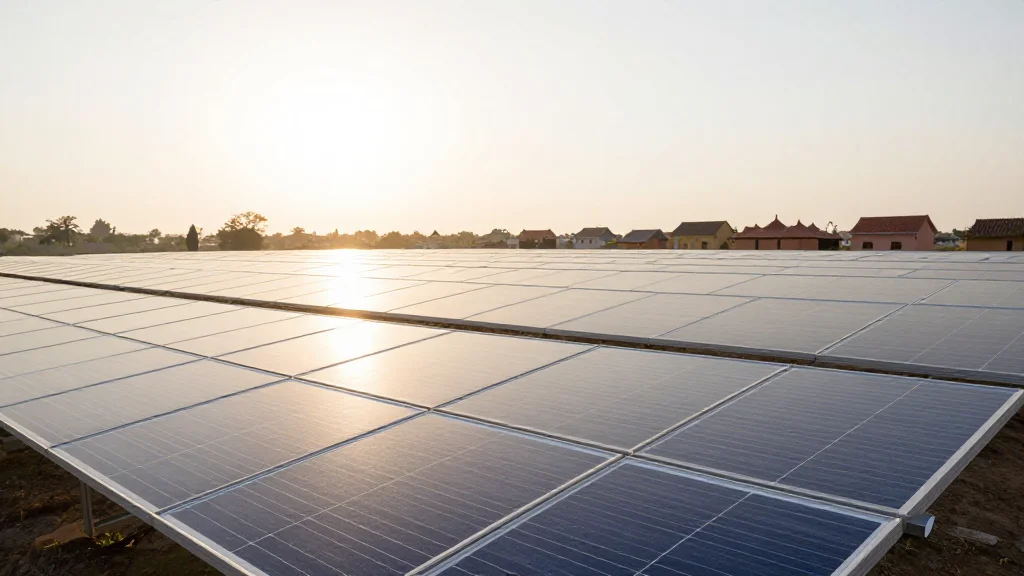
India’s Khavda Solar Park Set to Power 30 GW, Offering a Blueprint for Emerging Markets

Why It Matters
The Khavda solar park illustrates how an emerging economy can marry rapid industrial growth with aggressive decarbonisation, challenging the narrative that development must rely on fossil fuels. By demonstrating that a single project can deliver 30 GW of clean power, India provides a scalable model for nations grappling with energy poverty, climate commitments, and the need for affordable electricity. The park’s success could catalyse a wave of similar investments across the Global South, reshaping global energy markets and reducing reliance on coal imports. Moreover, the project highlights the importance of policy continuity and market incentives. India’s shift from coal expansion to solar dominance required sustained government support, competitive auctions, and a regulatory environment that encouraged private participation. Replicating this framework could help other emerging markets overcome financing gaps and accelerate their own renewable rollouts, ultimately contributing to a more diversified and resilient global energy system.
Key Takeaways
- •Khavda solar park will span 280 square miles in Gujarat’s Rann of Kutch.
- •Project aims for 30 GW capacity and 60 million panels by 2029.
- •India’s installed solar capacity grew ~40 % annually, crossing 150 GW in March 2024.
- •IEA expects solar to meet nearly half of India’s additional electricity demand through 2030.
- •Kingsmill Bond (Ember) said, “China built on coal; India is building on sun.”
Pulse Analysis
India’s Khavda solar park is more than a headline‑grabbing megaproject; it is a strategic lever that could redefine how emerging economies approach energy security and climate policy. Historically, rapid industrialisation in the Global South has been powered by cheap coal, creating a legacy of high emissions and air‑quality challenges. By contrast, India’s aggressive solar push leverages its geographic advantage—high insolation and vast, underutilised land—to sidestep that legacy. The park’s 30 GW output, roughly equivalent to the combined capacity of several European nations, demonstrates that scale is no longer a barrier for solar.
Financially, the project signals a maturing market for renewable infrastructure in emerging markets. Investors are increasingly comfortable with long‑term power purchase agreements backed by sovereign guarantees, reducing perceived risk. If Khavda meets its timeline, it will validate financing models that blend public policy with private capital, encouraging similar structures in Africa’s Sahel or Latin America’s Andean corridor. The ripple effect could be a surge in green bond issuances and a reallocation of capital away from coal‑centric projects.
Strategically, the park also serves as a geopolitical asset. Situated near a contested border, its renewable nature reduces vulnerability to fuel supply disruptions that traditionally accompany fossil‑fuel imports. For neighboring countries, the project offers a template for cross‑border energy cooperation that could foster stability. In sum, Khavda is a litmus test: its success will likely accelerate a global shift toward solar‑led growth pathways for emerging economies, while any delays could reinforce skepticism about the feasibility of large‑scale renewables in developing contexts.
India’s Khavda Solar Park Set to Power 30 GW, Offering a Blueprint for Emerging Markets
Comments
Want to join the conversation?
Loading comments...