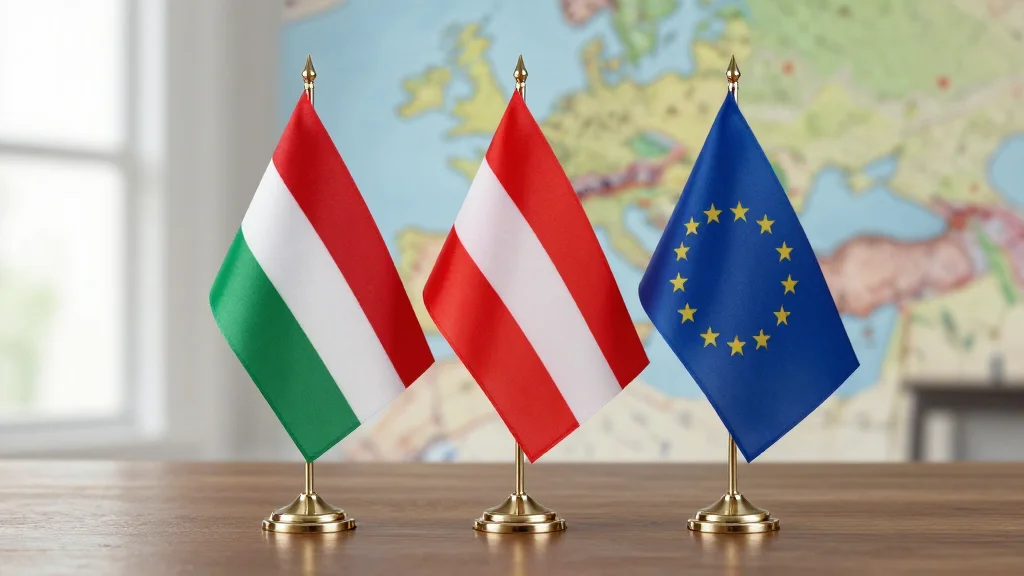
Magyar Wants to Put the Austro-Hungarian Empire Back on the Map
Why It Matters
A coordinated Central European bloc could amplify the region’s bargaining power in EU policy and funding decisions, reshaping the balance of influence between larger member states and the bloc’s conservative governments.
Key Takeaways
- •Magyar aims to merge Visegrád Group with Slavkov format
- •Austria is Hungary’s second-largest investor, over $12.9 billion
- •Magyar seeks release of $19.8 billion frozen EU funds
- •Proposed Central European bloc could boost Brussels voting power
- •Divergent Ukraine policies may challenge alliance cohesion
Pulse Analysis
Péter Magyar’s election marks a decisive break from Viktor Orbán’s nationalist isolationism, ushering in a diplomatic strategy that leans on historical ties and pragmatic economics. Having spent a decade in Brussels, Magyar understands the EU’s institutional mechanics and is leveraging that knowledge to negotiate the release of nearly $20 billion in frozen cohesion funds and to tap $17.6 billion in European defense loans. By proposing a merger of the Visegrád Group with the Slavkov format, he aims to create a Central European bloc that can act as a cohesive voting bloc, reminiscent of the Benelux model, thereby increasing the region’s leverage over EU legislation and budget allocations.
Economic interdependence underpins Magyar’s outreach, especially toward Austria, which remains Hungary’s second‑largest foreign investor with more than $12.9 billion in capital and a labor pipeline of over 130,000 Hungarian workers. Strengthening this partnership could attract additional Austrian private‑sector projects, bolster cross‑border infrastructure, and stabilize the Austrian economy amid global trade volatility. Moreover, a unified bloc could present integrated proposals for EU cohesion money, enhancing the efficiency and impact of funded projects across Central Europe, from transport corridors to digital infrastructure.
Nonetheless, the alliance faces substantive hurdles. Divergent stances on Ukraine—Austria and Poland support additional aid, while Hungary, the Czech Republic, and Slovakia balk at a $99 billion loan package—could fracture consensus on foreign policy. Additionally, differing views on migration, energy security, and democratic reforms may test the bloc’s cohesion. If Magyar can navigate these fissures, the Central European coalition could emerge as a decisive counterweight to larger powers like Germany and France, reshaping the EU’s internal dynamics and offering a new model for regional cooperation.
Magyar wants to put the Austro-Hungarian Empire back on the map
Comments
Want to join the conversation?
Loading comments...