US contributions underpin the UN’s core budget; lingering arrears threaten essential peacekeeping and humanitarian programs, making the funding gap a geopolitical and operational risk.
The United States remains the single largest financial pillar of the United Nations, yet its recent $160 million payment covers only a fraction of the $4 billion in overdue contributions. While the Trump administration has repeatedly questioned the UN’s relevance and trimmed foreign‑aid budgets, the cash infusion signals a pragmatic acknowledgment that the organization’s operating budget cannot function without American support. This partial payment, however, does little to alleviate the $2.196 billion regular‑budget arrears or the $1.8 billion owed for peacekeeping missions, underscoring a persistent funding gap.
Beyond the headline numbers, the UN faces an acute fiscal crisis that could cripple its core functions by mid‑year. Secretary‑General Guterres has warned that without a comprehensive overhaul of contribution rules or full payment from all 193 member states, the regular operating budget may be exhausted as early as July. Such a shortfall would force the UN to curtail critical programs, from humanitarian aid to conflict‑resolution initiatives, potentially destabilizing fragile regions that rely on its presence. The financial strain also fuels debates within member states about reforming the dues formula, which currently ties contributions to economic capacity but allows significant variance.
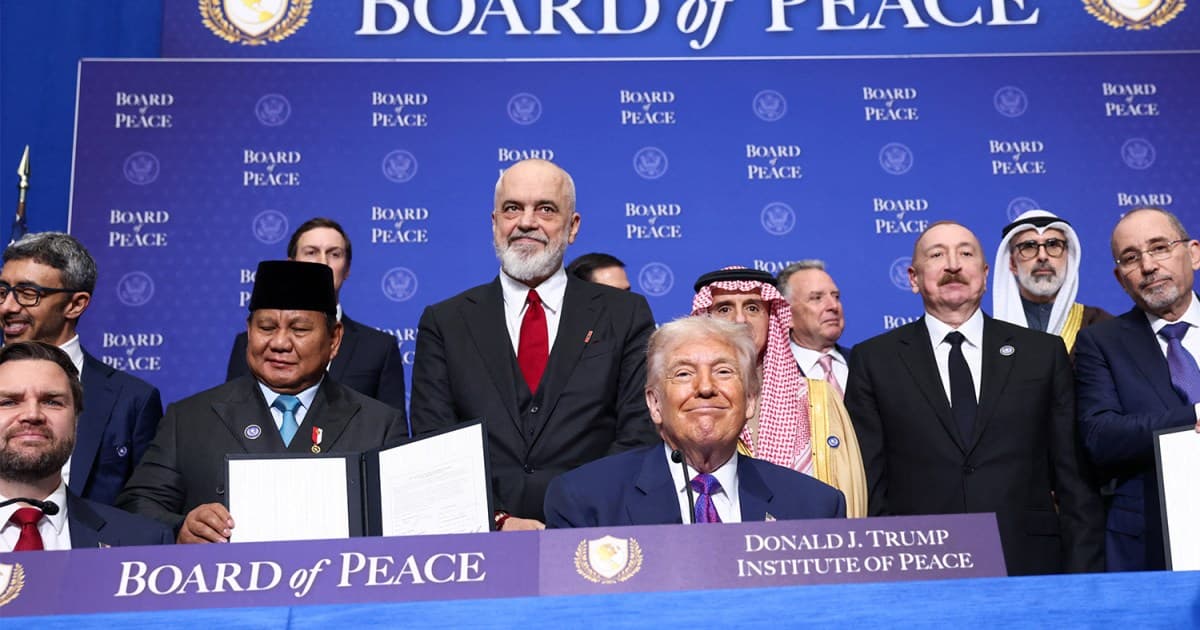
Politically, President Trump’s recent endorsement of the UN at his Board of Peace gathering introduces a nuanced narrative. While he framed the UN as a partner worth sustaining, his administration continues to withdraw from dozens of UN programs and maintains a rhetoric of skepticism. The Board of Peace, positioned as a parallel mechanism to the Security Council, could either complement or undermine the UN’s authority, depending on how Washington balances its dual tracks. For policymakers and investors, the United States’ fiscal posture toward the UN will remain a bellwether for global governance stability and the viability of multilateral peacekeeping efforts.
By AP · Published On 20 Feb 2026
The United Nations announced that the United States has paid approximately $160 million towards its nearly $4 billion in outstanding dues. The payment goes towards the UN’s regular operating budget, according to spokesman Stephane Dujarric.
But the shortfall comes as the administration of US President Donald Trump has openly questioned its commitment to the UN and has slashed money earmarked for the international body.
Still, on Thursday, Trump appeared to endorse funding the UN during the inaugural meeting of his Board of Peace in Washington, DC.
“We’re going to help them money‑wise, and we’re going to make sure the United Nations is viable,” Trump said. “And I think it’s going to eventually live up to its potential. That will be a big day.”
The UN has indicated that the US owes about $2.196 billion to its regular budget, including $767 million for the current year. Another $1.8 billion is owed for the UN’s peacekeeping operations.
For years, the UN has faced a financial crisis, with a growing shortfall of contributions. Each of the organisation’s 193 member states is required to contribute, based on its economic ability.
Poorer countries could be asked to contribute as little as 0.001 percent of the UN’s regular budget.
Wealthier countries could reach the maximum contribution amount of 22 percent.
Unpaid dues have already forced the UN to slash its spending and reduce its services. In a stark warning last month, United Nations Secretary‑General Antonio Guterres cautioned that the international body faces an “imminent financial collapse” unless its financial rules are overhauled or all 193 member nations pay their dues.
Guterres revealed that the UN’s regular operating budget could be depleted as early as July, a scenario that would severely jeopardise its global operations.
The US is the largest donor to the UN, as the world’s largest economy, but it currently owes billions in unpaid dues. UN officials have stated that the US accounts for approximately 95 percent of the arrears to the organisation’s regular budget.
Since returning to the White House for a second term in January 2025, Trump has elevated concerns that US dues might go unpaid. The Republican leader has repeatedly criticised the UN as ineffective, even articulating that sentiment at September’s UN General Assembly.
“What is the purpose of the United Nations?” Trump asked the assembly. “All they seem to do is write a really strongly worded letter and then never follow that letter up. It’s empty words.”
Throughout his second term so far, he has cut foreign aid spending and withdrawn from international commitments. In January, for instance, his government pulled out of 31 UN programmes, including its democracy fund and a body that works on maternal and child health.
But on Thursday, at his Board of Peace meeting, Trump appeared to take a warmer stance towards the UN, saying he planned to work “very closely” with the organisation.
“Someday, I won’t be here. The United Nations will be,” he said, seeming to endorse its longevity.
Trump also acknowledged the organisation’s financial distress: “They need help, and they need help money‑wise.” He did not mention the US arrears.
While the Board of Peace establishment was meant to oversee the Gaza ceasefire, many see it as an attempt by Trump to rival the UN Security Council’s role in preventing and ending conflicts around the world. Critics have described the board, which Trump chairs, as a “parallel system” that risks undermining the UN’s authority and operations.
Trump himself appeared to position his Board of Peace as an oversight body for the UN in Thursday’s remarks. The Board of Peace, he said, “is going to almost be looking over the United Nations and making sure it runs properly.”
Comments
Want to join the conversation?
Loading comments...