The initiative anchors India’s container trade in domestic hands, boosting self‑reliance and reshaping global shipping competition. It also catalyzes shipbuilding, port infrastructure, and ancillary logistics across the country.
India’s maritime policy is undergoing a decisive shift as the Bharat Container Shipping Line (BCSL) materialises through a multi‑agency MoU. By consolidating stakes from the Shipping Corporation of India, Container Corporation of India, and key port authorities, the government is creating a national champion designed to capture a larger share of the burgeoning container market. This move dovetails with the Amrit Kaal 2047 vision, which seeks to make the nation self‑sufficient in critical logistics and to position shipping as a growth engine for the broader economy.
The BCSL blueprint calls for 15 new vessels built in Indian shipyards, expanding to a 51‑ship fleet within five years. The $1 billion Container Manufacturing Assistance Scheme and a $1.6 billion port‑capacity fund provide the financial backbone for domestic shipbuilding and infrastructure upgrades, promising to generate jobs and stimulate ancillary industries. By anchoring production locally, India aims to reduce reliance on foreign shipyards, lower charter costs, and create a sustainable supply chain for container vessels.
Strategically, BCSL’s initial focus on regional routes to the Red Sea and intra‑Asian lanes establishes a revenue base while building operational expertise. The long‑term ambition to link Africa, Europe and the United States signals a bid to challenge established global carriers and diversify trade corridors. If successful, the carrier could reshape freight rates, enhance India’s bargaining power in international trade negotiations, and accelerate the country’s transition toward a high‑value, export‑driven maritime economy.
A consortium of six Indian entities signed an MoU to launch Bharat Container Shipping Line (BCSL), each taking equity stakes ranging from 5% to 30%. The new carrier will order 15 container ships and aims to operate 51 vessels within five years, supported by a $1 billion manufacturing assistance scheme and a $1.6 billion port capacity boost. The initiative aligns with India's Amrit Kaal 2047 policy to boost domestic shipping.
Source: Seatrade Maritime
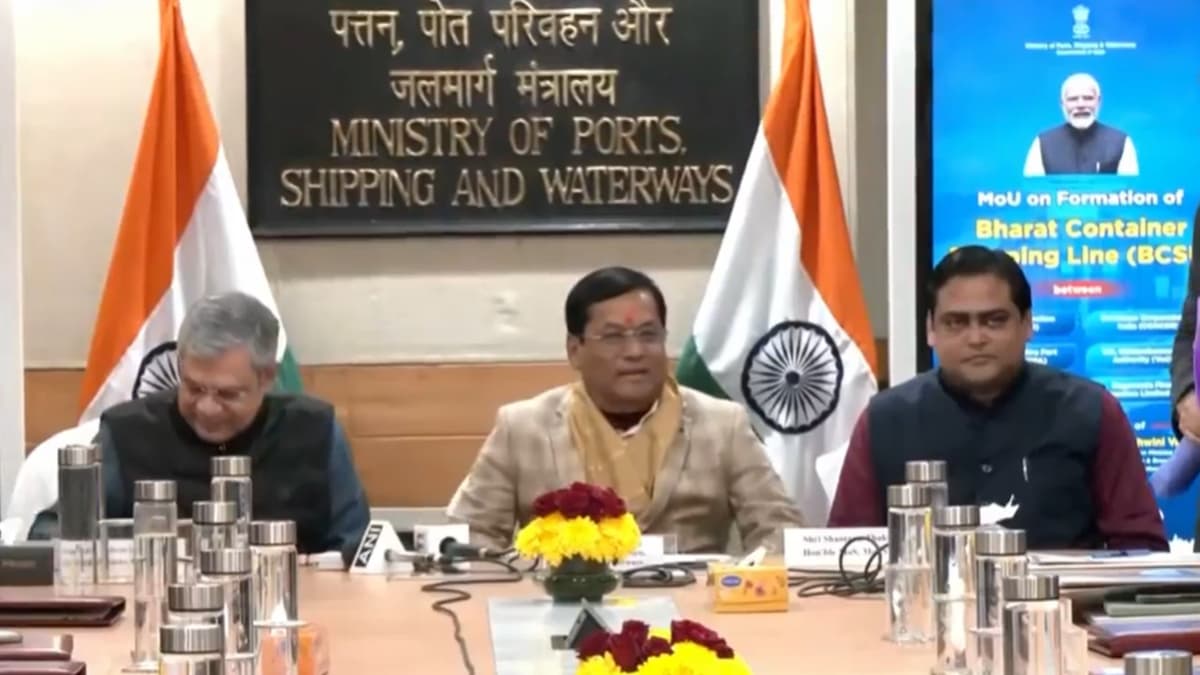
The formation Bharat Container Shipping Line (BCSL) of the is slowly coming together with the latest move – the signing of the Memorandum of Understanding (MoU) that will establish the carrier.

Credit: Screenshot from Ministry for Ports, Shipping and Waterways
A half‑dozen companies were signatories to the MoU, including the Shipping Corporation of India (SCI) and the Container Corporation of India (Concor), each holding a 30 % stake in BCSL, with a 20 % stake for Sagarmala Finance Corp, 10 % for Jawaharlal Nehru Port Authority, and 5 % each for V.O. Chidambaranar Port Authority and Chennai Port Authority.
BCSL will order 15 container ships from domestic yards in the next financial year, ending in 2027, with the intention of operating 51 vessels—owned and chartered—within the next five years.
The Indian carrier’s initial operational focus will be regional, up to the Red Sea in the west and east to other parts of Asia, but in the long term the expectation for the world’s fourth‑largest economy is to expand its links to Africa, Europe and the US.
Related: Synergy bags management of Yang Ming newbuild pair
Alphaliner reported that there are two funding measures confirmed by the signing of the MoU:
A $1 billion assistance scheme over five years that will support a container‑manufacturing operation capable of producing one million TEU annually.
Another $1.6 billion to increase port capacity that will support India’s new container ecosystem, as part of the broader national strategy that requires India to be self‑reliant in shipping.
The wider maritime sector will play a critical role as the “robust engine of the nation’s development” in the national Amrit Kaal 2047 policy, which aims to transform the nation into a developed country 100 years after independence. This will see the development of ship‑building yards and recycling facilities, the extension and investment in ports and logistics, and the development of BCSL.
Sarbananda Sonowal, the Minister for Ports, Shipping and Waterways (MoPSW), confirmed that these initiatives, “The Bharat Container Shipping Line, aligned with the Container Manufacturing Assistance Scheme (CMAS) announced in Budget 2026–27, will anchor India’s container trade in Indian hands.”
Overall, the Minister concluded that the policy decisions being put into practice are, “Likely to play a multiplier role to enhance our strategic and commercial presence in global maritime trade.”
Nick Savvides – Europe correspondent
Experienced journalist working online, in monthly magazines and daily news coverage. Nick Savvides began his journalistic career as a freelance writer from his flat in central London, and has since worked in Athens, contributing to major publications including The Observer, The European, Daily Express and Thomson Reuters.
Most recently, Nick joined The Loadstar as the publication’s news editor, developing its profile, increasing readership, and building a team to cover supply‑chain issues and container‑shipping news.
He previously held editorial roles at ci‑online (Containerisation International), International Freighting Weekly (IFW), and Informa’s suite of maritime titles. He also worked for ICIS (chemical tanker reporting), Lloyd’s Register (technical magazine), and The Naval Architect (Royal Institution of Naval Architects).
Nick’s work at Fairplay earned him the Seahorse Club Journalist of the Year and Feature Writer of the Year 2018 awards. After Fairplay closed, he joined the US start‑up FreightWaves.
Comments
Want to join the conversation?
Loading comments...