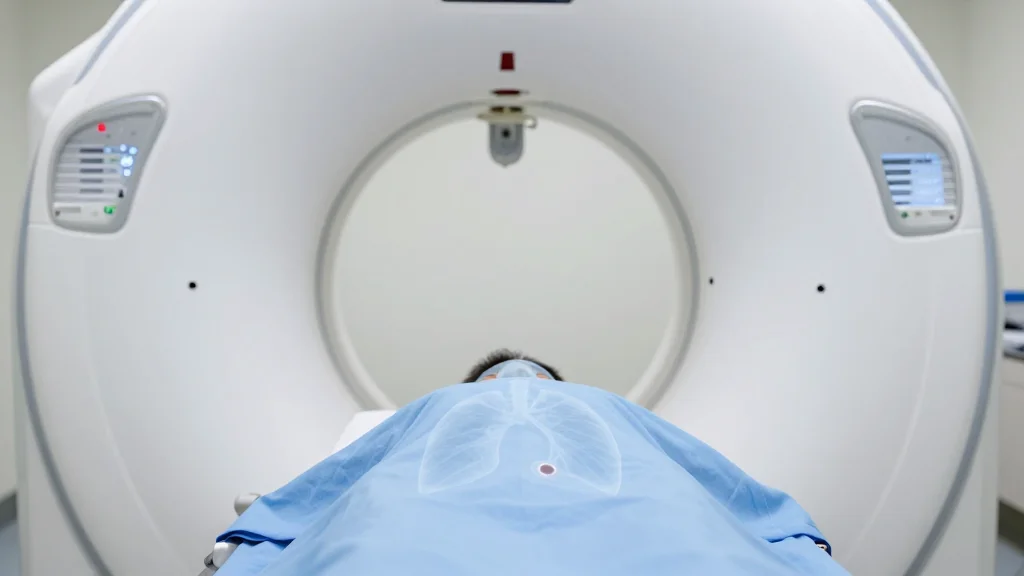
Bronchial Branch Tracing with Cone-Beam CT Tool-in-Lesion Confirmation for Peripheral Pulmonary Nodules
Why It Matters
Improved navigation and diagnostic accuracy can accelerate lung‑cancer detection, influencing treatment outcomes and screening program efficiency.
Key Takeaways
- •CBCT raised navigational yield from 75% to 90% in study.
- •Diagnostic yield improved to 80% with CBCT versus 65% standard.
- •Procedure time increased ~5 minutes, still statistically significant.
- •Radiation dose rose to 3.9 mSv with CBCT, versus 0.35 mSv.
- •No complications reported, indicating safety of CBCT integration.
Pulse Analysis
Lung‑cancer screening programs are uncovering an ever‑growing pool of peripheral pulmonary nodules, yet bronchoscopic biopsy remains technically demanding. Traditional bronchial branch tracing paired with radial endobronchial ultrasound offers real‑time guidance but often falls short of confirming that the sampling tool is truly within the lesion, limiting diagnostic yield. Cone‑beam computed tomography, with its intra‑procedural three‑dimensional imaging, fills this gap by providing immediate visual confirmation, potentially reshaping the bronchoscopic diagnostic landscape.
The recent single‑center trial demonstrated that integrating CBCT into the existing workflow can markedly improve both navigational and diagnostic performance. Navigational yield jumped to 90% after CBCT‑guided re‑navigation, and diagnostic yield climbed to 80%, surpassing the 65% achieved with standard care. While the addition of CBCT added roughly five minutes to total suite time—a statistically significant but clinically modest increase—the safety profile remained pristine, with zero procedural complications reported. The trade‑off is a higher radiation dose, averaging 3.9 mSv versus 0.35 mSv, a factor that clinicians must weigh against the diagnostic benefits.
For interventional pulmonology teams, these findings suggest that selective CBCT use could become a valuable adjunct, especially for challenging nodules where conventional tools falter. The modest time penalty and heightened radiation exposure may be justified by the potential to reduce repeat procedures and expedite definitive cancer staging. As CBCT technology becomes more accessible and dose‑reduction strategies evolve, broader adoption could enhance the overall efficiency of lung‑cancer work‑ups, ultimately improving patient outcomes and health‑system resource utilization.
Bronchial branch tracing with cone-beam CT tool-in-lesion confirmation for peripheral pulmonary nodules
Comments
Want to join the conversation?
Loading comments...