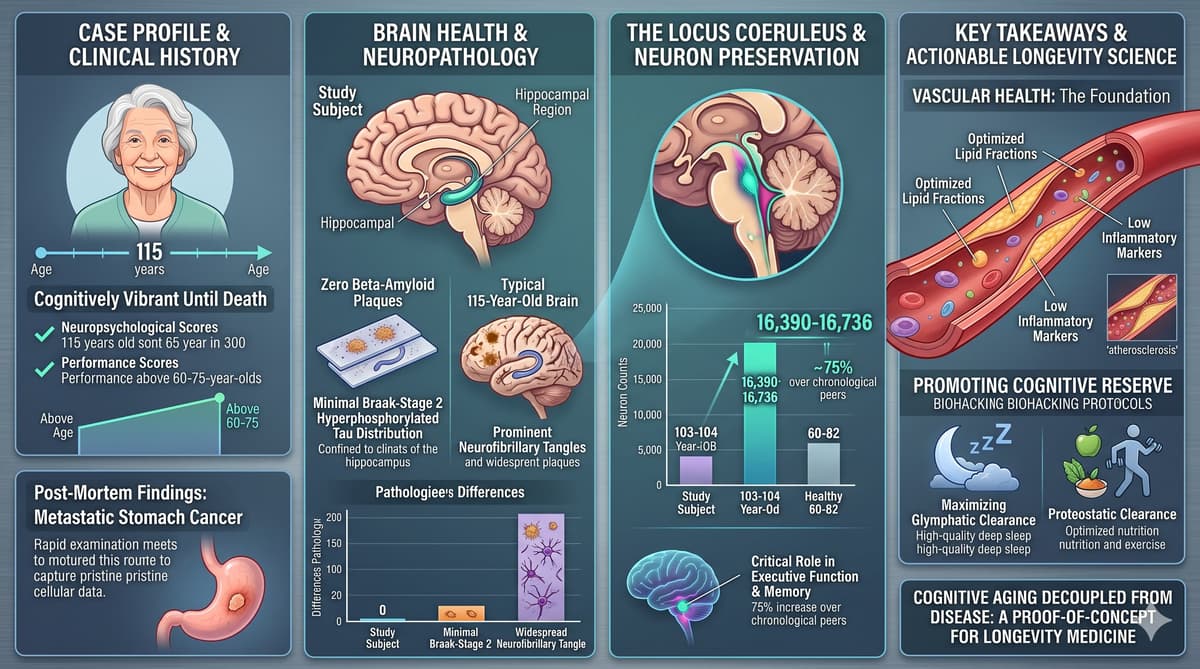
The 115-Year-Old Brain That Escaped Aging: Supercentenarian Autopsy Challenges the Inevitability of Cognitive Decline
Key Takeaways
- •Oligoclonal hematopoiesis reduced to two stem cell clones at age 115
- •Blood telomeres 17× shorter than brain, indicating stem cell exhaustion limit
- •450 harmless somatic mutations found, none in cancer‑driver regions
- •Unique genome assembly revealed 6,909 novel structural variants, enriching brain‑expressed VNTRs
Pulse Analysis
The case of Hendrikje van Andel‑Schipper, often cited as “W115,” has become a cornerstone for biogerontology since her 2008 autopsy revealed a brain that defied the typical trajectory of age‑related atrophy. Unlike most centenarians, she retained intact cognition and showed no vascular degeneration, prompting scientists to preserve her organs for deep molecular analysis. Over the past decade, her tissues have been subjected to multi‑omics pipelines, providing a rare, whole‑body snapshot of human biology at the outer limits of lifespan. This unique resource allows researchers to test long‑standing theories about why aging accelerates after the ninth decade.
Genome‑wide sequencing of W115’s blood uncovered an extreme form of oligoclonal hematopoiesis: virtually all circulating white cells originated from just two related stem‑cell clones, a stark contrast to the roughly 1,300 active clones in a typical adult. Correspondingly, telomeres in her blood were 17‑fold shorter than those in her post‑mitotic brain tissue, implicating hematopoietic stem‑cell exhaustion as a potential lifespan ceiling. Despite accumulating about 450 somatic mutations, none affected known oncogenic drivers, and a high‑resolution long‑read assembly revealed 6,909 structural variants unique to her genome, many clustered in subtelomeric regions that regulate brain‑expressed genes.
These discoveries have reshaped the research agenda for extreme longevity. By demonstrating that a healthy brain can persist despite severe clonal restriction and a modest mutation load, the findings shift focus toward preserving stem‑cell pools and stabilizing structural genome architecture. The 100‑plus Study, launched in Amsterdam, now screens hundreds of cognitively intact centenarians to validate the protective signatures first observed in W115. For biotech firms and pharmaceutical pipelines, the data suggest new targets—telomere maintenance, clonal hematopoiesis modulation, and VNTR‑driven gene regulation—that could translate into interventions extending healthspan rather than merely delaying disease.
The 115-Year-Old Brain That Escaped Aging: Supercentenarian Autopsy Challenges the Inevitability of Cognitive Decline
Comments
Want to join the conversation?