
TPE Long-Term Effects in Healthy Elderly Same as Sham
A 2025 Aging Cell trial of therapeutic plasma exchange (TPE) with and without IVIG in 42 healthy adults over 50 showed a modest 2.6‑year biological‑age reduction at the mid‑point but no significant difference versus sham at the final assessment. The authors attribute the loss of effect to possible compensatory mechanisms, regression to the mean, or the limits of a small sample. Consequently, the study provides proof‑of‑concept for a transient rejuvenation signal but fails to demonstrate durable anti‑aging benefits. Stakeholders should treat the mid‑trial gains as short‑lived rather than a lasting therapeutic breakthrough.

Best Longevity Retreats & Destinations (2026): An Independent, No-BS Guide
The longevity‑retreat market has exploded, offering programs from $340‑night fasting centers to $5,000‑night elite diagnostic experiences. Evidence‑based options—especially medically supervised fasting and the Pritikin program—show measurable health improvements, while many luxury integrative retreats rely on amenities over outcomes. International venues...
KHL Foundation Launches a Medical Tourism Gene Therapy Program for Older Patients
The KHL Foundation, founded by longevity veterans Ken Scott and Helga Sands, has launched a medical‑tourism program that offers a gene‑therapy cocktail to people over 60. The Rejuvenation Cocktail combines intramuscular follistatin with intranasal klotho and SIRT1, targeting muscle, brain...

China Launches Standardized Physician Education in Longevity
China has launched its first national competency‑based education programme in longevity medicine, targeting physicians across internal medicine, geriatrics, cardiology and related fields. Developed by the China Non‑public Medical Institutions Association and the Asia‑Pacific Longevity Medicine Society, the curriculum blends ageing...
Sam Altman's Anti-Ageing Bet: How AI And Biology Are Beginning To Converge
Sam Altman is backing a new biotech venture that merges AI‑driven protein design with advanced cellular reprogramming to reverse biological aging. The company claims its platform can reset epigenetic clocks and simultaneously address age‑related diseases such as Alzheimer’s, cardiovascular disease,...

Higher Predicted Age by a Metabolomic Aging Clock Correlates with Dementia Risk
Researchers applied a metabolomic aging clock (MileAge) to 223,496 UK Biobank participants and found that a higher metabolomic‑age delta predicts a 61% increase in all‑cause dementia risk and earlier disease onset. The hazard ratio for dementia rose to 1.61 per...

Defying Death: The Immortality Movement Goes Mainstream
The longevity movement, once confined to ultra‑wealthy circles, is breaking into mainstream investment. Investor Boyang Wang, backing Vibe Science, highlights a new wave of bold research, including the controversial concept of brainless clones that could receive brain transplants. Venture capital...
GHK-Cu Rescues Cigarette Smoking‐induced Skeletal Dysfunction via Sirt1
The so‑called Glow Protocol mixes GHK‑Cu, TB‑500 and BPC‑157 into a sub‑cutaneous blend marketed by clinics as an anti‑aging treatment. No peer‑reviewed human trials exist for this injection regimen; the evidence base consists mainly of animal studies and topical human...
Dietary Change Can Shift the Klemera-Doubal Method Aging Clock by a Few Years
Researchers evaluated whether a short‑term dietary shift could move the Klemera‑Doubler Method (KDM) biological‑age clock. In a 4‑week trial with 104 adults aged 65‑75, participants were assigned to high‑fat or high‑carb omnivore and semi‑vegetarian diets. The high‑carb omnivore group showed...

Update on Brad Stanfield's Rapamycin Clinical Study in NZ
Brad Stanfield’s New Zealand rapamycin trial tested a 6 mg weekly dose over 13 weeks in sedentary adults aged 65‑85. The intervention blunted improvements in functional tests such as sit‑stand, walking speed, and grip strength compared with an exercise‑only control, though participants...

A View of the Changing Field of Research Into Cellular Senescence in Aging
Researchers are shifting from broad senolytic clearance toward precision targeting of harmful senescent cell subpopulations. Early clinical trials of dasatinib‑quercetin showed modest success, but most efforts now focus on mapping senescent heterogeneity and functional pathogenicity. New strategies aim to act...
Olive Oil’s "Dark Horse" Metabolite Triggers Autophagy and Reverses Senescence in Human Muscle
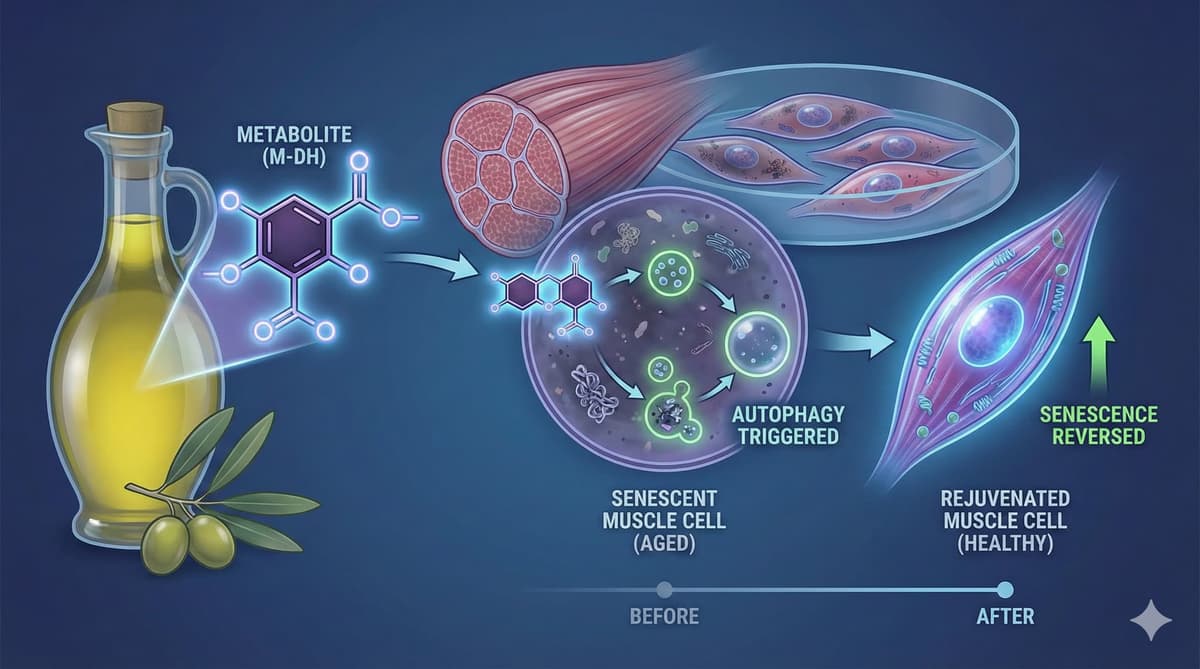
Researchers at the University of Udine and Sorbonne Université identified Oleuropein Aglycone (OLE), a polyphenol in extra‑virgin olive oil, as a potent activator of the AMPK‑FOXO3a‑Sestrin pathway in human skeletal‑muscle cells. In vitro experiments showed a 43% reduction in reactive oxygen...

Cyclarity Unveils Oxidized Cholesterol Excretion Data
Cyclarity Therapeutics presented Phase 1 data for UDP-003, its cyclodextrin drug that binds and removes oxidized cholesterol (7‑ketocholesterol) from humans. The Monash Victorian Heart Institute trial showed dose‑dependent urinary excretion of 7KC, with no serious adverse events and a short...
Magnesium-Acetyl-Taurate Superior to Magnesium L-Threonate? Recent Study Poinst to This Being True
A recent pre‑clinical rat study compared magnesium‑acetyl‑taurate (MAT) with magnesium L‑threonate (MLT) and found MAT superior in raising magnesium concentrations in brain tissue, blood plasma, cerebrospinal fluid, and muscle. MAT also delivered greater gains in spatial learning, memory, anxiety‑related behavior,...