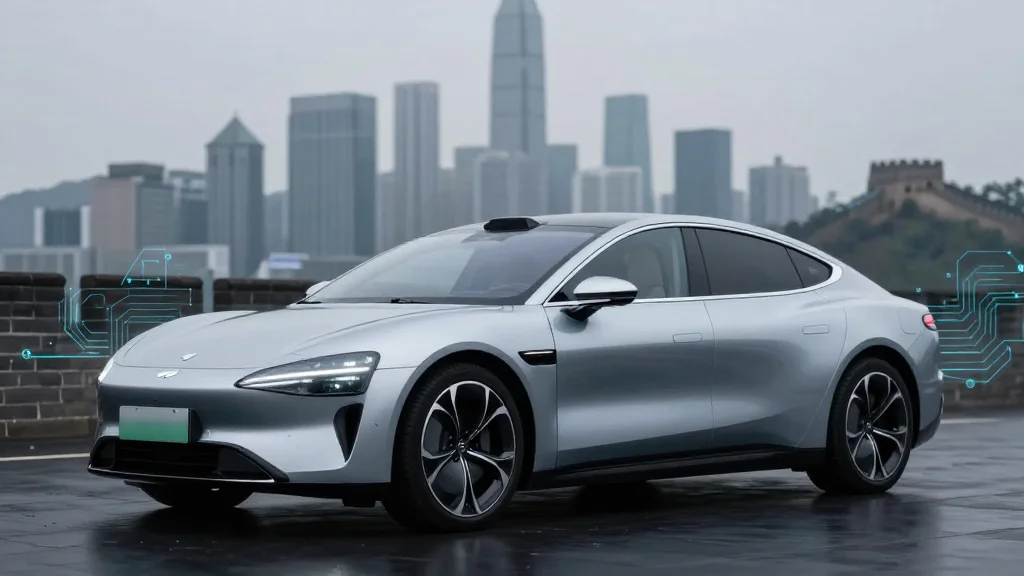
Volkswagen Group Unveils AI‑Driven "In China, for China" EV Campaign at Beijing Media Night

Companies Mentioned
Why It Matters
Volkswagen’s AI‑powered "In China, for China" campaign illustrates how automakers are merging product innovation with data‑driven marketing to win over China’s fast‑evolving consumer base. By committing to a rapid rollout of new EVs and leveraging AI to personalize outreach, VW aims to capture a larger slice of a market that already accounts for a third of global vehicle sales. The approach could set a new benchmark for how legacy manufacturers compete with tech‑native rivals, influencing budgeting, talent acquisition and partnership strategies across the automotive sector. Beyond China, the success of AI‑enhanced brand activation may prompt other global brands to adopt similar tactics, accelerating the convergence of automotive engineering and digital marketing. If Volkswagen demonstrates measurable lift in conversion rates and sales velocity, the model could become a template for multinational campaigns in other high‑growth regions such as India and Southeast Asia.
Key Takeaways
- •Volkswagen Group unveiled four world‑premiere EV models at Beijing’s Auto China 2026 Media Night
- •CEO Oliver Blume emphasized the AI‑driven "In China, for China" strategy as a global tech driver
- •Ralf Brandstätter announced a rollout cadence of a new vehicle every two weeks starting 2026
- •AI systems will personalize ads across Baidu, WeChat and e‑commerce platforms, aiming for double‑digit lift in conversion
- •VW plans to launch over 20 new electrified models in 2026, targeting up to 1.5 million units annually
Pulse Analysis
Volkswagen’s Beijing media night marks a strategic inflection point where product development, localized engineering and AI‑centric marketing converge. Historically, the Group’s China strategy relied on joint‑venture badge engineering; the current push signals a shift toward owning the entire value chain—from the China Electronic Architecture (CEA) that underpins the ID. AURA series to the AI algorithms that dictate media spend. This vertical integration reduces time‑to‑market, a critical advantage in a market where consumer preferences evolve within weeks.
The two‑week vehicle cadence is ambitious, but it mirrors the software‑first mindset of Chinese tech firms. By treating each model launch as a modular release, VW can iterate quickly, gather real‑world data, and feed insights back into both product refinement and marketing personalization. The AI platform’s ability to segment audiences at a micro‑level could also mitigate the risk of over‑saturation in a crowded EV landscape, where brand differentiation increasingly hinges on digital experience rather than just hardware.
However, the strategy is not without risks. Rapid launches demand a robust supply chain and flawless execution across multiple joint ventures, each with its own governance. Any hiccup—be it component shortages or software bugs—could erode consumer trust. Moreover, the AI‑driven approach raises data‑privacy considerations in a regulatory environment that is tightening around consumer data usage. Volkswagen will need to balance personalization with compliance to avoid backlash.
If Volkswagen can navigate these challenges, the payoff is substantial: a reinforced foothold in the world’s largest auto market, a scalable AI marketing engine, and a blueprint for replicating the model in other high‑growth regions. Competitors will likely accelerate their own AI investments, ushering in a new era where automotive branding is as much about algorithmic precision as it is about engineering excellence.
Volkswagen Group Unveils AI‑Driven "In China, for China" EV Campaign at Beijing Media Night
Comments
Want to join the conversation?
Loading comments...