

AI Just Took Half the Data Engineering Jobs. Here's What's Left.
The video argues that AI is not eliminating data engineers but redefining the role, outlining a 2026 AI‑enhanced data engineering stack that promises to keep the top 1% of engineers job‑proof. Founder Chris Garzone of Data Engineer Academy walks viewers through how AI now handles everything from SQL and Python development to automated documentation, positioning AI as a productivity multiplier rather than a threat. Key insights include AI‑driven automation across the entire data pipeline: ingestion tools auto‑document schemas and suggest design changes; transformation layers like DBT are scaffolded by AI models such as JITBT or Claude; orchestration platforms (e.g., Airflow) generate retry logic and self‑healing code; observability suites (Soda, Monte Carlo) detect anomalies, alert engineers, and propose root‑cause fixes; and documentation generators (Autodoc, DBT docs) produce column‑level metadata at ten‑fold speed. Garzone cites concrete examples: AI flagged a sudden dip in Amazon’s daily revenue, pinpointing upstream pipeline failures; AI‑generated DBT infrastructure eliminated manual code copying; and vector databases with LangChain enabled a technical program manager to retrieve complex revenue queries via natural language, bypassing analysts entirely. He also promotes a free interview‑prep guide derived from 2,000 student interviews, reinforcing the academy’s up‑skilling mission. The implication is clear: data engineers who adopt this AI stack will command higher salaries, promotions, and market relevance, while those who cling to legacy tools risk obsolescence. The window for learning these technologies is narrow, making early adoption a strategic career move.

Is AI Just a Fad?
The video opens with a personal anecdote about receiving a "non‑negotiable" job offer from Amazon straight out of college, highlighting how such language can intimidate young professionals. The speaker discovered wide salary variance among peers and realized the offer was...

Data Engineering Roadmap 2026: Skills, Timeline, Salary
The speaker outlines a proactive ‘data engineering roadmap’ strategy for orchestrating career and salary growth over a multi‑year horizon. Using a friend’s five‑year plan as an example—mapping promotions and job switches that boosted total compensation from about $100k to roughly...

Job Hopping Is Why Some Data Engineers Make Way More
The video argues that frequent job-hopping can dramatically increase lifetime compensation for data engineers, claiming switchers can earn 10–20 times more than long-tenured employees. Using a hypothetical 10-year comparison, the speaker says a stay-at-home trajectory might grow from $100k to...

How Data Engineers Saved Lyft Millions in Failed Payments
Lyft’s Lift Pink subscription, offering monthly discounts, faced a surge of failed renewal payments as many users entered faulty credit‑card information during free‑trial sign‑ups. The churn threatened revenue and highlighted a systemic data‑quality problem. The engineering team discovered that transaction, payment,...

Why You’re Not Getting Hired (Wrong Role, Wrong Strategy)
The adviser tells a job seeker that their main problem is targeting the wrong role—applying as a performance engineer when they should be pursuing data engineering or AI roles—and that performance engineering may be becoming less in demand. They warn...

AI Isn’t Taking Your Job—You’re Using It Wrong
The video argues that artificial intelligence will not eliminate jobs; instead, it will add work that can be completed faster and with less effort. Using a crane analogy, the speaker likens AI to a tool that speeds construction for those...

Is AI Going to Take Over Data Engineering?
The speaker argues that AI will significantly affect data engineering but not fully replace it, using a crane-building analogy: AI is a tool that speeds work and increases productivity. While automation may reduce some roles, it can also expand capacity,...

I Answered Every Data Career Question for 10 Hours (Zero to $350K)
Christopher Garzon, founder of the Data Engineering Academy, hosted a ten‑hour AMA covering his rapid rise from an Amazon data analyst to a $450K‑earning data engineer at Lyft and the launch of his training program. He outlines compensation strategies, imposter‑syndrome...

Why Real-World Projects Beat Online Courses
The video argues that learning through real‑world projects is far more effective than relying solely on online courses or theoretical lectures. The speaker illustrates this with a personal example: receiving a fraud alert on an American Express card makes the concepts...

Stop Learning 100 Tools—Master AWS Instead
The speaker advises job-seekers targeting higher-paying data roles to deepen expertise in one dominant cloud platform—AWS—rather than skimming many tools like Snowflake, Databricks or other clouds. They argue proficiency exists on a continuum and recommend mastering enough AWS to reliably...

Can You Really Make $200K–$500K in Data? Students Ask the CEO
In an AMA, a CEO fielded prospects’ questions about transitioning into high-paying data and AI roles, outlining a structured program that builds technical skills, produces portfolio projects, and reshapes resumes. He emphasized leveraging existing career experience while learning data engineering/AI...

AI Won’t Replace Data Engineers—It’ll Multiply Them
The video argues that artificial intelligence will not eliminate data engineering roles but will function like a construction crane—speeding up the building process without replacing architects or laborers. By framing AI as a productivity tool, the speaker emphasizes that data...

How to Use AI to Work Faster as a Data Engineer
The video explains how data engineers can leverage AI tools like ChatGPT to speed up routine tasks such as writing SQL and provisioning AWS infrastructure. It emphasizes that AI should be used after mastering core skills; AI can instantly locate bugs...

Will AI Replace Data Engineers? The Real Answer
The video tackles the hot question of whether artificial intelligence will make data engineers obsolete. The speaker argues that AI will not replace these professionals; instead, it depends on them to supply clean, well‑structured data and the compute power needed...

Worried AI Will Take Your Job? Watch This.
AI should be seen as a force multiplier rather than a replacement for human skills, according to the speaker. Workers shouldn’t skip learning core tools—like SQL or cloud infrastructure—because AI can perform tasks they don’t yet know; instead, they should...

🚨 AI That Fixes Data Pipelines By Itself? Big Tech Is Already Doing This
Big tech is rapidly embedding AI into data pipelines to detect anomalies and errors in real time and, increasingly, to automatically repair issues as data flows through systems. Advances now extend these capabilities from structured to unstructured data—like audio and...

The Job Application Funnel That Got Me $450K at Lyft
In this video, Data Engineer Academy founder Chris Garzone breaks down the job‑application funnel that helped him earn $450,000 at Lyft and shows data‑professionals how to replicate the process. He emphasizes the first step of measuring the interview conversion rate—how...

Data Engineering Is Booming—Stop Being Skeptical
The video addresses the rapid growth of data engineering and challenges the skepticism many software, backend, and QA professionals feel about entering the field. The speaker argues that formal data‑engineering degrees or certificates are scarce, keeping the talent bar low. Recruiters...

Software Support to Data Engineer: $130K to $180K+
The video argues that moving from a software support position to a data‑engineering role can dramatically increase compensation, citing a typical jump from $130,000 to $180,000 or more. The speaker emphasizes the “up‑and‑over” strategy: by leveraging fifteen years of technical experience,...

Data Engineers Are #1 in Demand—Do Your Research
In a recent talk titled “Data Engineers Are #1 in Demand—Do Your Research,” the speaker urges data professionals to replace cynicism about AI with concrete market research. He argues that the prevailing belief that upskilling is unnecessary because AI will...

Data Engineering Salary Questions Answered | $60K to $450K Journey
The video is an AMA session that walks prospective data‑engineering candidates through the full compensation spectrum—from entry‑level $60K salaries to senior roles that can command $450K. The host fields live questions from participants, explains how the program tailors cover letters...

How Data Engineers Saved Lyft Millions in Failed Payments
Lyft’s Lift Pink subscription, offering monthly discounts, faced a surge of failed payments when free‑trial users attempted to renew, threatening millions in lost revenue. Data engineers discovered that faulty or fake credit cards were the primary cause. Because transaction, card, and...
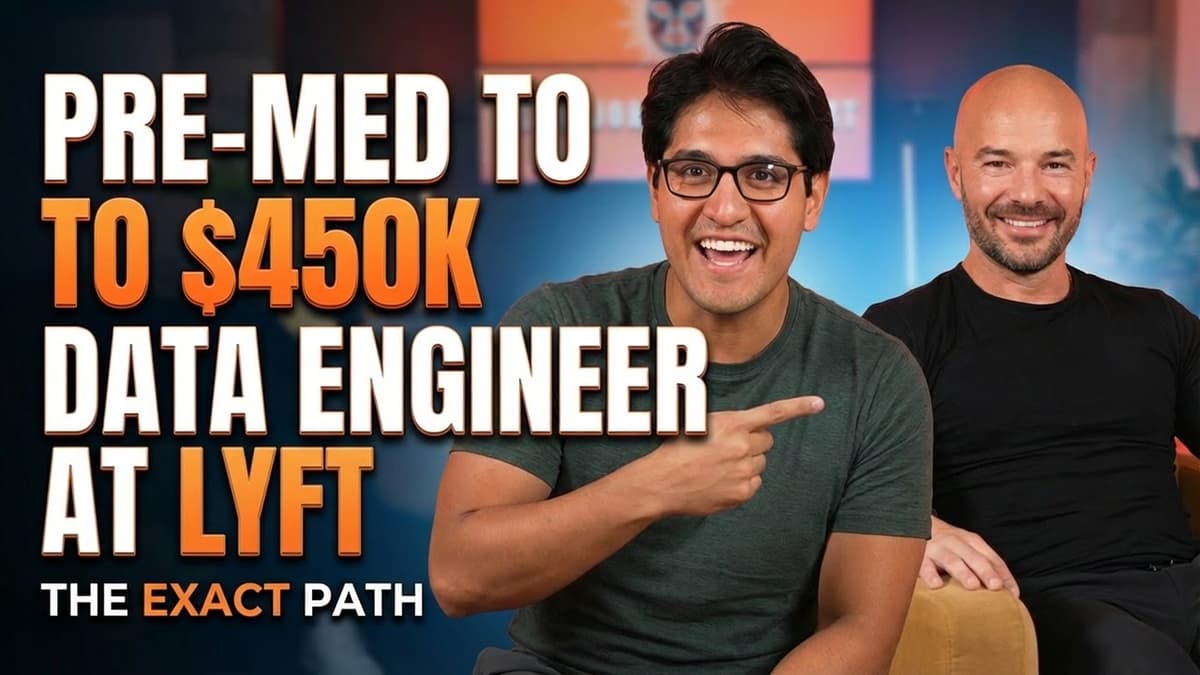
I Made $450K as a Data Engineer at Lyft—Here's My Exact Path
The video chronicles a former Boston College pre‑med student who pivoted to data engineering, ultimately earning $450 K at Lyft and launching a career‑coaching side hustle. He emphasizes self‑directed learning, rapid skill acquisition, and the power of community platforms to fill...

Data Engineering Explained in 2 Minutes (The Most Underrated Career)
The video demystifies data engineering, describing it as the hidden foundation that powers every modern tech function. Using a house‑building analogy, the speaker likens data engineers to the electricians and plumbers who lay the wiring and pipes before designers add...

Why Soft Skills + PySpark Can Land You Lead Data Engineer Roles
The video highlights how a blend of soft skills and PySpark proficiency can catapult engineers into lead data‑engineer positions, especially in the Bay Area’s startup ecosystem. The speaker recounts a chance encounter with a medical‑device startup founder that led to...

Stop Blaming the Market: Land Your Data Job Now
The video challenges the common excuse that a "bad" or "good" job market dictates when to pursue a data career. Instead, it argues that market conditions are perpetually shifting, and candidates should focus on actions within their control—namely, skill acquisition...

Data Engineering Is Undervalued
Data engineering is often the most overlooked discipline, yet it provides the essential infrastructure that powers analytics, AI, and business intelligence. By constructing reliable extraction, transformation, and loading pipelines, engineers turn raw inputs into clean, query‑ready datasets. This foundational work...

Job Hopping Is Why Some Data Engineers Make Way More
Data engineers who change jobs strategically and continuously upskill are earning significantly more than their loyal counterparts. Recent analyses show that frequent moves can increase compensation by as much as 30 percent, while staying at a single firm can cost...
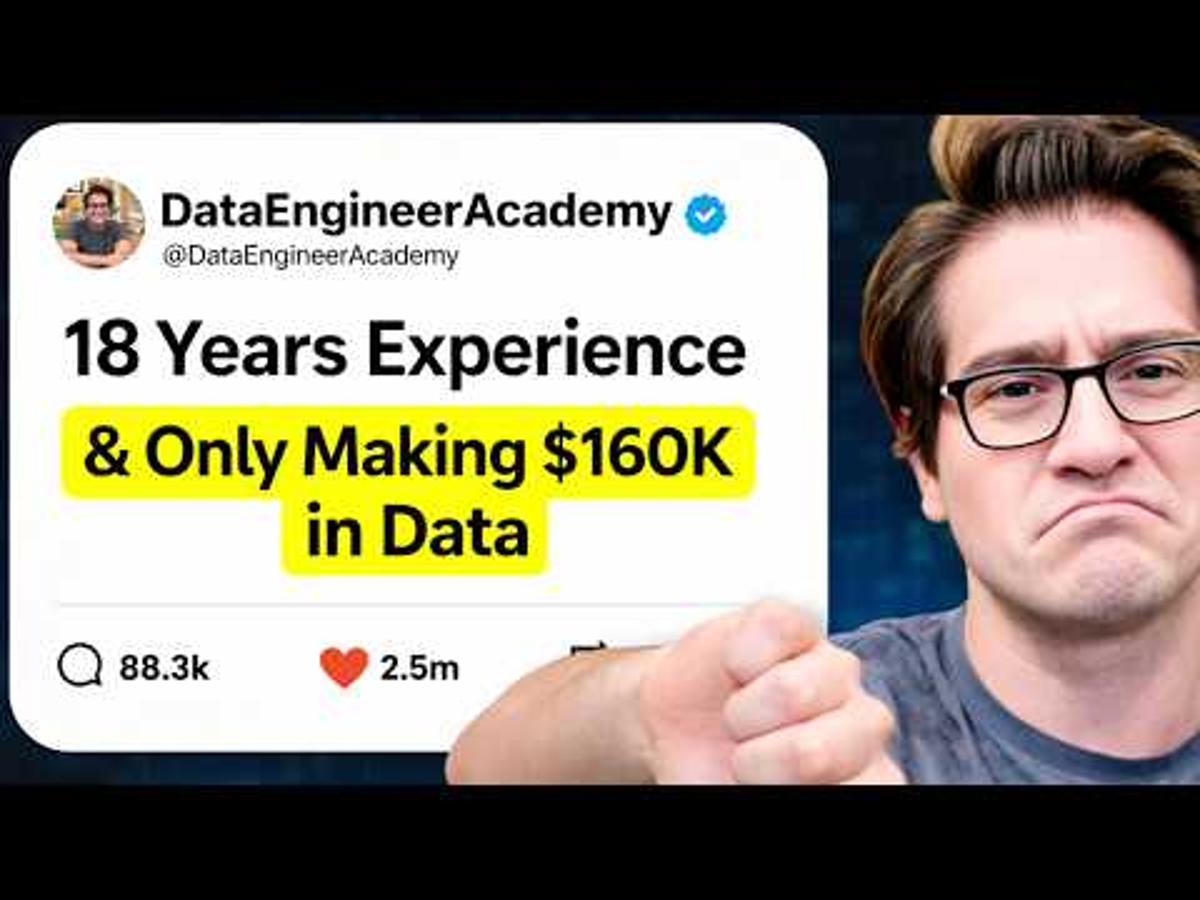
18 Years Experience & Only Making $160K in Data (Live AMA with CEO of Data Engineer Academy)
The live AMA hosted by the CEO of Data Engineer Academy centered on a senior data professional who, after 18 years in the field, was earning only $160,000. Participants asked how to break through the compensation ceiling and transition into...

10 System Design Interview Tips That Got Me to $500K
The video, presented by Chris Garzone, founder of Data Engineer Academy, outlines a systematic approach to acing system‑design interviews for data‑engineering roles. Garzone shares tips drawn from his "System Design Cheat Code" book, emphasizing how candidates can move from a...

Online Bootcamps vs Data Engineering Course - Which One Gets You Hired? (Live Q&A)
The video is an Ask‑Me‑Anything session where a data‑career coach fields live questions from professionals eyeing higher‑paid roles in data engineering, product management, or technical program management. Participants range from senior clinical data programmers to administrative service managers, each seeking...

Stop Chasing Titles—Maximize Your Data Salary Instead
The video urges engineers to stop obsessing over titles and instead invest in soft‑skill development that drives business value. It argues that while technical prowess gets candidates through early screening, the interview’s most anxiety‑inducing stage—soft‑skill assessment—filters out the majority of...
Will AI Replace Data Engineers? Here’s the Truth
The video tackles the hot question of whether artificial intelligence will supplant data engineers, concluding that AI is a powerful augmenting tool rather than a job‑killer. Using a crane analogy, the speaker illustrates how new technology speeds construction without eliminating...

Data Engineers in 2025: Stop Being Skeptical, Start Researching
Data engineers are at a crossroads in 2025, as the speaker argues that lingering skepticism about AI's impact is holding professionals back. He urges data practitioners to replace doubt with diligent research into labor market trends and compensation data. The talk...

Fear Is Costing You Millions in Your Data Career
The video warns that fear is a hidden, multi‑million‑dollar drain on data‑focused careers. Drawing on a 2025 study of over 100,000 professionals, the speaker highlights that roughly nine‑tenths of respondents have been dissatisfied with their roles for more than two...

From Software Support to Data Engineer: $50K+ Salary Jump
The video advises seasoned software‑support professionals to pivot into data engineering, arguing that the transition can unlock a substantial salary boost—often exceeding $50,000. With 15 years of experience, a support engineer earning $130,000 can realistically target $180,000 as a data engineer....

Are You Competitive for a Data Engineer Job?
The video tackles a common concern among software, backend, and QA professionals: whether their existing skill set positions them competitively for data engineering roles. It highlights that formal data‑engineering degrees or certificates are still scarce in most universities, meaning the...

Stop Chasing Titles—Optimize for Pay in Tech
The video urges tech professionals to abandon title chasing and focus on compensation. The speaker cites stark examples: a 20‑year veteran earning $120,000 while he earned $500,000 with just five years of experience, and junior roles often paying two to...

How to Build a RAG System Companies Actually Use
The video walks viewers through building a Retrieval‑Augmented Generation (RAG) system that can be deployed in real‑world enterprises. It starts by defining RAG as a technique that feeds a company’s internal documents into a large language model so the model...

Future-Proof Your Data Career: Think + Do (AI Can't Replace This) 🧠
The video argues that staying relevant in data engineering hinges on two complementary abilities – the capacity to think like an architect and the ability to execute efficiently using AI tools. First, the speaker stresses that designing system architectures requires deep...
Social Media Lied To You. Companies Are Hiring THIS Instead 💼
The video argues that, contrary to the buzz surrounding the latest generative‑AI gadgets, the strongest hiring signal today is a surge in data‑engineering talent. Citing the World Economic Forum’s Jobs Report, the presenter notes that data‑warehousing, data engineering and big‑data...

AI Won't Take Your Job. But THIS Person Will 😳
The video contends that artificial intelligence will not eliminate data‑engineering roles; instead, it will generate new opportunities as AI systems depend on high‑quality data. The speaker explains that data is the primary moat for any AI product, and only humans can...
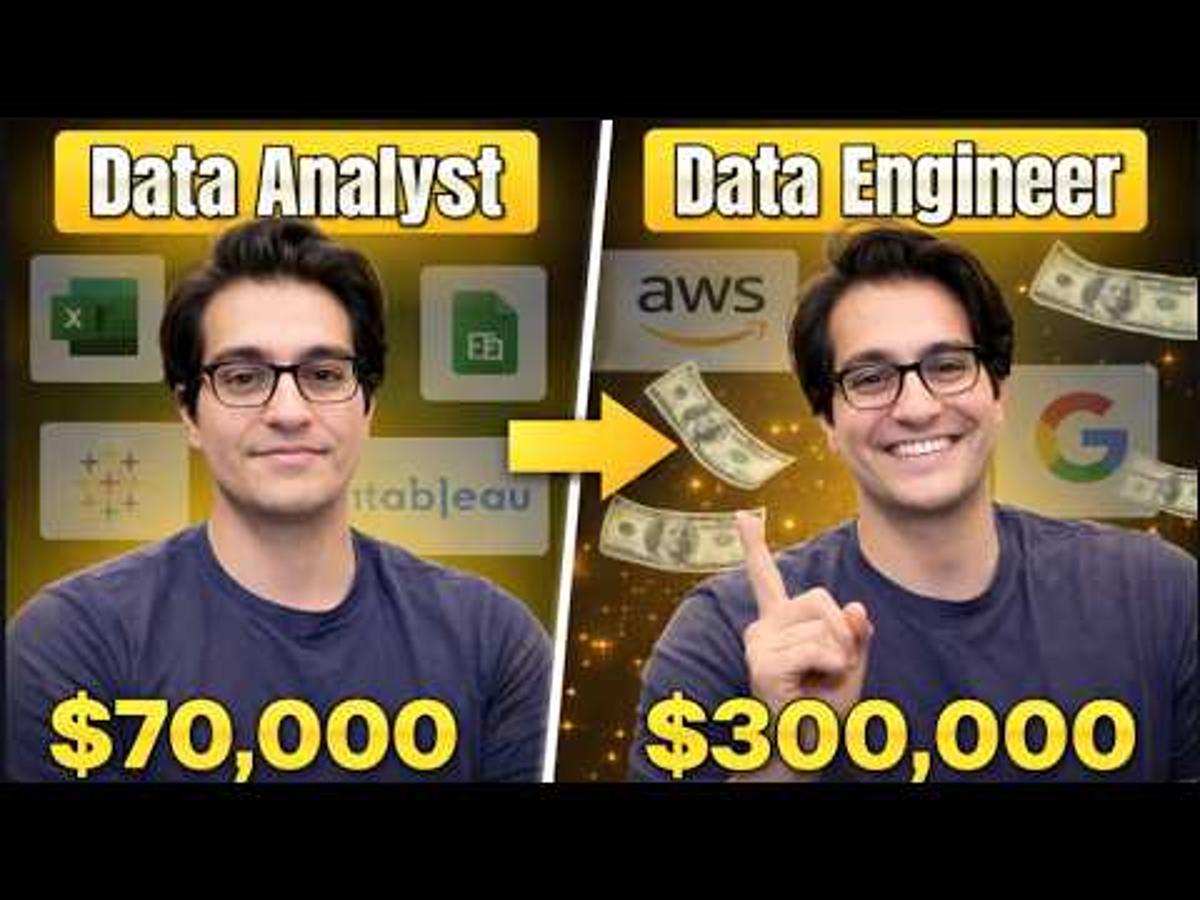
Data Analyst to Data Engineer: The Exact Roadmap to Nearly Quadruple Your Salary
The video explains how data analysts can transition into data engineering roles, a move that can nearly quadruple compensation. Chris Garzone outlines the fundamental differences between the two positions, emphasizing that analysts typically work with Excel, SQL, and dashboards, while...

What No One Tells You About Data Engineering
The video tackles the pervasive myth that the data‑engineering job market is either booming or collapsing, urging viewers to see it as a constantly shifting landscape. The speaker recounts hearing opposite excuses—from “the market is great, no need to upskill”...

Data Engineering Roadmap 2026 (Skills, Timeline, Salary)
The video warns data engineers and other tech professionals that staying in the same role without updating their skill set often leads to stagnant wages. It argues that the abilities a company hired you for may no longer align with...

Data Engineering Roadmap 2026: Skills, Timeline, Salary
The video outlines a pragmatic roadmap for data engineers aiming to accelerate their careers through 2026, emphasizing the power of a five‑year, salary‑focused plan rather than ad‑hoc moves. The presenter shares that systematic preparation—weekly coding drills, quarterly interview simulations, and continuous...