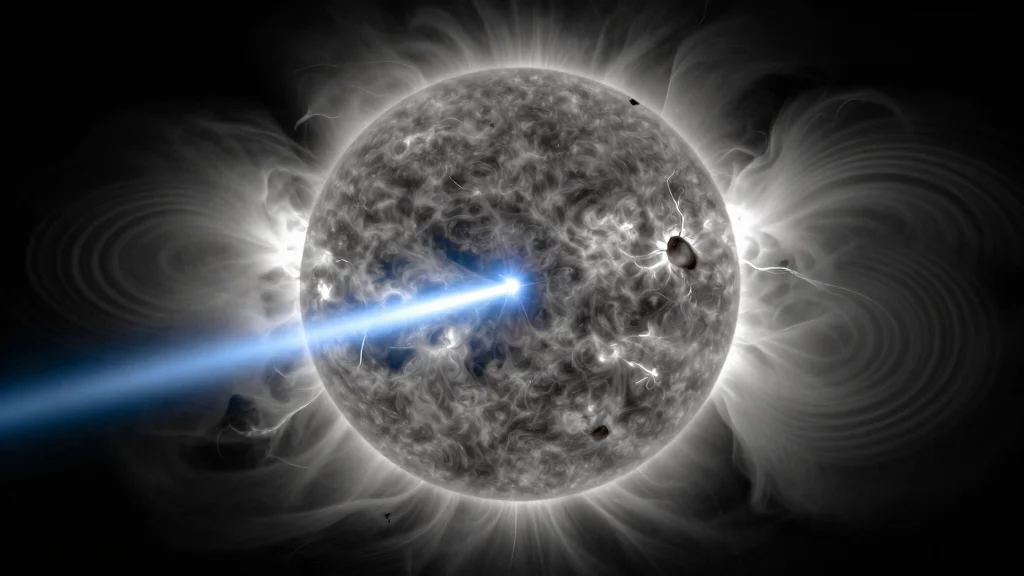
Closer Look at the Sun Reveals More Chaotic Magnetic Heart
A recent analysis of Parker Solar Probe data reveals that protons and heavy ions respond differently to magnetic reconnection near the Sun. Heavy ions are accelerated in tight, laser‑like beams, while protons generate scattering waves that disperse subsequent particles. This divergence contradicts prevailing models that assume uniform particle behavior during reconnection. The study, published in Astrophysical Journal Letters, suggests a more complex magnetic engine driving solar eruptions and space‑weather events.

Nickel-Rich Rocks Discovered by Perseverance Hint at Complex Chemistry on Early Mars
Perseverance’s instruments detected unusually high nickel concentrations—up to 1.1 % by weight—in 32 sedimentary rocks within Neretva Vallis, the ancient river channel feeding Jezero crater. The nickel is tightly associated with iron‑sulfide minerals and sulfate phases such as jarosite and akaganeite,...

Earth’s Building Blocks Came From Close to Home, Planetary Scientists Say
A new isotopic analysis of ten element systems shows Earth formed exclusively from inner‑solar‑system material, overturning theories that outer‑solar material contributed to its makeup. Researchers from ETH Zurich applied a rarely used statistical method to meteorite data, finding Earth’s composition...

Chimpanzee’s Drum Solo Offers Clues to Origins of Music
Researchers examined 89 spontaneous performances by Ayumu, a captive male chimpanzee, revealing structured, tool‑driven drumming with isochronous timing and a play‑face indicating positive affect. Transition analysis showed non‑random sequencing that partially mirrors chimp pant‑hoot patterns, and tool use produced a...