How to Implement EOS in SaaS: How SaaS Founders Actually Make the Entrepreneurial Operating System Work (and Where It Breaks)

Companies Mentioned

Why It Matters
EOS provides SaaS leaders with a repeatable structure that surfaces problems early and enforces accountability, directly influencing growth velocity and operational resilience.
Key Takeaways
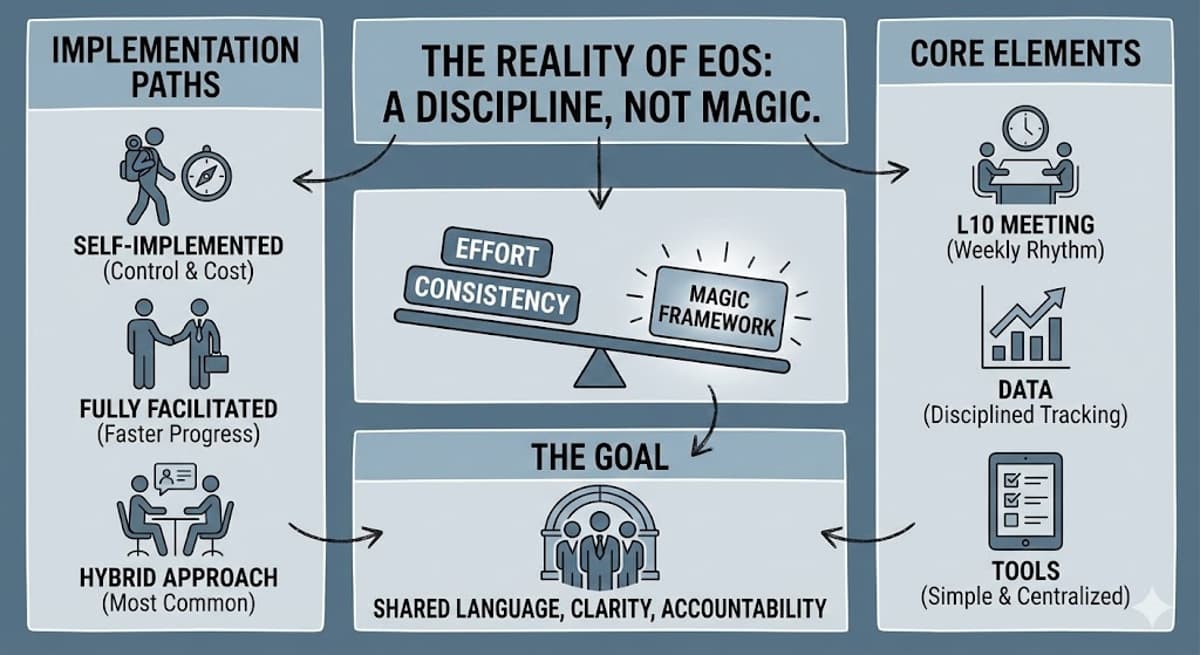
- •Self‑implementation saves money but risks founder fatigue
- •Facilitators accelerate adoption and enforce accountability
- •Hybrid model balances external guidance with internal ownership
- •Weekly L10 meetings drive data‑driven issue resolution
- •Simple tools work; discipline outweighs software sophistication
Pulse Analysis
In the crowded SaaS landscape, the Entrepreneurial Operating System (EOS) stands out not for its novelty but for its relentless focus on discipline. By establishing a shared language and a predictable cadence—most notably the weekly Level 10 meeting—EOS forces leadership teams to confront reality each week. This regularity transforms vague accountability into concrete, data‑driven decisions, helping founders cut through the noise of vanity metrics and prioritize actions that truly move the needle.
Practitioners report three dominant implementation pathways. Self‑implementation offers cost savings but often leaves founders exhausted as they become de‑facto referees. Fully facilitated engagements bring external pressure and rapid progress, yet the high day‑rate can strain budgets. The hybrid approach, where a facilitator jump‑starts the system before handing it over to internal owners, combines the best of both worlds, delivering structure without long‑term dependency. Across these models, the consistency of weekly metrics review and quarterly "rocks" proves far more critical than strict adherence to the EOS playbook.
Scaling EOS beyond the executive suite is achievable through layered Level 10 meetings that keep groups small and focused. Simple tools—Google Sheets, ClickUp, or the native Ninety platform—are sufficient as long as data ownership is clear and meetings remain non‑negotiable. Crucially, founders must stay actively engaged; delegating EOS entirely erodes credibility and stalls momentum. When SaaS companies commit to the rhythm, EOS becomes a silent engine of operational excellence, turning disciplined execution into a sustainable competitive edge.


Comments
Want to join the conversation?
Loading comments...