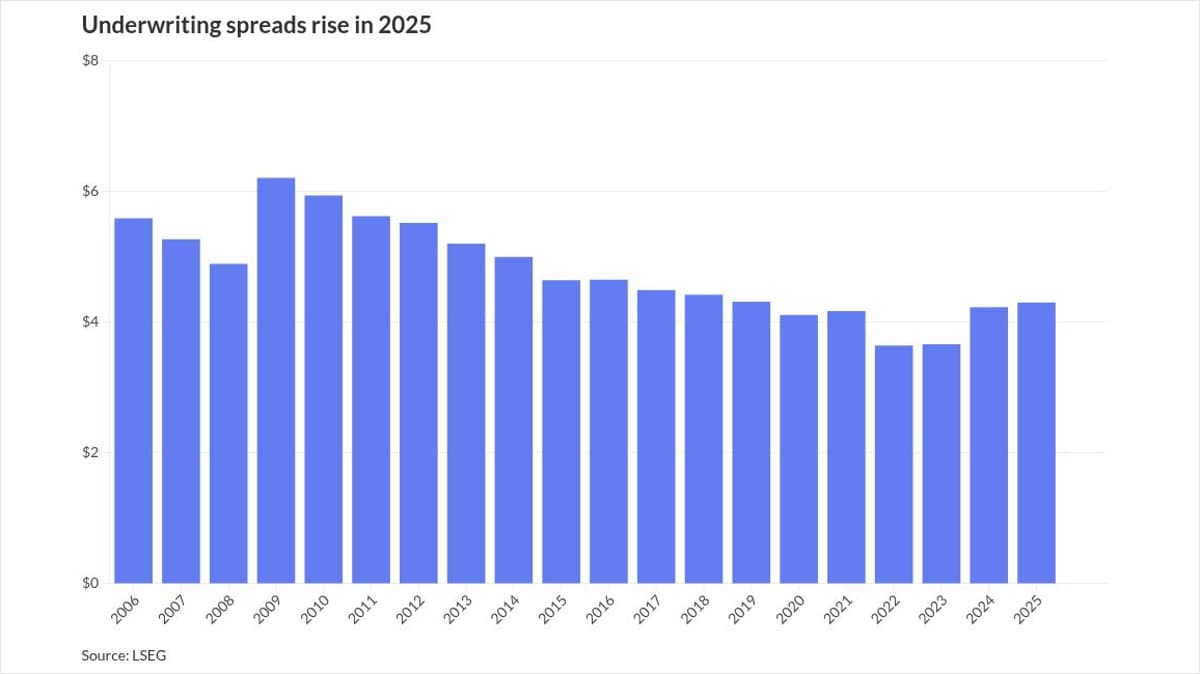
Underwriting Spreads Rise in 2025
Why It Matters
Higher spreads raise the cost of capital for state and local borrowers, signaling tighter market conditions and potentially influencing fiscal budgeting and bond pricing strategies.
Key Takeaways
- •2025 average spread $4.30, up from $4.23
- •Negotiated spreads $4.64; competitive spreads $1.78
- •Record issuance $586B fuels spread widening
- •Underwriters absorb rate volatility, balance‑sheet risk
- •Citi and UBS exits tighten muni underwriting capacity
Pulse Analysis
The resurgence of underwriting spreads in 2025 marks a structural shift in the municipal bond market after fifteen years of gradual compression. While the headline figure of $4.30 per $1,000 may appear modest, it reflects a broader rebalancing as underwriters grapple with heightened interest‑rate volatility and larger balance‑sheet exposures. Dealers are now pricing risk more aggressively, especially on negotiated deals where bespoke structures demand deeper analytical resources. This dynamic is amplified by the departure of major players such as Citi and UBS, which has thinned the competitive pool and left remaining banks to shoulder a greater share of distribution risk.
Issuance volume is a critical driver of this pricing environment. LSEG data shows municipal issuance surged to $586 billion in 2025, eclipsing the previous year’s record and setting the stage for further growth in 2026. When supply swells, issuers compete less fiercely for underwriting capacity, allowing banks to command higher takedowns. Conversely, in low‑issuance years, underwriters cut spreads to win limited business. This inverse relationship underscores how market liquidity directly influences fee structures and, ultimately, the effective cost of borrowing for municipalities.
Looking ahead, the trajectory suggests a gradual but steady rise in spreads as issuance remains robust and dealer balance sheets stay constrained. While analysts caution against a return to the double‑digit spreads of the early 2010s, the incremental fee pressure could erode municipal budget margins, prompting issuers to seek alternative financing mechanisms or negotiate more favorable terms. Stakeholders—investors, issuers, and underwriters alike—must monitor these trends closely, as they will shape the pricing landscape and risk calculus for municipal finance in the coming years.
Underwriting spreads rise in 2025


Comments
Want to join the conversation?
Loading comments...