
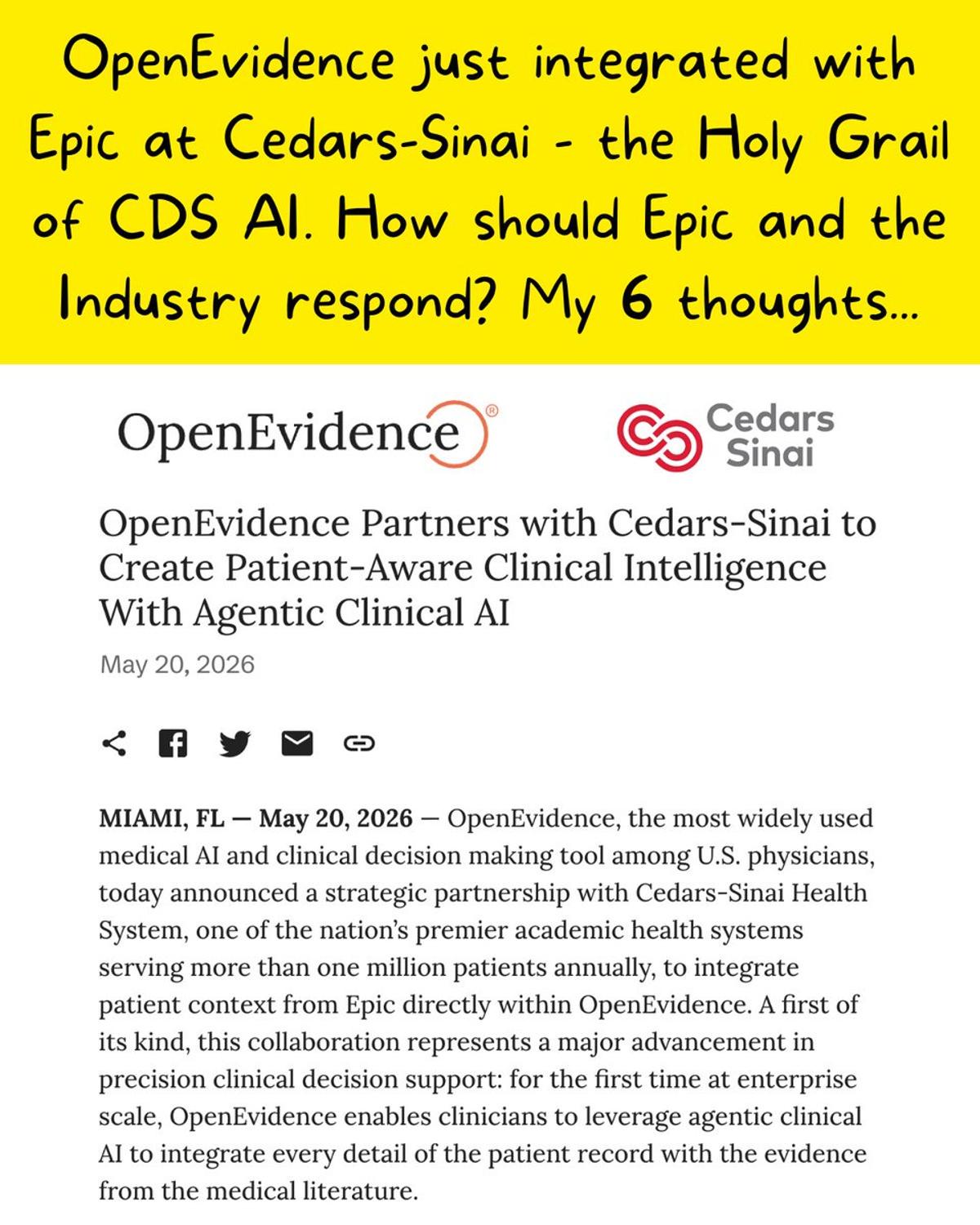
Cedars Sinai Deploys Live Patient‑Context AI for Clinical Decision Support
Cedars Sinai clinicians are the FIRST to use OpenEvidence to integrate live patient context from Epic and access personalized CDS AI. My 6 thoughts on what this means for the industry: First, the gist of what was announced: → Clinicians can ask questions in natural language and receive answers grounded in both research guidelines AND the specific patient in front of them (the holy grail of CDS AI!) → Patient context includes prior procedures, comorbidities, medications, allergies, and longitudinal health data - not just a summary snapshot → The system operates agentically: it interprets the clinical question, dynamically pulls relevant EHR data, evaluates current literature, and synthesizes a context-aware answer → Cedars-Sinai is also going to display its own protocols and guidelines alongside the medical literature, so clinicians can see both Alright my 6 thoughts: 1/ This reduces the friction to clinicians at Cedars Sinai trying OE. If you were using one of the other CDS AI tools before, you’d be hard pressed to now. You just save so much more time. 2/ It’s inevitable that Epic will just build the same integration with OE, UpToDate, Doximity and others directly into the chat bar interface (new Epic Toolbox category soon?) - where clinicians already do all their other actions with Epics AI clinician assistant “Art”. The pitch from Epic will be “why would you want to open up a separate tab every time you want to ask an AI assistant to do something?” - and they’d be right. When the output from the CDS AI is mostly plain text, it’s not so important for the CDS AI to own the UI/UX. 3/ But if this happens, then the CDS AI tools will be no different than the AI model products in general (ie OpenAI, Anthropic) - Epic will just let health systems switch them in and out. Oh, and of course, the CDS AI tools will pay the Epic App Store fee for this. 4/ Which means if you are a CDS AI tool and you want doctors to stay in your window, you have to offer something useful beyond a chat interface. Then again, if you’re getting faster distribution because Epic facilitates more native integrations with your CDS AI model - do you care to own the UI/UX? 5/ If you’re OE, Doximity, UpToDate - your goal should be to do as many of these EHR integrations as possible to prove you are the CDS AI model of choice. Put yourself in pole position for Epic to make you their default CDS AI model and be willing longterm to give up ownership of the UI/UX to Epic - because, well, they already own it. 6/ What does this mean for the AI scribe tools like Abridge that incorporated CDS into their product? Maybe they need to make CDS AI also available outside the live clinical encounter and become the default instead of OE - because won’t physicians want to use the same CDS AI during the encounter that they use outside of it (or do they not care)? But none of this matters if health systems choose to make Epic the interface for all this.
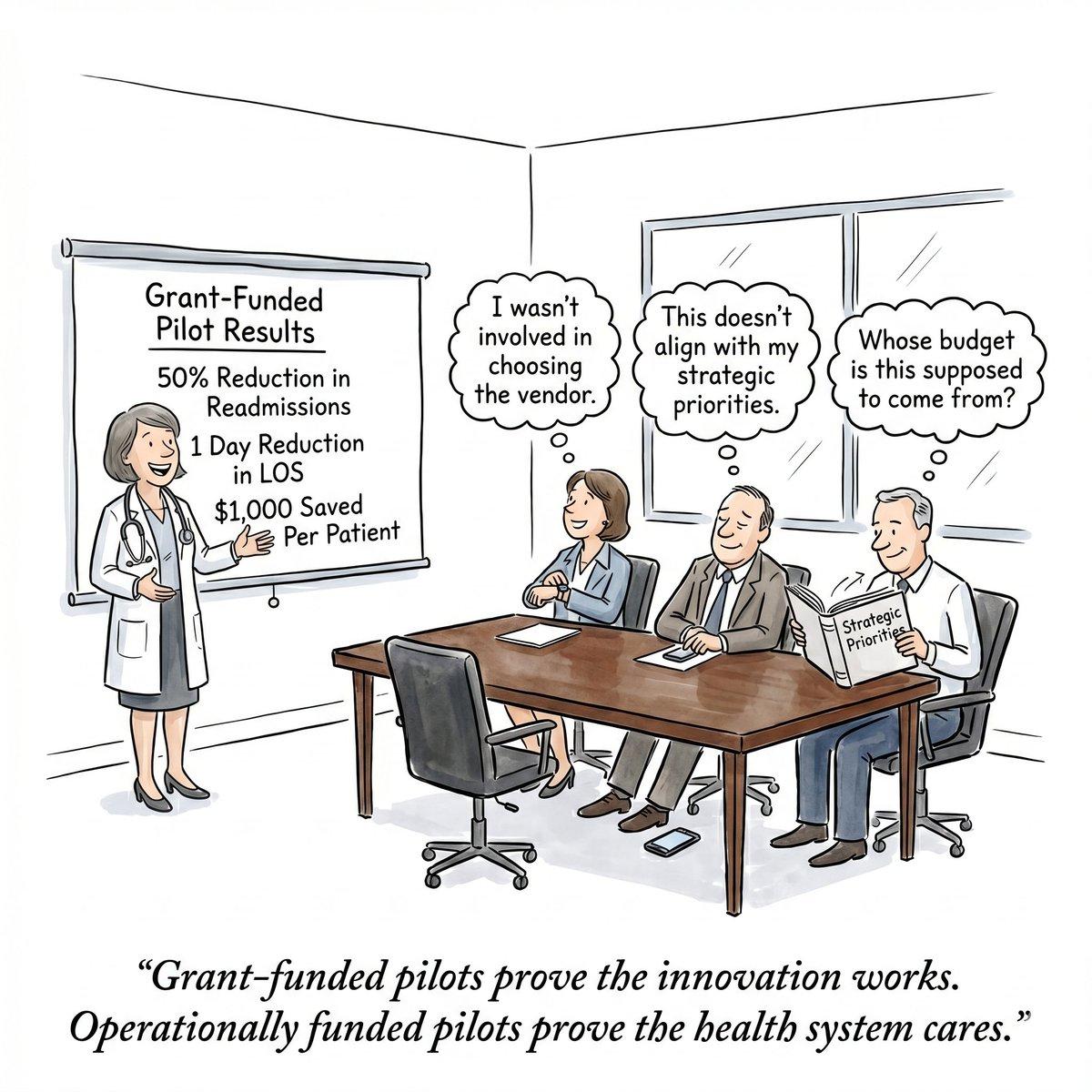
Grant Wins Often Stifle Health‑Tech Scaling
Winning a grant can be one of the WORST things that happen to your Health Tech innovation - in fact, winning a grant can be Deadly. Here's what I mean: I've done many, many grant-funded pilots of our Health Tech product...
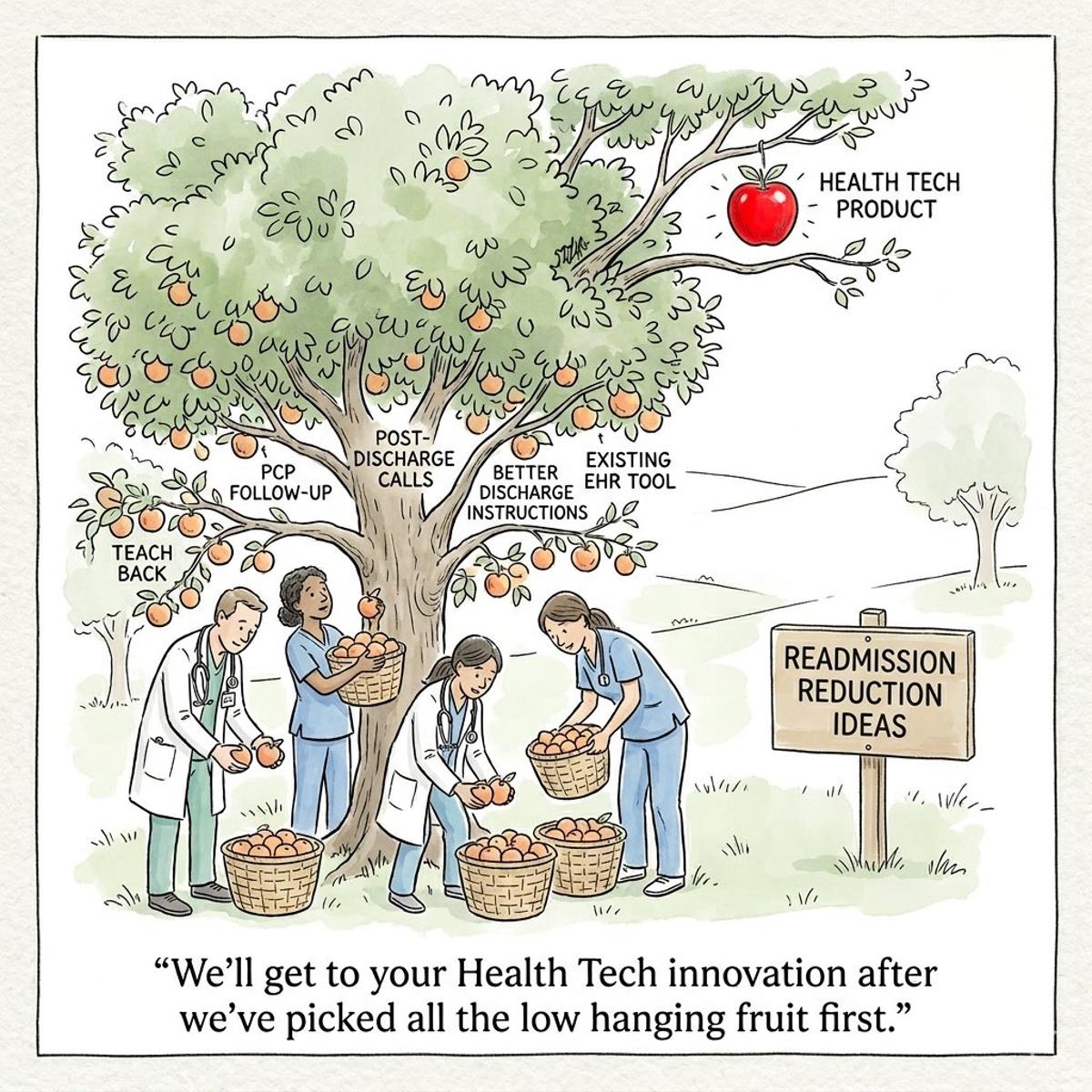
Health Tech Must Prove Value over Existing Solutions
Dear Health Tech startups: your product is the LAST resort for a health system to solve a problem. That’s why they won’t buy. Here’s what I mean… For years my investors would say to me: “@SeamlessMD has been so successful at reducing...
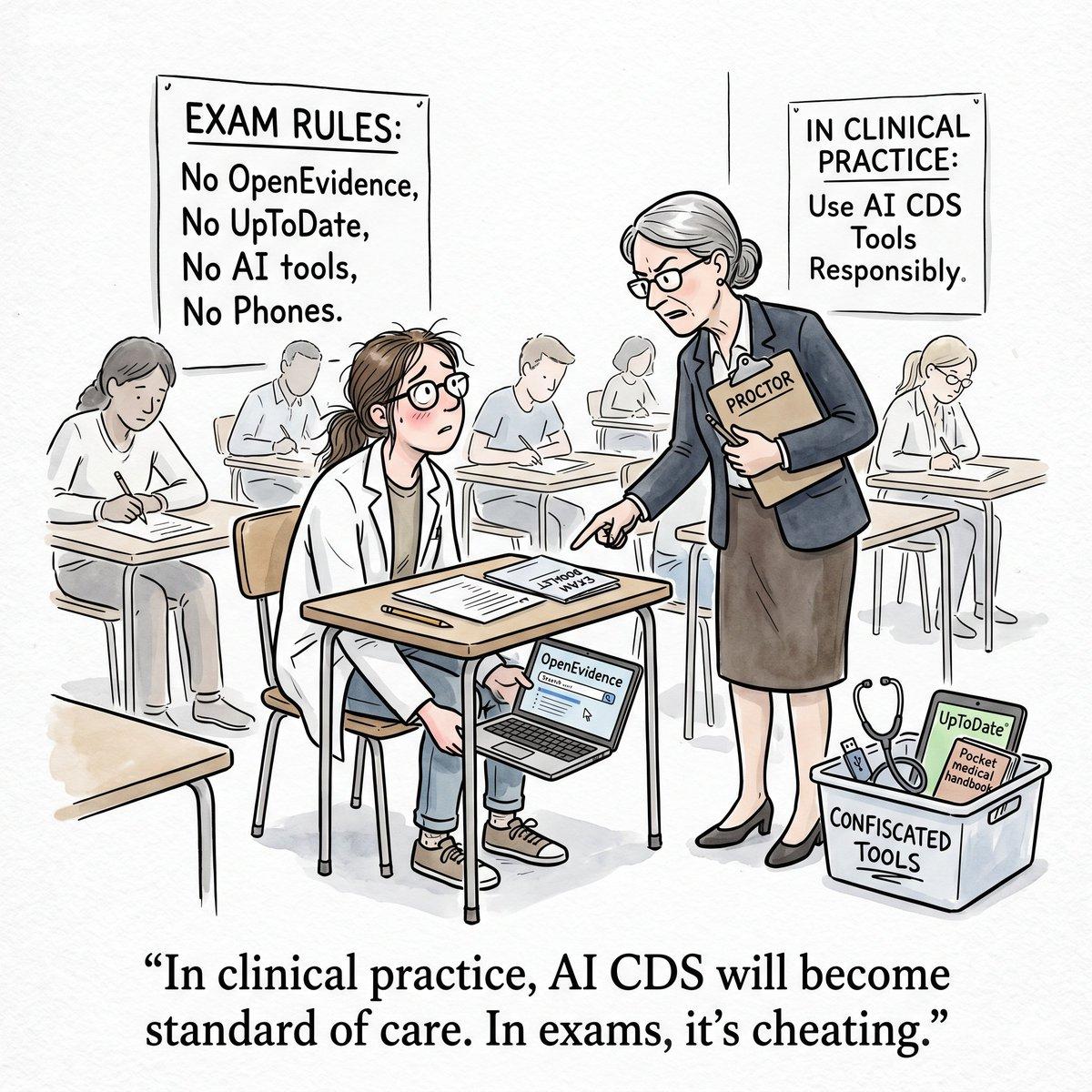
Medical Exams Must Evolve Beyond Memorization to AI
Someone failed their driving test for using their rear view camera. Should a medical trainee fail an exam if they used OpenEvidence? Medicine is about to have the same debate - except the stakes are a lot higher. When every car...
Health Tech Adoption Ignores Clinical Evidence, Despite Building It
The uncomfortable truth is that when it comes to Health Tech, clinical evidence is neither sufficient nor perhaps even necessary to drive adoption of change in healthcare This is not a new phenomenon - been living this the last 13+ years...
Google's AI Co-Clinician Outperforms Docs in Telemedicine Exams
Did Google just show us the path to the Telemedicine AI Agent of the future? Meet Google’s “AI Co-Clinician” and my prediction for how this could all play out... First, what Google shared: → A fully AI telemedicine visit where the AI...
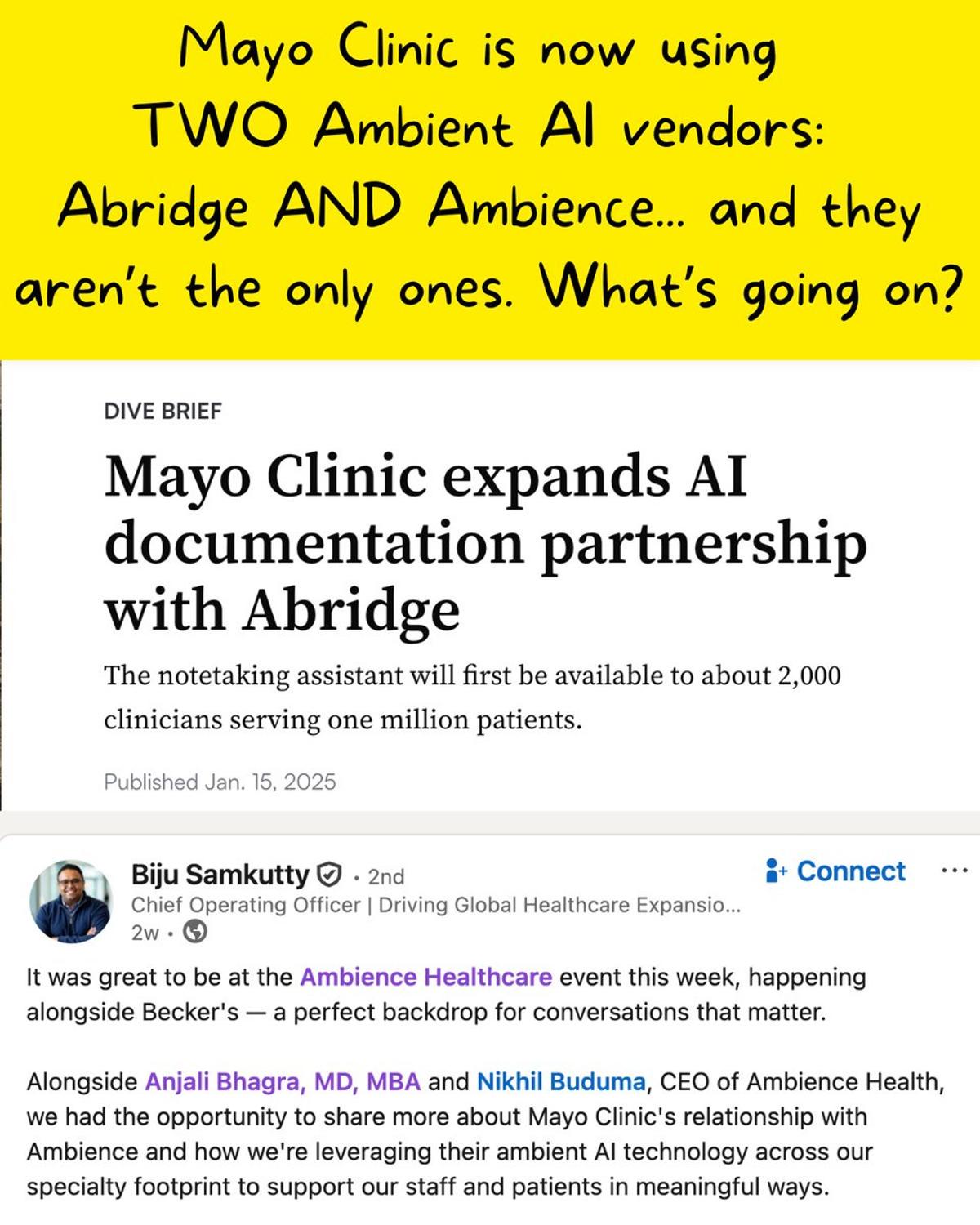
Health Systems Add Multiple AI Vendors for Specialty Precision
Mayo Clinic partnered with Abridge initially - and now is adding Ambience for specialty care. That’s MORE point solutions - not less. What’s going on here? Recently I spoke to a CMIO whose health system is also planning to add a...
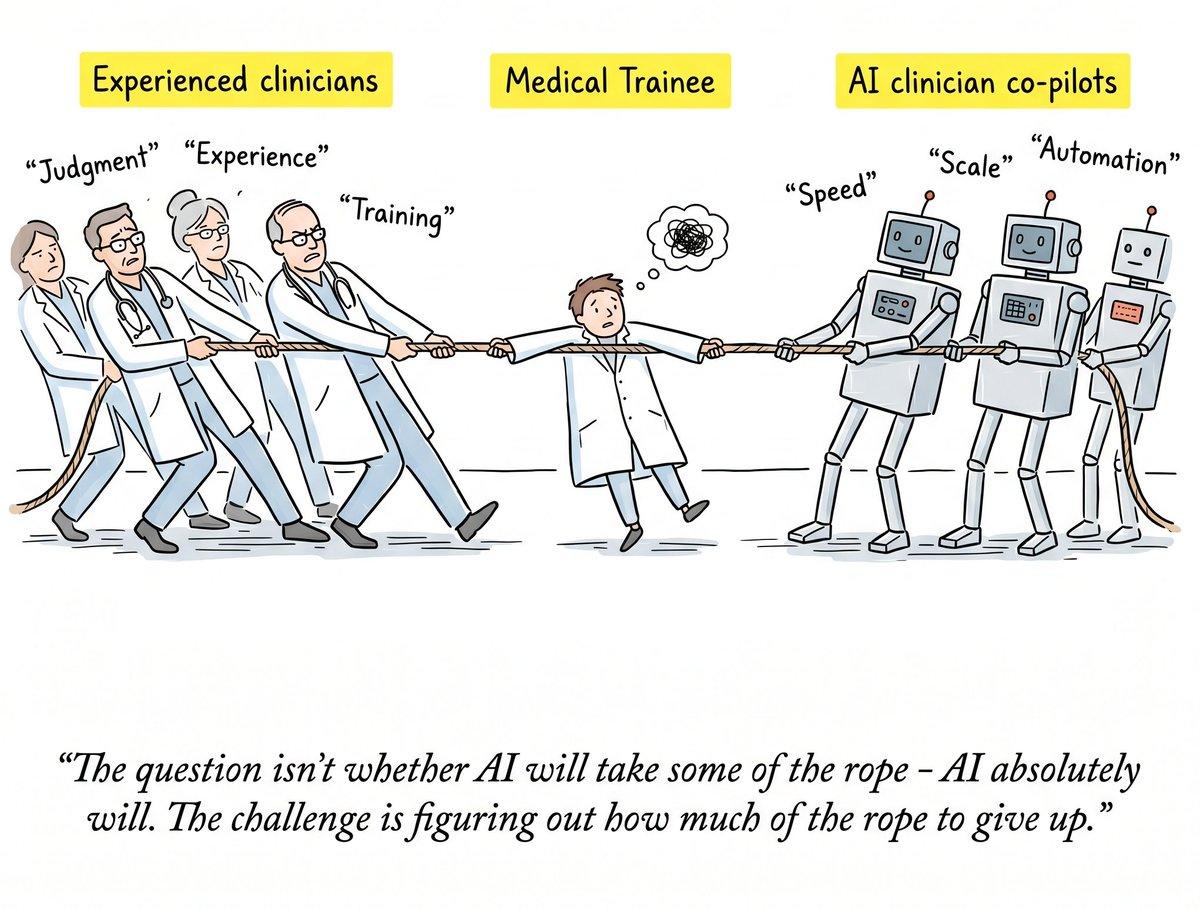
AI Shifts Skills: De‑skill Some, Re‑skill Others
Yes, AI in Healthcare will lead to "de-skilling" of certain skills - but it will also unlock "re-skilling" in completely new domains. The question isn't whether that trade off is happening - it's figuring out what should go in each...
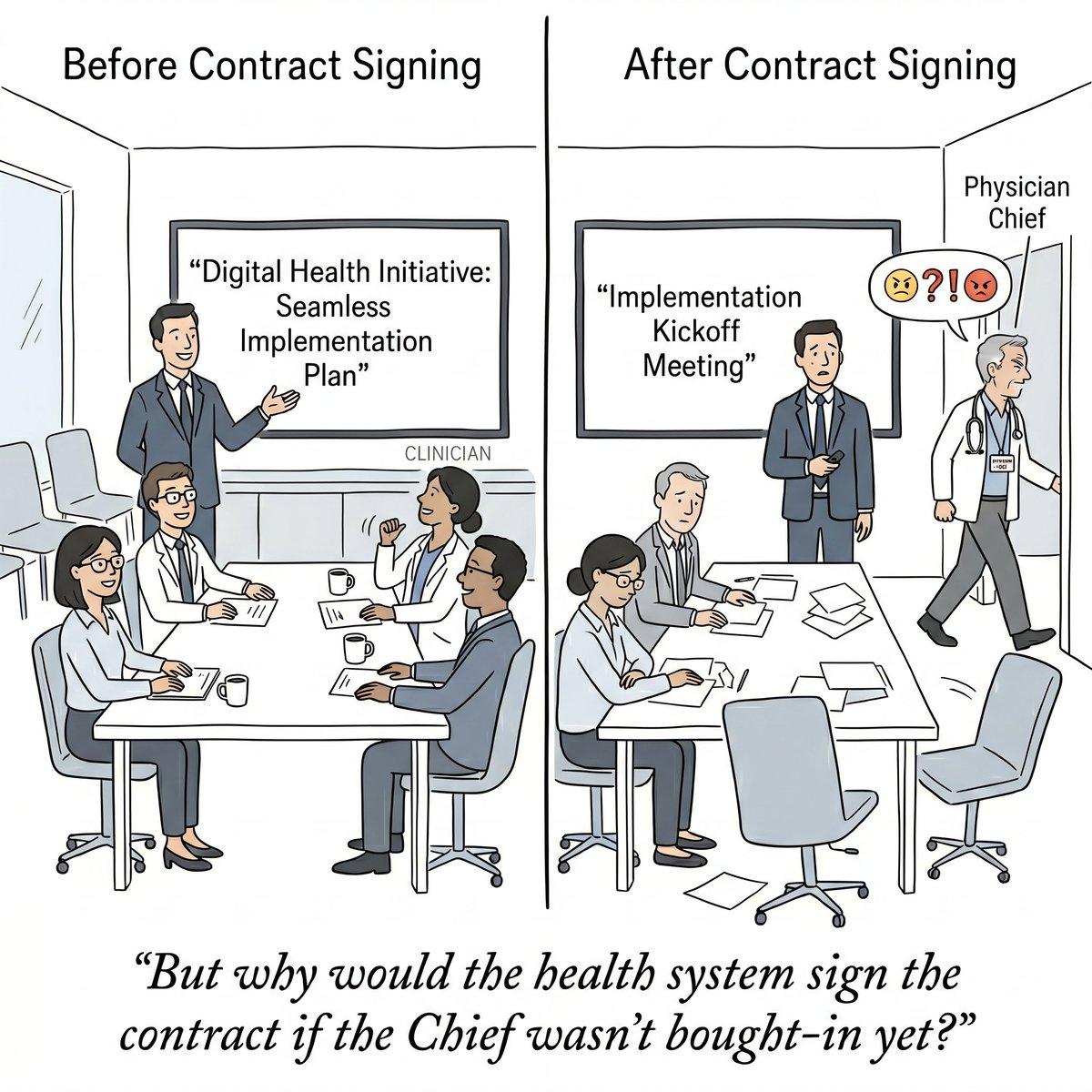
Secure Genuine Champion Buy‑in Before Launching Digital Health
The Digital Health implementation almost blew up in our face as the Department Chief walked out in frustration halfway through our Kick Off meeting. With 20+ stakeholders watching, it couldn't have gone any worse. We had gotten brought into a health...

Patients Choose Risky Care When Health Systems Fail
I don’t think patients want ChatGPT or an AI doctor startup to replace their health system - but when you’re desperate, you’ll take what you can get - the safety and efficacy be damned. So if health systems don’t fill...

AI Advice Still Needs Doctor Confirmation for New Parents
A month into fatherhood, I've used every clinical AI tool I have access to: OpenEvidence, DoximityGPT, Gemini - and I'm STILL asking my doctor friends for advice... but WHY? Isn't AI supposed to make physicians obsolete? Let’s not act surprised: of...

Integrations Only When Customers Demand, Not Startup Pitch
Recently more than one person called my Health Tech startup @SeamlessMD the “incumbent”. While we’ve been around 13+ years, it feels strange to call ourselves that - probably because we view the EHR as the incumbent. That said, there are...

AI Medical Tools Need Evidence, Not RCTs, to Trust
How can we trust CDS AI like OpenEvidence, DoximityGPT, etc if no one's done studies showing their use improves patient outcomes? While I understand the intent, I think it's ultimately a misguided question. Anytime a new medical textbook comes out, should...

Health Systems Split: Epic AI vs Third‑Party Solutions
Every health system on Epic is facing the same question: trust Epic’s Patient AI or go 3rd Party? Sutter and Hartford just chose opposite answers. My 4 thoughts: The news this week: → Sutter Health was the 1st health system to go-live...

Hard-to-Measure ROI Stifles Life‑Saving Healthcare Innovation
I've seen hospital CEOs cancel innovations that reduced readmissions and ED visits. The outcomes were incredible - but the financial ROI was too hard to prove. And since "ROI is needed to justify everything right now in healthcare" many great innovations...