
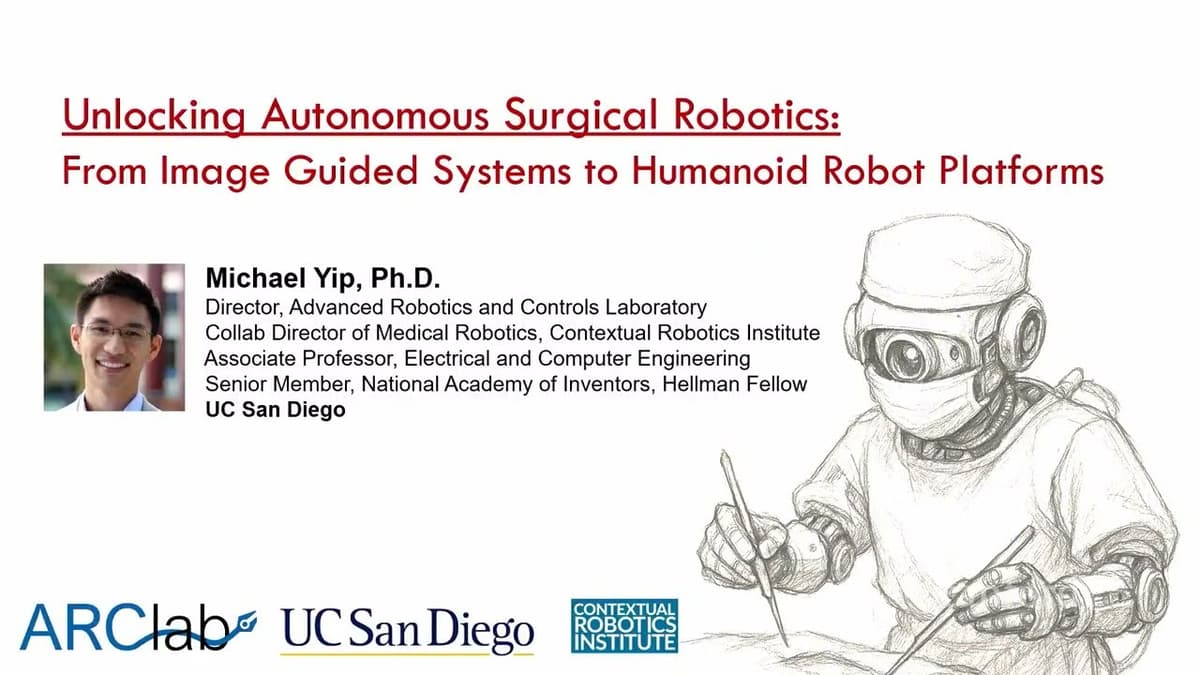
Stanford Robotics Seminar ENGR319 | Spring 2026 | Unlocking Autonomous Medical Robotics
The Stanford Robotics Seminar explored the emerging field of autonomous surgical robots, framing the technology as a response to a growing shortage of skilled healthcare workers. The speaker highlighted that tens of thousands of surgeons and hundreds of thousands of nurses are unavailable to meet patient demand, positioning robots as a scalable solution that can operate 24/7 with sub‑millimeter precision. Unlike today’s dominant teleoperated platforms such as the Da Vinci system, which merely amplify a surgeon’s hand movements, true autonomy requires robots to possess inherent skill. The talk identified four foundational pillars—perception, modeling, planning, and control—and explained how each must be mastered to navigate the unstructured, deformable environment of an operating room. Data scarcity, privacy constraints, and the impossibility of resetting a surgical scene make conventional foundation‑model approaches unreliable. The presenter cited historical attempts like Robodoc, Aesop, and recent UC San Diego research on autonomous suturing, needle tracking, and deformable tissue reconstruction. A key technical breakthrough discussed was the use of real‑time digital twins powered by position‑based dynamics, enabling fast simulation of tissue physics and precise robot control without compromising surgical safety. If these challenges are overcome, autonomous robots could deliver uniform, programmable expertise across hospitals, reduce reliance on scarce human specialists, and lower procedural costs. The technology promises to transform surgical workflows, expand access to high‑quality care, and create new business models for medical device manufacturers.
Stanford CS336 Language Modeling From Scratch | Spring 2026 | Lecture 10: Inference
The lecture focuses on inference for large language models, emphasizing that once a model is trained, the recurring cost of generating responses dominates operational budgets. It contrasts the one‑time training expense with the continuous, token‑by‑token computation required for chatbots, agents,...
Stanford CS153 Frontier Systems | Amit Jain From Luma AI on Unified Intelligence Systems
The Stanford CS153 lecture featured Amit Jain of Luma AI discussing the company’s pursuit of unified intelligence systems—platforms that combine massive 3D, video, and language data to create generative visual and creative tools. Jain traced Luma’s origins to his Apple work...
Stanford Online AI Programs Top Questions: When and How to Enroll in Online AI Courses
The video explains how prospective students can enroll in Stanford Online’s AI offerings, distinguishing between credit‑bearing university courses and professional‑development programs. It outlines the application process, required documentation, and timing for each track. Applicants must complete two distinct applications: the credit‑bearing...
Stanford Online AI Programs Top Questions: What's the Learning Experience Like?
Stanford Online’s AI offerings answer a common question: why pay for courses when the material is freely available on YouTube? The university’s promotional video explains that the programs are designed for learners who need more than just video lectures. Four primary...
Stanford CS153 Frontier Systems | Mati Staniszewski From ElevenLabs on The Future of Voice Systems
In a Stanford CS153 Frontier Systems session, ElevenLabs CEO Mati Staniszewski outlined the company’s mission to reshape voice AI, tracing its origins from a Discord text‑to‑speech bot to a full‑stack platform for creators. He emphasized the early obsession with fixing...
Stanford CS336 Language Modeling From Scratch | Spring 2026 | Lecture 9: Scaling Laws
The lecture introduced scaling laws as a framework for predicting language‑model performance when moving from modest to massive training regimes. Professor Kumar emphasized that rather than spending millions on large‑scale trial runs, researchers can conduct inexpensive small‑scale experiments and extrapolate results...
Stanford Robotics Seminar ENGR319 | Spring 2026 | Ingredientsfor Long-Horizon Robot Autonomy
The Stanford Robotics Seminar highlighted Physical Intelligence’s push toward truly autonomous, long‑horizon robots that can handle everyday home and industrial jobs. While recent advances enable robots to perform complex, short‑duration tasks—like unlocking a lock or precise object reorientation—the speaker emphasized...
Stanford CS336 Language Modeling From Scratch | Spring 2026 | Lecture 7: Parallelism
The lecture introduces multi‑GPU parallelism, extending the single‑GPU concepts covered previously to clusters of dozens or thousands of devices. It outlines the hardware hierarchy—from a single GPU’s HBM and caches to multi‑GPU nodes linked by NVLink/MV switches and finally to...
Stanford CS336 Language Modeling From Scratch | Spring 2026 | Lecture 6: Kernels, Triton, XLA
The lecture builds on a prior overview of GPU architecture, focusing on practical kernel development with Triton and performance profiling. It revisits the memory hierarchy—registers, L1/L2 caches, and high‑bandwidth memory (HBM)—and emphasizes that faster memory is smaller and localized to...
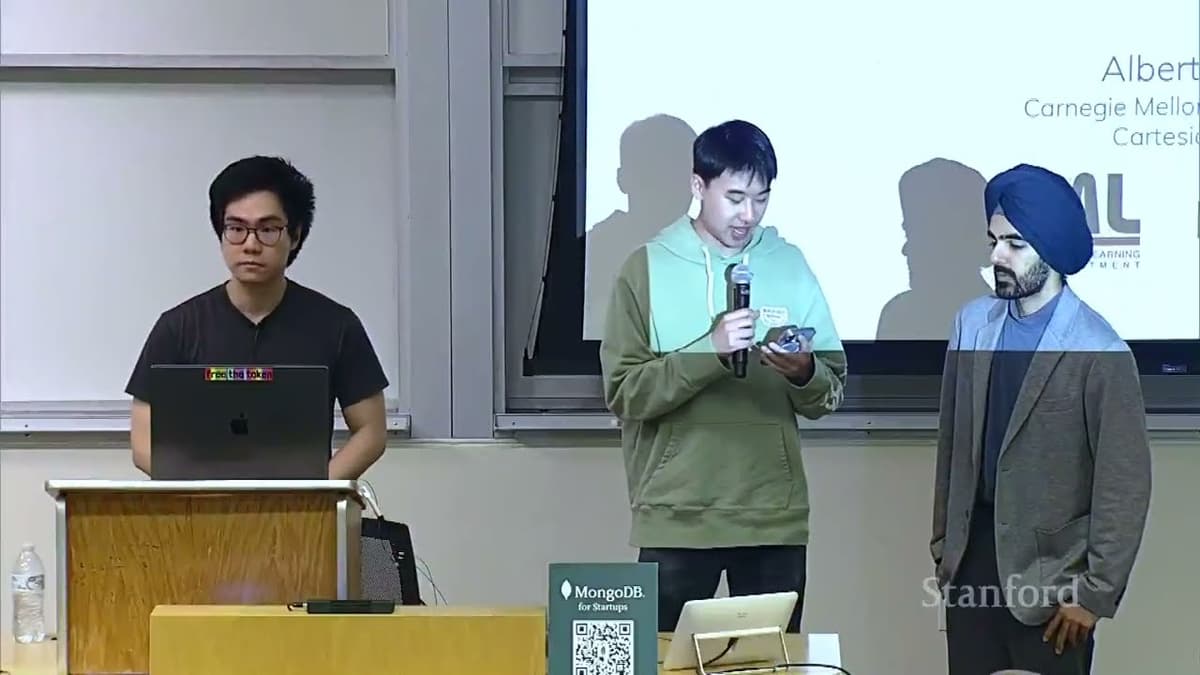
Stanford CS25: Transformers United V6 I On the Tradeoffs of State Space Models and Transformers
Albert Gu’s Stanford CS25 talk examined the trade‑offs between traditional transformer architectures and the emerging family of state‑space models (SSMs), highlighting how these linear‑complexity models reshape sequence‑modeling. Over the past three years, models such as Mamba, Mamba 2/3, xLSTM, DeltaNet, and Gated DeltaNet...
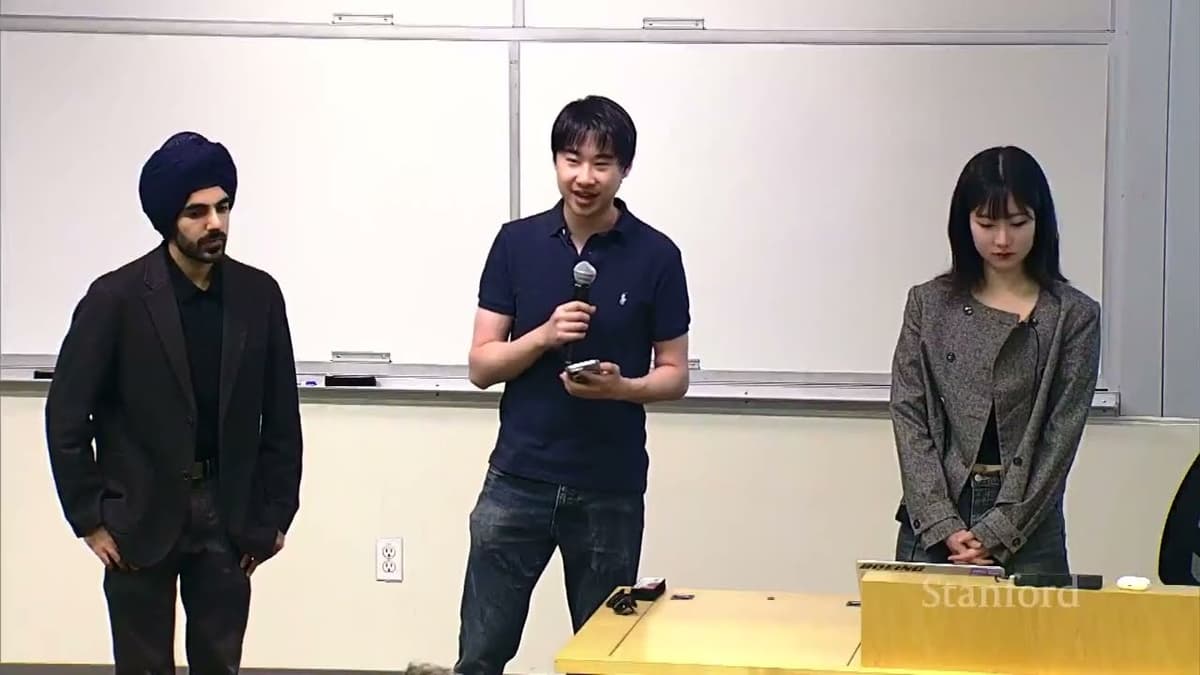
Stanford CS25: Transformers United V6 I From Representation Learning to World Modeling
The Stanford CS25 lecture introduced Joint Embedding Predictive Architecture (JEPA) and its causal extension as a new paradigm for world modeling, emphasizing latent‑space prediction over raw pixel reconstruction. Speakers highlighted how JEPA treats future prediction as an energy‑based compatibility score,...
Stanford CS25: Transformers United V6 I Overview of Transformers
Stanford’s CS 25 “Transformers United” returns for its sixth iteration, a graduate‑level seminar that demystifies the transformer architecture that underpins today’s AI boom. Co‑instructors Steven, a fourth‑year CS PhD, and Karan, a third‑year EE PhD, frame the course as a bridge...
Stanford Robotics Seminar ENGR319 | Spring 2026 | Mechanical Intelligence in Locomotion
The seminar introduced recent work on mechanical—or morphological—intelligence for locomotion, emphasizing the largely unexplored mesoscale robot class (≈1 kg) that bridges micro‑robots (10 kg). The speaker argued that at this scale robots interact with about ten terrain elements simultaneously, creating a noise‑dominated regime...

Stanford CS336 Language Modeling From Scratch | Spring 2026 | Lecture 4: Attention Alternatives
The lecture covered advanced transformer architectures, focusing on attention alternatives that achieve linear‑time complexity and the use of mixture‑of‑experts (MoE) to boost parameter efficiency. Professor Kumar explained why quadratic attention costs dominate as context length grows and introduced techniques—such as exploiting...

Stanford CS336 Language Modeling From Scratch | Spring 2026 | Lecture 3: Architectures
The lecture surveys modern transformer architectures, emphasizing how design choices have crystallized around stability and scalability. Starting from the original Vaswani transformer, the instructor traces the shift from post‑norm residual placement to pre‑norm, noting that moving layer‑norm outside the residual...

Stanford CS336 Language Modeling From Scratch | Spring 2026 | Lecture 2: PyTorch (Einops)
The lecture focused on resource accounting for large language‑model training, covering how to estimate compute, memory needs, and precision choices using PyTorch and the einops library. Professor Wang introduced a simple formula—flops equal six times the number of parameters times the...

Stanford CME296 Diffusion & Large Vision Models | Spring 2026 | Lecture 2 - Score Matching
Lecture two of Stanford CME296 introduces score matching as the next‑generation framework for generative modeling, following the diffusion‑based DDPM approach covered previously. The professor revisits the goal of sampling from an unknown data distribution and contrasts the traditional reverse‑diffusion noise‑prediction...

Stanford CME296 Diffusion & Large Vision Models | Spring 2026 | Lecture 1 - Diffusion
The video introduces Stanford’s CME296 course on diffusion and large vision models, taught by twin brothers with experience at Uber, Google, and Netflix. It outlines the class’s two main goals—understanding image‑generation paradigms and the training/evaluation of underlying models—while stressing the...

Stanford Robotics Seminar ENGR319 | Winter 2026 | Gen Control, Action Chunking, Moravec’s Paradox
The Stanford Robotics Seminar examined why learning from demonstration remains harder for physical robots than for symbolic AI, coining an "algorithmic Moravec's paradox" that highlights fundamental instability in continuous control. The speaker traced the recent surge in narrow manipulation capabilities...

Stanford CS547 HCI Seminar | Winter 2026 | Computational Ecosystems
The talk explores how computational ecosystems can be reshaped to align HCI work with personal values, moving beyond incremental tool improvements toward systemic redesign. The speaker argues that many persistent human problems stem from entrenched processes rather than missing technology,...

Course Overview: Systems Leadership
The video introduces a new leadership framework called systems leadership, designed for today’s fast‑changing, crisis‑laden environment. Robert Seagull explains that this approach requires leaders to internalize previously separate dualities and to see how their organization interacts with broader ecosystems. Key insights...

Course Overview - Web Security
The video introduces Stanford’s advanced cyber‑security program, co‑directed by Neil Dwani with professors Dan Bonet and Zakir Demerich, to train professionals in defending web applications against today’s most damaging threats. It positions the course as essential for anyone who builds,...

Stanford CS221 | Autumn 2025 | Lecture 20: Fireside Chat, Conclusion
The final lecture of Stanford CS221 featured a fireside chat with instructor Percy, structured around career, life, research advice, class logistics, and a forward‑looking AI outlook. The informal format let students probe Percy’s personal journey from early MIT AI courses...

Stanford CS221 | Autumn 2025 | Lecture 19: AI Supply Chains
The Stanford CS221 lecture framed AI as a supply‑chain phenomenon, urging technologists to look beyond model design and consider the upstream resources and downstream applications that shape societal outcomes. Professor Rishi highlighted how AI now accounts for a third of...

Stanford CS221 | Autumn 2025 | Lecture 18: AI & Society
The Stanford CS221 lecture pivots from algorithms to AI’s societal footprint, arguing that the technology’s influence now rivals the printing press and steam engine. The professor stresses that AI’s rapid adoption—evidenced by ChatGPT’s 800 million weekly users—marks the early stage of...

Stanford CS221 | Autumn 2025 | Lecture 17: Language Models
The Stanford CS221 lecture 17 provides a sweeping overview of modern language models, emphasizing their ubiquity—from chat assistants and phone keyboards to code‑completion tools—and the massive scale at which they are built. Professor Kumar walks students through concrete examples such as...

Stanford CS221 | Autumn 2025 | Lecture 15: Logic I
The lecture introduces logic as the final technical pillar before the AI society module, emphasizing propositional logic as a foundational formal language for representing and reasoning about knowledge. Professor Pietschmann contrasts logical reasoning with earlier topics—search, MDPs, Bayesian networks—highlighting its deterministic...

Stanford CS221 | Autumn 2025 | Lecture 14: Bayesian Networks and Learning
The lecture revisits Bayesian networks as a compact representation of joint probability distributions, built from a directed acyclic graph and local conditional probability tables. After a quick refresher using the classic burglary‑earthquake‑alarm example, the professor reviews exact and approximate inference...

Stanford CS221 | Autumn 2025 | Lecture 13: Bayesian Networks and Gibbs Sampling
The lecture revisits Bayesian networks, emphasizing their construction—identifying variables, drawing directed graphs, and populating conditional probability tables (CPTs). It then shifts focus to probabilistic inference, contrasting exact tensor‑based computation with approximate sampling methods, and introduces Gibbs sampling as a faster...

Stanford CS221 | Autumn 2025 | Lecture 12: Bayesian Networks I
In Lecture 12 of Stanford’s CS221, Professor Koller pivots from the model‑free learning methods covered earlier to a model‑based framework, introducing Bayesian networks as a systematic way to represent and reason about uncertain worlds. He explains that a joint probability distribution...

Stanford CS221 | Autumn 2025 | Lecture 11: Games II
The lecture revisits two‑player zero‑sum games, reviewing the minimax principle and alpha‑beta pruning before introducing reinforcement‑learning techniques to learn game evaluation functions. Professor Ng explains why hand‑crafted heuristics, such as chess piece‑value tables, can be replaced by learned value networks. Key...

Stanford CS221 | Autumn 2025 | Lecture 10: Games I
The lecture introduces game theory as the next step after Markov decision processes and reinforcement learning, focusing on two‑player zero‑sum games. It defines a game formally with start states, player‑turn functions, and successor mappings, and emphasizes that utility is realized...

Stanford CS221 | Autumn 2025 | Lecture 9: Policy Gradient
The lecture revisits reinforcement learning fundamentals before shifting focus to policy‑based approaches that learn the policy itself rather than a value function. After reviewing Markov decision processes, Q‑learning, SARSA, and the role of exploration policies, the instructor frames the discussion...

Stanford CS221 | Autumn 2025 | Lecture 8: Reinforcement Learning
The lecture revisits Markov Decision Processes (MDPs) before launching into reinforcement learning (RL). It outlines the core components of an MDP—states, actions, transition probabilities, rewards, and discount factor—using the illustrative "flaky tram" example, and clarifies how a policy maps states...

Stanford CS221 | Autumn 2025 | Lecture 7: Markov Decision Processes
The lecture introduces Markov Decision Processes (MDPs) as the stochastic extension of deterministic search problems, positioning them as the foundation for reinforcement learning. After reviewing search’s start state, successors, costs, and end criteria, the professor highlights that real‑world decisions often...

Stanford CS221 | Autumn 2025 | Lecture 6: Search II
The lecture revisits search problems, introducing Uniform Cost Search (UCS) as an exact algorithm capable of handling cycles, and briefly foreshadows its relationship to A*. Key concepts include the distinction between past cost (minimum cost from start) and future cost (minimum...

Stanford CS221 | Autumn 2025 | Lecture 5: Search I
The lecture introduces search as a core reasoning tool that complements machine‑learning predictors. After reviewing the limits of reflexive mapping, the instructor explains why deterministic search remains vital, citing Rich Sutton’s “Bitter Lesson” that general, compute‑driven methods—search and learning—scale best. Key...

Stanford CS221 | Autumn 2025 | Lecture 4: Learning III
The lecture introduces deep learning fundamentals while guiding students from hand‑crafted computation graphs to the PyTorch ecosystem. After reviewing linear models, the professor emphasizes that modern frameworks like PyTorch and JAX handle forward evaluation, automatic differentiation, and graph management far...

Stanford CS221 | Autumn 2025 | Lecture 3: Learning II
The lecture introduces linear classification, extending the regression framework to predict discrete class labels. By representing inputs as vectors and applying a weighted sum plus bias, the model outputs a logit whose sign determines the predicted class, typically encoded as +1...

Stanford CS221 | Autumn 2025 | Lecture 2: Learning I
The lecture introduces tensors and the einops library, emphasizing how naming axes clarifies operations across any order. It then dives deep into the einsum function, showing how a single notation can express identity mapping, summations, element‑wise products, dot products, outer...

Stanford CS221 | Autumn 2025 | Lecture 1: Course Overview and AI Foundations
The opening lecture of Stanford’s CS221 course sets the stage by redefining artificial intelligence as a combination of perception, reasoning, action, and learning. Professor Percy Liang emphasizes that, despite rapid advances, the core foundations remain stable while the curriculum adapts...
Stanford AA228 Decision Making Under Uncertainty | Autumn 2025 | Offline Belief State Planning
The lecture introduced offline belief‑state planning for partially observable Markov decision processes, emphasizing that exact POMDP solvers quickly become intractable and motivating scalable approximations. Students were shown how the number of alpha vectors grows exponentially—e.g., a ten‑step horizon can generate...
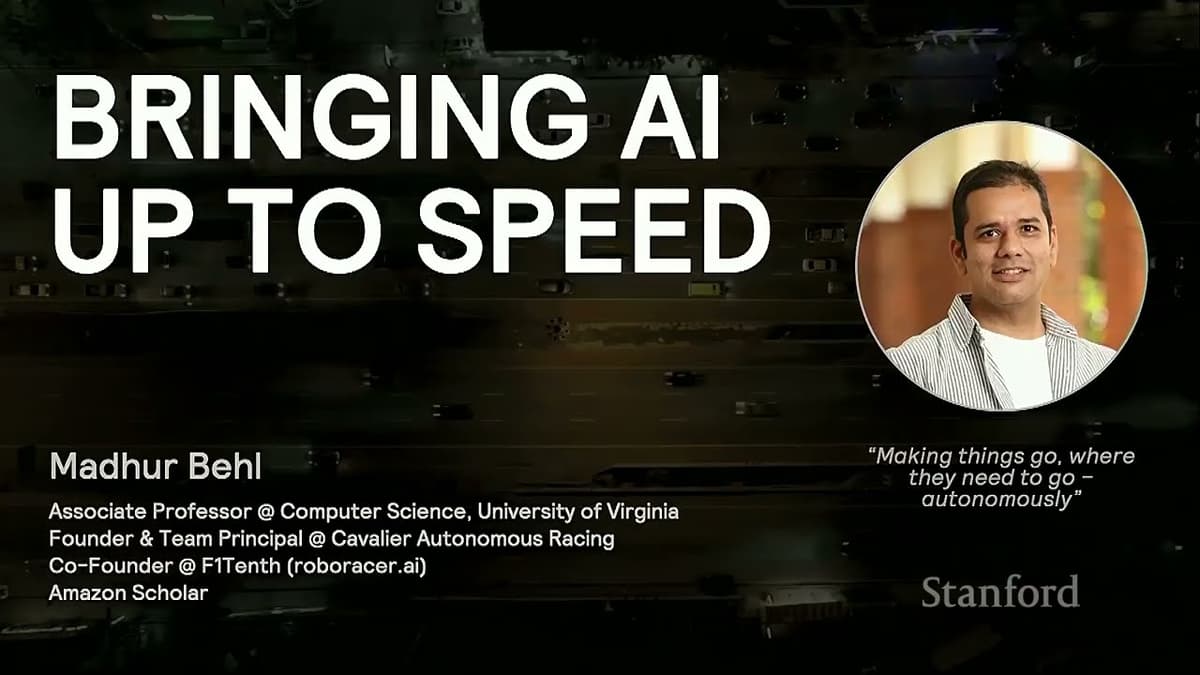
Stanford Robotics Seminar ENGR319 | Winter 2026 | Bringing AI Up To Speed
The lecture framed autonomous driving as the ultimate test for artificial intelligence, contrasting it with games like chess that have already been mastered by AI. While chess operates in a closed, rule‑bound environment, driving unfolds in an open system where...