

Pick Markets Where You Can Actually Find Deals
I get asked all the time “how do you choose a market” & to be honest it’s pretty simple Instead of approaching it from the statistical perspective, I approach it from the “can I actually find a deal in this market” perspective Here’s how I choose a market to invest in: First let’s talk about how institutions look at deals & why it doesn’t make sense to look at deals that way as a smaller investor Way I see it, there’re 2 strategies when choosing a market 1. “rising tide lifts all boats” 2. search for dislocations/discounts Strategy 1 is used by institutions who need to deploy a lot of capital This involves them playing “economist”. They need to find markets with high population growth, rent growth & appreciation They operate in a competitive segment of the mkt ($20MM+) & it’s difficult to pick up assets for a “discount” in that range So instead, they have to find mkts where competitors are underpricing future growth This is dangerous since if you guess wrong, it could be a disaster. But institutions are built for this as they have analysts & data they can use to correctly pick the next high-growth mkt As a smaller investor, you don’t. You have no edge over large firms. It’s not a smart place to compete But as a smaller investor you don’t need to deploy a lot of capital So you can use strategy #2 Instead of playing economist, you search for the least competitive mkts, where there’re the most pricing dislocations &, therefore the most discounts Basically I look for the market with the least competition that’s stable // Choosing a Market // Ignore the data & focus on making money (finding markets where you can stabilize over the market cap rate) A 4 step process: Step 1: Look for cities/towns under 250k pop Step 2: Vet supply Step 3: Vet demand Step 4: Make sure there’re mispricings (Assuming shorter term holds) Step 1: This is really just to narrow down to an area that has less competition 250k isn’t a hard & fast rule & this is by far the least important step If you find a mkt that satisfies steps 2-4, you can ignore step 1 Steps 2 & 3: There are 2 drivers of a mkt - supply & demand Want to make sure supply doesn’t increase & demand doesn’t decrease - that’s where you get into trouble If anything else happens (ex “demand increases”) that’s actually positive So what causes supply to increase? There’s only 1 answer - development And when do developers develop? When it’s profitable So if you can find a mkt where it’s not profitable, you know supply won’t go up Easy way to do this is to find mkts where the avg sale price per unit (market basis) is below replacement cost Intuitively, this means it’s not profitable to build For ex, let’s say the mkt basis is $200k & replacement cost is $100k. In this mkt developers would obviously build like crazy Why would you buy existing product for $200k/unit when you could build brand new for $100k/unit? You wouldn’t So we’re looking for the opposite We’re looking for mkts where the mkt basis is $75k & replacement cost is $250k (not profitable to build) Finding this “neutralizes” supply Now you need to make sure the 2nd variable will stay stable Demand is trickier I look at: - UE rate (just need “decent”) - pop growth (just want “stable”) - crime rate (just want “not bad”) - employer concentration (don’t want a “Detroit”) You get the idea. Don’t go crazy, just need to make sure the mkt won’t crap out over your hold Step 4: Last criteria is making sure there’re mispricings (discounts) You want to find deals where your stabilized yield is greater than the mkt cap rate So track a mkt for a bit If you don’t see a few deals where the stab yield is 200bps+ above the MCR, the mkt is too competitive & you need to try again If you do find a few deals, you’ve found your mkt That’s really it You’re looking for the market with the least competition that’s stable. Way you make money in RE is stabilizing over the MCR, so that’s what you’re looking for

Entrepreneurs Capture Full Reward, Employees Get Fraction
Most people don't think about risk/reward correctly because they only think about the level of risk and are unable to accurately conceptualize the magnitude of the reward Let’s take two scenarios - one as an employee at a RE firm, one...
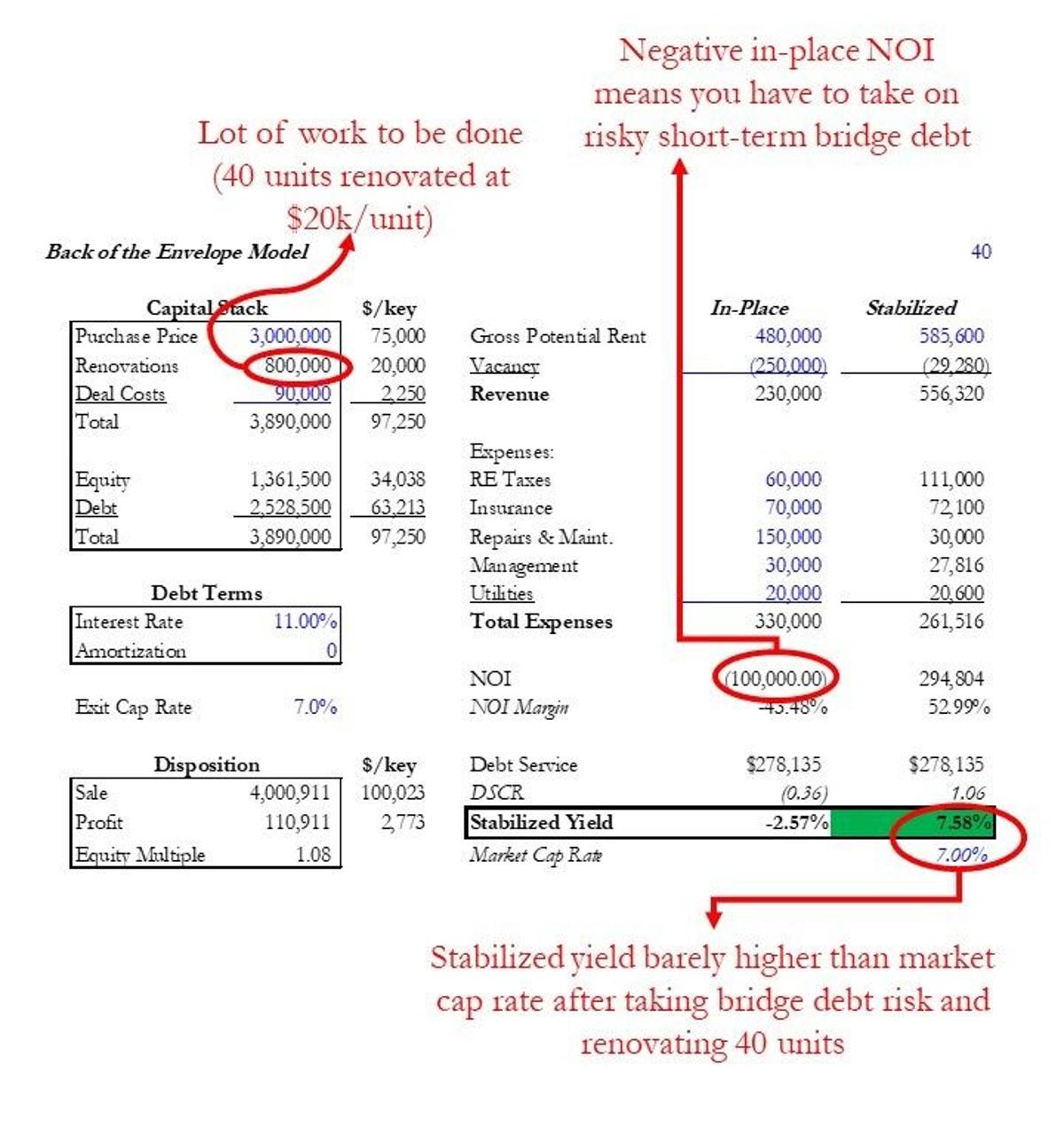
Skip Risky Deals: Bridge Debt, Low DSCR, Thin Spreads
Here’s how to identify when a deal is too risky: Sometimes the deals you don’t do are more important than the deals you do This 40-unit deal that I underwrote a while ago had 4 major deal breakers 1. Having to take...

Analyze Property Physically Before Trusting Excel Numbers
If you’re buying real estate solely based on numbers, you’re already losing Real estate isn’t just numbers in excel. It’s tangible Here’s how to actually analyze a property without making that costly mistake: First thing most investors do when they see...
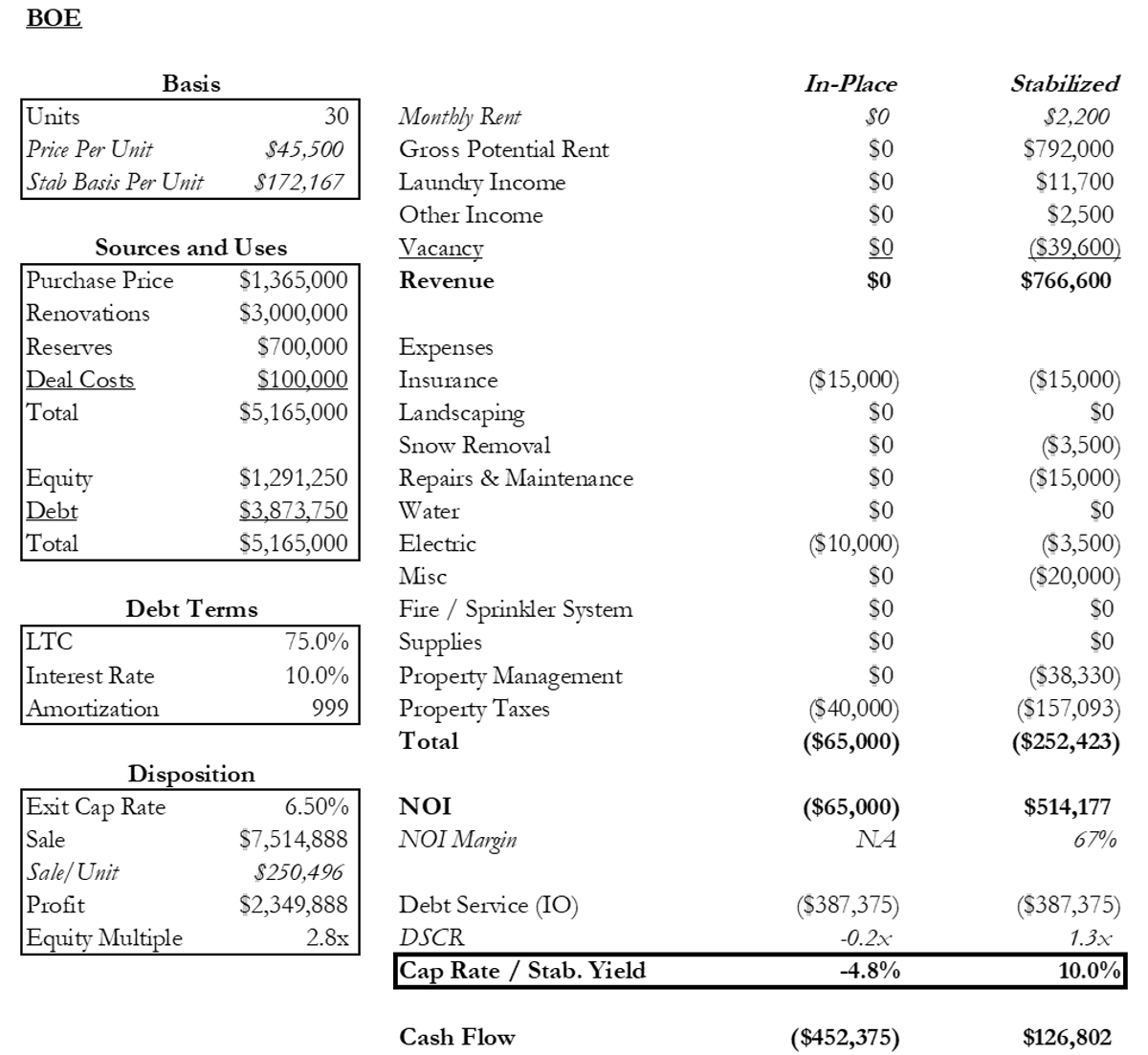
Charge Higher Spread for High‑Risk, Heavy‑Lift Deals
Just because the standard is to underwrite 150 bps of spread doesn’t mean you should do that for every deal. This is a multifamily deal I was looking at a little while ago. It’s a *heavy* lift: - Currently operating as a...

Leverage Small Deals by Turning Sellers Into Banks
"If you owe the bank $100, that's your problem. If you owe the bank $100MM, that's the bank's problem" What people don't realize is that you can create this exact scenario with way less money Let's say you're looking to buy a...

Beating the S&P Is the Only
What people don't understand about the S&P is that every single person in the country who has money is also invested in it When your money goes up 15%, so does everyone else's You gained zero relative wealth. You need to outperform...

Choose Deal‑by‑deal for Low‑cost, Flexible REPE Startup
You want to start your own real estate private equity firm but you don’t know how much it’ll cost Here’s how to think about start-up costs: There are basically 2 ways to set up a real estate private equity firm 1. First way...

Underwriting Simplified: Three Core Questions for Deal Success
A lot of people try to complicate the real estate underwriting process, but it’s actually pretty simple once you understand the basics Here are the central questions you need to answer during your underwriting: Question 1: “Can I capitalize the deal?” Question 2:...

Value‑Add Real Estate Profits Without Rent Growth
This seems to be one of the biggest misconceptions “Real estate investors need rent growth” No they don’t On a value-add deal, you make money even if rents decrease. You’re underwriting to *current* market rent $2.5MM profit if rents stay flat, $1.2MM profit if...

Remote Real Estate Works—But Never Buy Sight‑Unseen
I've gotten a lot of questions recently on how to operate a remote deal so I'm going to dive into the several methods you can use and the benefits and drawbacks of each strategy. First off, buying properties remote is 100%...

Choose Self-Reliance over Credentials for Real Competence
At some point in your life, you have to choose: credentials or self-reliance Pretty much everyone ends up choosing the credentialed path which is a big mistake. Think it’s important to understand what you’re giving up and what you’re signing up...

Endure Longer, Outlast the Competition
Life is hard. Most people just give up on it eventually (start settling, readjusting their goals downward) Average person gives up by 20. Even most above average people throw in the towel by 30 If you’re willing to endure the pain for...

Simple Joint Ventures Let Doctors Own Their Office Spaces
A lot of people watch Billions or Suits and get conned into thinking they need to come up with some incredibly clever business strategy to succeed Couldn't be farther from the truth My mentor started off investing in office buildings Purely by...

Delaying Costs Years: Iterate Faster Than Competitors
Reason why waiting is so costly is it reduces iterations Try --> make dumb mistake --> iterate --> success If someone is 100 iterations ahead of you, you're cooked. That's why if you wait 1 year to do something, you're actually 3...

Now Is the Cheapest, Easiest Era to Launch a Startup
Best time in history to start a business - ~0 startup costs - can find any info you need w/ google/AI - connect w/ already-successful people on X w/ a DM - can hire employees all across the world for cheap - infinite scale...

Identify Good Real Estate, Not Just Cap Rates
// HOW TO HIT A HOME-RUN // A basic framework for finding deals that have the potential to be home-runs (3x+ return in 5 years or less) Most people think it's impossible but it's actually quite simple (but not easy) once you...

Target 150bp Yield Spread Over Market Cap
How private equity firms analyze deals: Most important metrics: 1. Stabilized cap rate (yield): Since we focus on value add, the entry cap doesn’t matter much, as long as we can service our debt The stabilized yield matters because it shows the intrinsic...

Master DSCR, LTV, Debt Yield: Buyer vs Lender Views
There are 3 main debt metrics in real estate: 1. Debt Service Coverage Ratio (DSCR) 2. Loan to Value (LTV) 3. Debt Yield Here’s how to view each from both a buyer’s perspective & a lender’s perspective: 1. DSCR Definition: The DSCR is the...

Launch a Side Hustle, Transition Risk‑Free to Full‑Time
It really doesn't have to be some big "leap of faith" Start a business while at your job. Grow it for a few years until it makes enough money to support your lifestyle + allows you to reinvest. Then leave to...

Just $70K Extra Can Net a $1M Property
Real estate is valued at a 15x multiple Only need to increase income $70k on one property to make a million bucks Not so hard when you think about it that way

REPE Funds Force Cap Rate Compression for Rapid Gains
How “The Game” works in Institutional Real Estate Private Equity A lot of people know that when cap rates go down RE investors make a lot of money. Most investors rely on a lucky market to do it But what if you...

Stop Overpaying: Verify Property Taxes via County Records
Most investors miscalculate property taxes and it can be extremely expensive Here’s how to do it right: Property taxes are usually re-assessed at sale. This means that you don’t underwrite the same property taxes the seller had They’re public info. So you're going...

Seek Low‑Competition Markets for Mispricing‑Driven Returns
People go about choosing a market all wrong. RE investors make money on mispricings Less competition means less price discovery which means more mispricings which makes it easier to generate outsized returns So your main criteria for a market should be "place...

Visit Before Buying: Remote Property Success Strategies
"You can't buy properties out of state" This is comically wrong. I've never even bought a property in a state I lived in Here's how to operate deals remotely: First off - a lot of people think you can buy a property sight...

Community Banks Fund Deals With 1.25 DSCR
Let’s say you’re looking to buy a real estate deal and want to use a community bank for the financing These lenders will be looking to make sure you satisfy 5 main requirements in order to fund your deal: The 5 lender...

Renovate a 1‑Bed Unit for $10‑15K: Key Costs
What does a renovation typically cost me? Generally a renovation for a Class C 1-bed unit costs me $10k-$15k Below are the items I focus on when touring to maximize rent and minimize cost You should think about the property in the 3...

Beginner’s Blueprint: Analyze Rents, Expenses, and Market Before Buying
Let’s say you’re a beginner looking at a new market for the 1st time Figuring out where to start can be daunting Here’re the steps you should take so you can start buying deals 1. Source market rents 2. Understand expense load 3. Get to...

Master the Big Picture, Accelerate Your Rise
After college I joined a $500MM+ AUM real estate private equity firm. Within just 2 years, I became a junior partner I won't deny luck played a part, but I'd like to think there was some skill involved as well Most important...

Longevity Wins: Outlast Competition in Business
It's really just a war of attrition How many people choose the right game to play (starting a business)? Of those people, how many show up every single day for a full year? 3 years? 10 years? After 10 years, there’s really no...

Real Estate PE Delivers 2x Return Before Deal Begins
Why is real estate private equity so lucrative? Because you basically get a 2x return on your capital before the deal even starts Let’s take a sample deal: $10MM purchase price. The deal will be purchased with a $7.5MM loan and $2.5MM of...

From $10k to 6‑Unit Deal in Months
How one of my clients bought a great deal with only $10k of his own capital: Sean entered the Acquisitions Bootcamp as a complete beginner. He ranked his real estate knowledge as a 5 out of 10 when the program started We...

Target Distressed Sellers in Low‑liquidity Markets for Discounts
A lot of real estate is simply finding structural sellers Over the last few years, a lot of bad operators made some big mistakes. So you’re simply going to target them: 1. Position yourself in lower liquidity markets (markets where owners will have...
Steady Boring Business Beats Chasing Quick‑rich Trends
Have a lot of friends who hopped around to get rich quick Tech during the run up, private credit All late, pretty much none of their equity ever materialized Better to just run a business in a boring field where you’ll get rich...
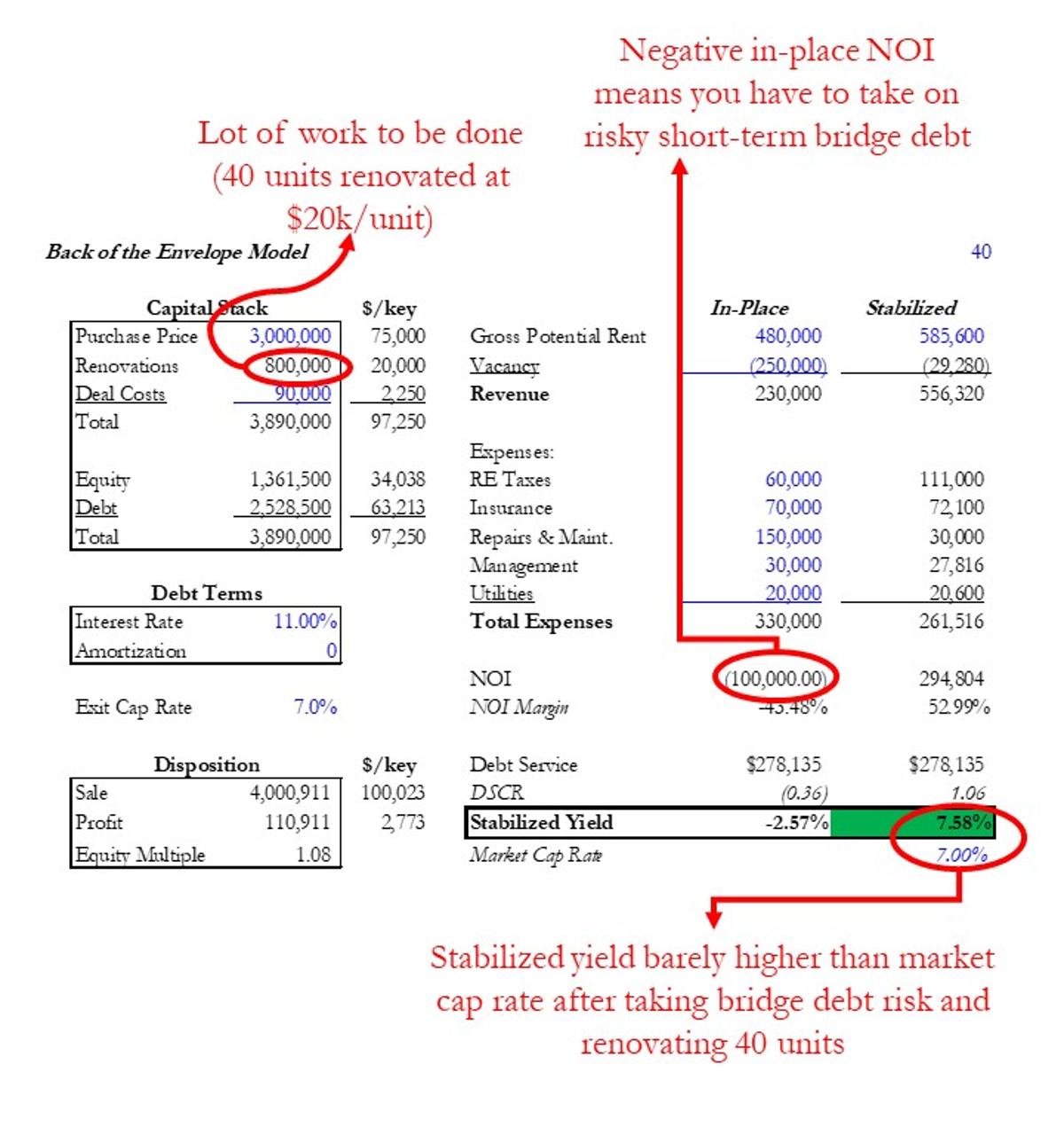
Walk Away When Bridge Debt, Low DSCR, Thin Yield Spread
Here’s how to identify when a deal is too risky: Sometimes the deals you don’t do are more important than the deals you do This 40-unit deal that I underwrote a while ago had 4 major deal breakers 1. Having to take...

Turn Distressed Assets Into Home Runs with Yield‑based Underwriting
How do I underwrite deals to ensure that (if I get my offer price) the deal ends up being a home-run? This is how. This is a real deal I submitted an offer on a while ago. 56 units, priced at...

Analyze Property Physically Before Trusting Excel Numbers
If you’re buying real estate solely based on numbers, you’re already losing Real estate isn’t just numbers in excel. It’s tangible Here’s how to actually analyze a property without making that costly mistake: First thing most investors do when they see a deal...

Target Small Markets, Vet Supply‑Demand, Spot Mispricings
I bought my first deal with $2,500 of my own money and now own over $50M of real estate If I had to start over in 2026, here’s how I’d find a market in just 4 steps: Step...

Don't Default to Lower L
When your DSCR doesn't hit the bank’s threshold (usually a ~1.25x DSCR), most people think banks don't give you any option but to lower the LTV But in reality, if you negotiate, you have 3 options: Option 1: Lower LTV Option 2: Schedule...

Start Small, Leverage Vacancy Data for First Deal
Your first deal doesn’t need to be big My first deal was tiny. A 3-unit multifamily deal. Bought it for just $200k At the time I was working in real estate private equity and was spending my nights and weekends looking for...