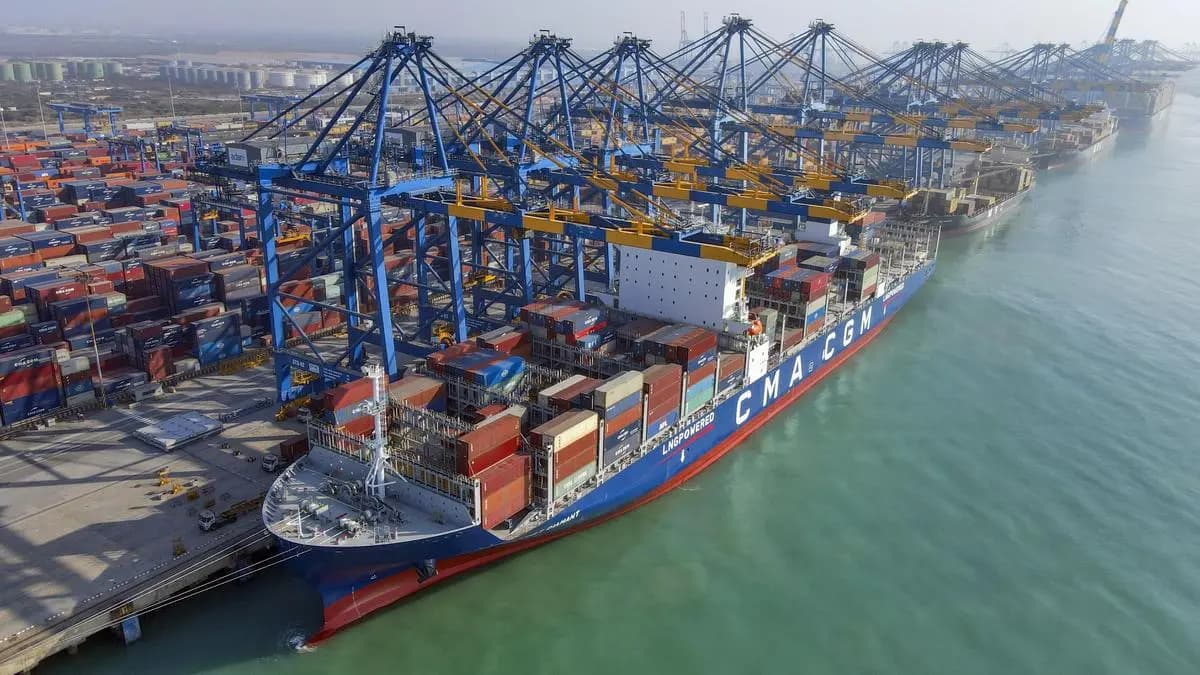
Mundra’s inherent operational strengths protect market share despite new rail infrastructure, preserving revenue streams for APSEZ and reinforcing India’s port hierarchy.
The Western Dedicated Freight Corridor, a 1,506‑km electrified rail link connecting Dadri to major western ports, is poised to reshape India’s inter‑modal freight landscape. By enabling double‑stack container trains, the DFC promises faster transit times and higher capacity for shippers moving goods between the northern hinterland and coastal gateways. However, the corridor’s primary benefit is a reduction in road‑based haulage, not a direct shift in port choice, as vessels still need to dock at deep‑water terminals for loading and unloading.
Mundra Port’s competitive moat rests on three pillars: a deep draft that accommodates larger vessels, rapid turnaround times that cut berthing costs, and a fully integrated logistics ecosystem that streamlines cargo handling from ship to rail or road. These attributes give Mundra a 300‑350 km distance advantage over rivals such as Nhava Sheva and Vizhinjam, effectively saving shippers the equivalent of five to six railway slabs in freight charges. Even with the DFC’s speed boost, the cost differential and service reliability at Mundra remain compelling, ensuring that shipping lines continue to prioritize the port for trans‑shipment.
For investors and industry observers, APSEZ’s confidence signals that the DFC will act as a complementary conduit rather than a disruptive force. Mundra’s volume stability supports the company’s broader growth narrative, including an 11% target for its logistics subsidiary. As India’s freight network modernises, ports that combine deep‑water capacity with seamless multimodal connections are likely to dominate, reinforcing Mundra’s role as a critical node in the nation’s supply chain architecture.
Mundra Port’s deep draft, faster vessel turnaround and integrated logistics ecosystem will ensure that shipping lines will continue to favour it over competing ports, says APSEZ CEO · Updated · February 14, 2026 at 04:16 PM
APSEZ says Mundra Port’s structural advantages — shorter hinterland distance, integrated services and superior turnaround times — will safeguard market share, even as India’s container transport network modernises.
Adani Ports and Special Economic Zone Ltd (APSEZ) has dismissed concerns that the Western Dedicated Freight Corridor (DFC) could siphon cargo away from its flagship Mundra Port in Gujarat, saying structural advantages like draft, vessel turnaround and integrated logistics will keep the port competitive.
The Western DFC, a 1,506‑km electrified freight corridor connecting Dadri in Uttar Pradesh to ports including Mundra and Nhava Sheva, is designed to enable faster, high‑capacity double‑stack container trains. While it is expected to increase freight efficiency across northern and western India, APSEZ said the corridor would have minimal impact on Mundra’s volumes, as the port’s operational and cost advantages remain unmatched.
Ashwani Gupta, Whole‑time Director & CEO of APSEZ, recently told investors,
“Anything which comes to Mundra can also go to a Vizhinjam for the transshipment. So that is the competitiveness in Mundra as a port. Now we can always say that the catchment area for our competitor and us are different, so that will always continue. Now the question is what is the impact of DFC on us? It is negligible, or I would say zero even, because when it comes to the travel time, the travel time on the DFC will improve but the travel time on connections to the competitor port and to the competitor ICD will remain the same as it is between Mundra and our other ICDs in the NCR.”
Gupta explained that Mundra’s competitiveness comes from more than just rail connectivity. Its deep draft, faster vessel turnaround and integrated logistics ecosystem mean that shipping lines will continue to favour Mundra over competing ports. Even after the WDFC becomes fully functional, Mundra retains a 300–350 km distance advantage, equivalent to five to six additional railway slabs — a structural cost edge that customers are unlikely to ignore.
Divij Taneja, Chief Executive Officer (Logistics) of the company, reinforced the view, noting,
“We don’t see too much disruption. We’re looking at our volumes remaining steady.”
He added that while some cargo may shift from road to rail, Mundra’s total container volumes are expected to remain largely unaffected.
On growth, Taneja said,
“If I’m looking at Adani Logistics, in particular, we are targeting double‑digit growth… roughly at 11 per cent.”
With the DFC expected to increase overall freight efficiency, APSEZ says Mundra Port’s structural advantages — shorter hinterland distance, integrated services and superior turnaround times — will safeguard market share, even as India’s container transport network modernises.
Comments
Want to join the conversation?
Loading comments...